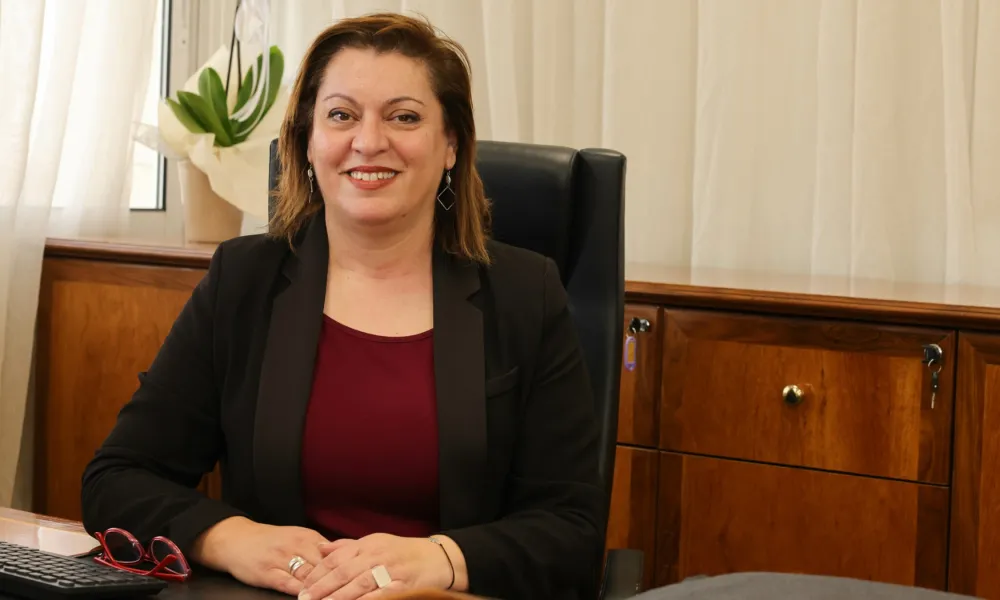

Cyprus Education Minister Athena Michaelidou has rejected calls to postpone the rollout of a new teacher evaluation system and says legislation for a new teacher recruitment framework should be finalised within a year, as she takes stock of progress and setbacks across the education sector.
In an interview with Politis, Michaelidou acknowledged delays in the installation of air conditioning units in schools and in advancing reform of Special Education, while plans for an Alternative School in Limassol also remain pending. At the same time, she cited progress in curriculum reform, all-day schooling, vocational education, artificial intelligence initiatives and technical education.
One year after setting 13 priorities for the 2025-26 school year, Michaelidou said lasting change depended on improving the tools used to support and develop teachers.
"A school changes when the tools with which we support, provide feedback to and develop the people who are in the classroom every day are optimised," she said.
The minister again placed two major reforms at the centre of the government's agenda: the implementation of the new teacher evaluation system and changes to teacher recruitment.
No delay to evaluation reform
The new teacher appraisal system was among the ministry's flagship reforms last year. The legislation has now been approved and formative evaluation is due to begin with the new school year.
Teaching unions have called for a postponement, arguing that new posts envisaged under the system have not yet been filled.
Michaelidou acknowledged that the positions of senior educator and inspector will not be filled until 2027 and 2028, but said that would not affect implementation.
Under the legislation's transitional provisions, experienced teachers will be able to assume the role of senior educator while receiving corresponding reductions in teaching duties.
"Important reforms are judged in their implementation," Michaelidou said, adding that the ministry's efforts are now focused on execution rather than further delays.
Recruitment system still under discussion
A more complex challenge lies in plans to replace the existing teacher appointment list system, which is scheduled to be abolished under legislation adopted in 2015.
Eleven years later, and with the deadline approaching, discussions continue over the structure of the system that will replace it.
The Education Ministry has presented its proposal to teaching organisations, but Michaelidou stressed that discussions remain open.
She said the ministry would examine suggestions submitted by unions and make adjustments where necessary in consultation with the Legal Service.
Time, however, is becoming increasingly limited.
The aim is to finalise the proposal and submit legislation to parliament in the autumn so that the new framework can take effect from September 2027.
Asked whether the ministry was pushing through major reforms at the last minute to limit opposition and ease parliamentary approval, Michaelidou was emphatic.
"We are not engaging in tactics."
She described recruitment reform as one of the most legally complex and demanding changes facing the education system.
Special Education reform delayed
Reform of Special Education, intended to create a more inclusive school system, was another key commitment from last year.
The relevant bill has yet to reach parliament, with the government now targeting the autumn for its submission.
Michaelidou said the reform involves modernising a framework that has been in place for about 30 years and followed consultations with all stakeholders, including the European Agency for Special Needs and Inclusive Education.
"When change requires more time in order to safeguard substance, speed is not an end in itself. Quality is an end in itself," she said.
According to the minister, the new framework will place greater emphasis on personalised assessment, education and support for each child, as well as a stronger role for families.
Air conditioning rollout falls behind schedule
One of Michaelidou's most specific pledges last year was the installation of air conditioning in all schools lacking the systems by September 2026.
With the deadline now reached, that target remains unmet.
The minister acknowledged "problems and delays" and said the new school year would begin with air conditioning installed in "almost all Lyceums, most Gymnasiums, a large percentage of our primary schools and almost all kindergartens".
She declined to provide a specific number of schools still awaiting installation or a revised completion date.
The delays, she said, were linked to safety issues, the condition of electrical systems and, in some cases, the need for power network upgrades or the installation of substations.
"We prefer to give the necessary time so that installations are carried out properly and safely rather than chase deadlines," she said.
Limassol Alternative School still pending
The planned expansion of the Alternative School model to Limassol also remains unfinished.
According to Michaelidou, the ministry is still preparing the project.
She defended the operation of the Alternative School in Nicosia, saying it had been implemented in a challenging environment marked by objections and misunderstandings from a small number of stakeholders.
She said the overwhelming majority of students completed the programme and were successfully reintegrated into mainstream schooling.
Progress across other reforms
Michaelidou said efforts continued to reduce excessive curriculum content and modernise educational programmes.
For the first time, secondary education authorities are attempting to align taught material with examinable content, while further rationalisation is still needed in some subjects.
The ministry also plans to continue expanding all-day schools, with the long-term goal of enabling all primary schools to operate as optional all-day institutions.
Legislation is being prepared to formalise and upgrade sports and music schools, setting out rules for operation, enrolment, staffing and admissions.
Vocational education, another major priority, expanded to 16 schools nationwide during the last academic year and will continue this year.
Michaelidou also pointed to improvements in literacy rates at primary level, citing assessments by the Centre for Educational Research and Evaluation, while acknowledging continuing weaknesses in secondary education literacy skills.
Other initiatives include financial literacy programmes in sixth-grade primary classes, new citizenship education material, policies and guidelines on the responsible use of artificial intelligence and teacher training programmes focused on emerging technologies.
The minister said stricter enforcement of mobile phone regulations in schools had produced "particularly positive" early results, according to feedback from school administrations.
She also described the pilot Technical Gymnasium programme as having already been "vindicated in practice", linking it to growing interest in technical and vocational education.
New year, familiar challenges
Many of the priorities identified by Michaelidou last year remain on the agenda for the coming academic year.
Teacher evaluation, recruitment reform, Special Education modernisation and curriculum changes all return to the government's list of priorities, alongside artificial intelligence, sports and music schools, all-day schooling and citizenship education.
New additions include the introduction of social workers in schools, earlier literacy intervention beginning at pre-primary level, formative assessment of students and enhanced professional development for teachers.
The government's agenda also includes upgrading school infrastructure, strengthening citizenship education and all-day schools, shifting curricula towards skills development and promoting the responsible and ethical use of artificial intelligence.