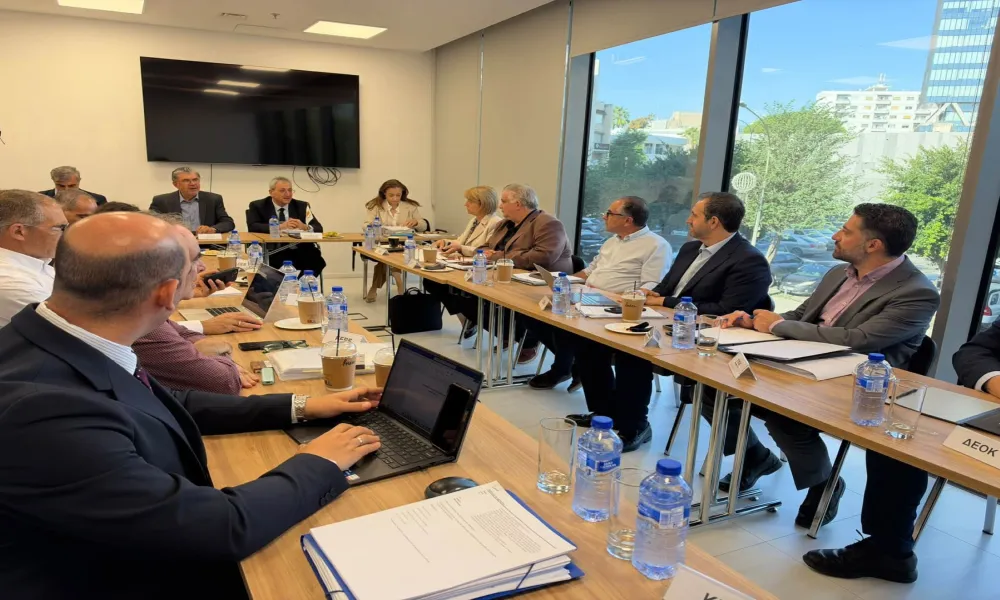

The creation of a new investment and governance framework for the reserves of the Social Insurance Fund (SIF) was the focus of Monday's meeting of the Labour Advisory Body, where experts from the International Labour Organization (ILO) presented key proposals being examined as part of Cyprus' pension reform process.
According to information obtained by Politis, Labour Minister officials briefed social partners at the start of the meeting on ongoing discussions with an ILO delegation currently in Cyprus to help design the new investment framework.
The minister also announced that, from 9 November, meetings of the Labour Advisory Body will be held once a week, every Monday.
Independent investment body proposed
During their presentation, ILO experts noted that the Social Insurance Fund is expected to generate annual surpluses of approximately €600 million in 2026, with authorities examining the possibility of directing those funds into a new investment mechanism.
At the same time, it was highlighted that a significant portion of the Fund's current assets consists of non-tradable government securities, representing state liabilities of around €12 billion.
The model presented envisages the establishment of an independent investment management body with a board of directors, investment and risk management committees and an external oversight mechanism.
The new organisation would be solely responsible for managing the Fund's investments.
The Social Insurance Services would remain under the Ministry of Labour and continue to oversee contributions and benefit payments.
Timeline targets 2027 launch
Under the preliminary timetable, the implementation roadmap is expected to be completed by the end of 2026.
The required legislative and organisational changes are scheduled to be introduced during 2027.
The objective is for the new investment mechanism to be operational by the third quarter of 2027 and capable of managing its first new capital before the end of the year.
However, participants acknowledged that setting up a fully independent and properly staffed investment institution is a complex process that may require a transitional period of between two and three years.
The discussion also included the possibility of retaining some flexibility for government borrowing from the Social Insurance Fund on favourable terms under exceptional circumstances.
Key issues remain unresolved
Several important matters remain under discussion, including:
- The exact legal structure of the new body.
- The composition and appointment process for its governing and oversight boards.
- The institutional role of social partners.
- The extent of legal safeguards.
- The framework for future government borrowing.
- The treatment of existing state liabilities owed to the Fund.
Pension reform issues still pending
The meeting also examined other outstanding pension reform matters.
Regarding the 12% actuarial reduction applied to certain pensions, the minister noted that every reduction of the penalty by 0.5 percentage points would carry a fiscal cost of approximately €5 million.
On the low-income pensioners' allowance, participants stressed that the new income threshold should move closer to the poverty line, in line with ILO recommendations.
Discussions also covered widowers' pensions for men affected by changes introduced in 2018, with the estimated cost of addressing the issue placed at around €35 million.