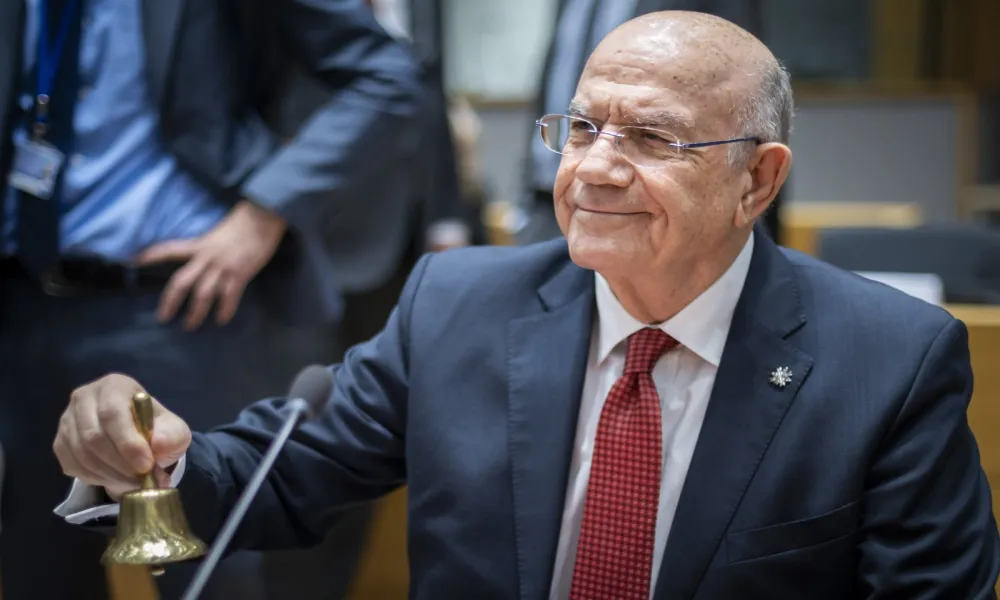

Finance Minister Makis Keravnos addressed the impact of rising inflation on citizens' cost of living, and the need for close, collective monitoring of the situation, speaking in Dublin.
An announcement from the Ministry of Finance said the Eurogroup and the EU's informal Economic and Financial Affairs Council (Ecofin) concluded their work in Dublin on Saturday.
On Friday, ministers reviewed recent economic developments and economic policy priorities, with the participation of the Chair of the European Parliament's Committee on Economic and Monetary Affairs.
In his intervention, Keravnos highlighted the impact of rising inflation on citizens' cost of living, noting the need for close, collective monitoring of the situation and readiness to adopt appropriate policy measures to support economies in the short term and ease these negative effects, without undermining efforts to safeguard the sustainability of public finances in the medium term or strengthen resilience over the longer term.
In this context, Keravnos raised his concerns over the impact of the conflict in the Middle East, which he said has increased uncertainty, with downside risk for growth and upside risk for inflation.
He asked whether greater emphasis should be placed on a more active role for European diplomacy, making it more dynamic and proactive when it comes to reducing tensions and ending conflicts.
In closing, he said efforts, both at national and EU level, should focus on the timely implementation of structural reforms and investment, particularly in completing the Savings and Investments Union, digital finance, promoting innovation and deepening the single market.
Banking union and deposit insurance
According to the announcement, the informal Ecofin meeting opened with a working lunch, at which ministers exchanged views on the competitiveness of the European banking sector, based on a presentation of the European Commission's recent report.
In his remarks, Keravnos, while acknowledging progress on the resilience of Europe's banking sector, reiterated Cyprus's longstanding support for completing the Banking Union.
With this in mind, he said ways should be examined to address the fragmentation of banking services and promote simplification of procedures, with the ultimate aim of creating a genuinely European banking system.
At the same time, he said, these efforts should go hand in hand with credible European safeguards on the capital and liquidity levels of banking institutions, particularly for host member states. The long-term goal, he said, should remain the creation of a single European deposit guarantee scheme.
Financial innovation and AI risks
On Friday afternoon, ministers held a joint meeting with central bank governors to discuss the future of innovation in Europe's financial sector.
The majority of ministers agreed that innovation and the spread of technology in financial services could offer huge opportunities to cut costs and speed up transactions without compromising the security of transactions.
Finance ministers and central bank governors also agreed that the spread of technology in the financial sector carries risks, which need to be recognised, examined and addressed, ensuring effective oversight that safeguards monetary sovereignty, financial stability and the safety of investors and consumers.
AI's impact on the labour market and energy
On Saturday morning, EU finance ministers discussed the impact of artificial intelligence on the labour market, the public sector, energy and the geopolitical environment.
Keravnos said artificial intelligence offers huge opportunities to boost productivity and growth. Our goal, he continued, should be to facilitate the spread of AI in order to strengthen the resilience and competitiveness of the European economy.
On the impact on energy, he noted that data centres, essential for the spread of artificial intelligence, require huge amounts of energy and water for cooling. With this in mind, he said, finance ministers need to ensure that the development of AI technologies does not create distortions elsewhere in the economy.
Our ultimate goal, he concluded, should be to combine the acceleration of green energy production with facilitating the spread of artificial intelligence, which will ultimately make a decisive contribution to improving competitiveness without disrupting social cohesion in Europe.
Source: Cyprus News Agency (CNA)