

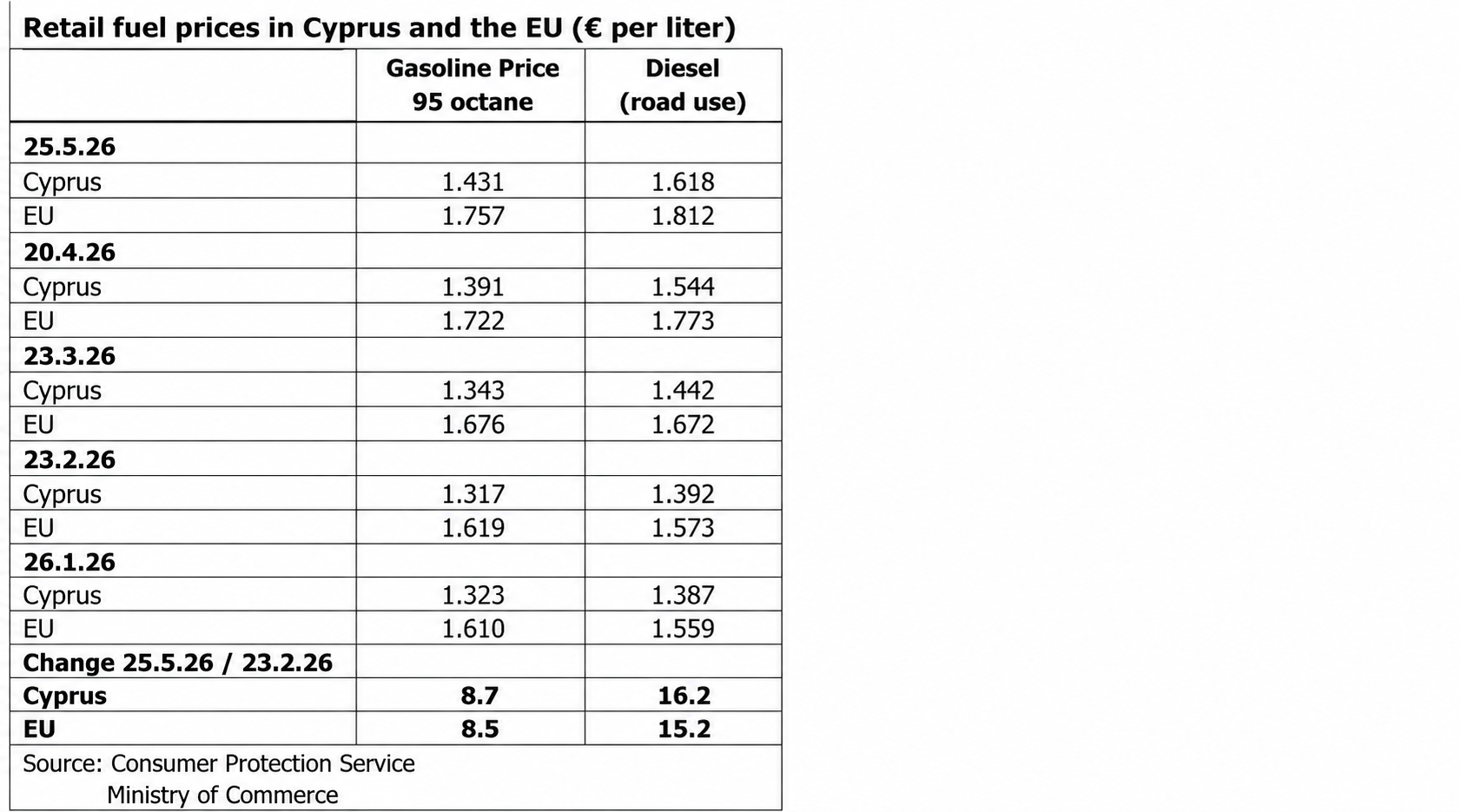
According to data from the Consumer Protection Service analysed by Politis from 23 February (pre war) to 25 May, the average price of 95 octane petrol in Cyprus (after taxes) has increased by 8.7%, while in the EU it rose by 8.5%. The increase is greater for diesel, reaching 16.2% for Cyprus and 15.2% for the EU.
According to the latest analysis of available European Commission data by the service, the average retail price in Cyprus (with taxes) for 95 octane petrol and diesel for 2026 stood at €1.431 and €1.618 per litre respectively.
Compared with member states and the European average prices for 2026, Cyprus ranks as the third cheapest for 95 octane petrol and the ninth cheapest for diesel.
As regards prices from 10 May to 3 June, diesel recorded an average decrease of about 9 cents per litre in the retail market. By contrast, 95 octane petrol recorded an average increase of about 5 cents per litre over the same period.
Increased uncertainty
The director of the service, Constantinos Karagiorgis, told Politis that “at this stage it is not possible to make safe forecasts for the course of fuel prices, as uncertainty in international markets remains particularly high.”
“The continuation of hostilities and the failure to reach a final agreement regarding the conflict in the Iran region continue to affect international energy markets, a fact that is immediately reflected in fluctuations in fuel prices,” he stressed.
As a result, he indicated, no reliable estimates can be made regarding the future course of prices, as any development in the geopolitical environment may directly affect the cost of petroleum products.
Nevertheless, he pointed out, available data show that efforts towards reaching an agreement have contributed to the de escalation of international prices. In particular, since 20 May a downward trend has been recorded in Platts prices, namely the prices at which refineries sell fuel to the market. “These reductions are expected to gradually be passed on to retail prices, without however the continuation of this trend being considered certain, due to the ongoing uncertainty,” he noted.
If the data recorded over the past approximately fifteen days in Platts prices are maintained, he added, further reductions are expected in retail diesel prices, as well as reductions in 95 octane petrol prices in the coming period.
“However, uncertainty remains high and strong fluctuations in international energy markets may continue as long as no final agreement is reached and hostilities do not end. For this reason, any estimate regarding the future course of prices should be treated with particular caution until there are clear indications of de escalation and stabilisation of international markets.”
Blow to competitiveness
The rise in energy prices is also a concern for businesses, as it acts as a deterrent to their competitiveness.
“Without affordable energy, the real economy cannot deliver its full range of development potential. At the same time, high energy prices trigger a spiral of increases across the entire supply chain and in the cost of goods and services, leading to the awakening of the inflation monster. This in turn activates the only defensive mechanism, which is the increase of interest rates. These three factors combined – reduced growth, inflationary pressures and increased interest rates – place a burden on households and businesses while also depriving the state of revenue,” said the Director General of OEB, Michalis Antoniou, to Politis.
“Developments in energy prices continue to be one of the most important factors affecting business competitiveness and the cost of living for households. For an island economy such as Cyprus, energy security and the containment of energy costs are strategic priorities,” said the Secretary General of the Cyprus Chamber of Commerce and Industry, Philokypros Roussounides, to Politis.
The Chamber considers that the acceleration of all reforms and investments that can contribute to reducing electricity costs is required, such as greater penetration of renewable energy sources, the development of storage systems, the strengthening of energy infrastructure and the promotion of modern energy management tools.
“The maintenance of competitive energy prices is not only an economic issue. It is a prerequisite for sustainable growth, attracting investment, enhancing productivity and safeguarding social cohesion,” he stressed.