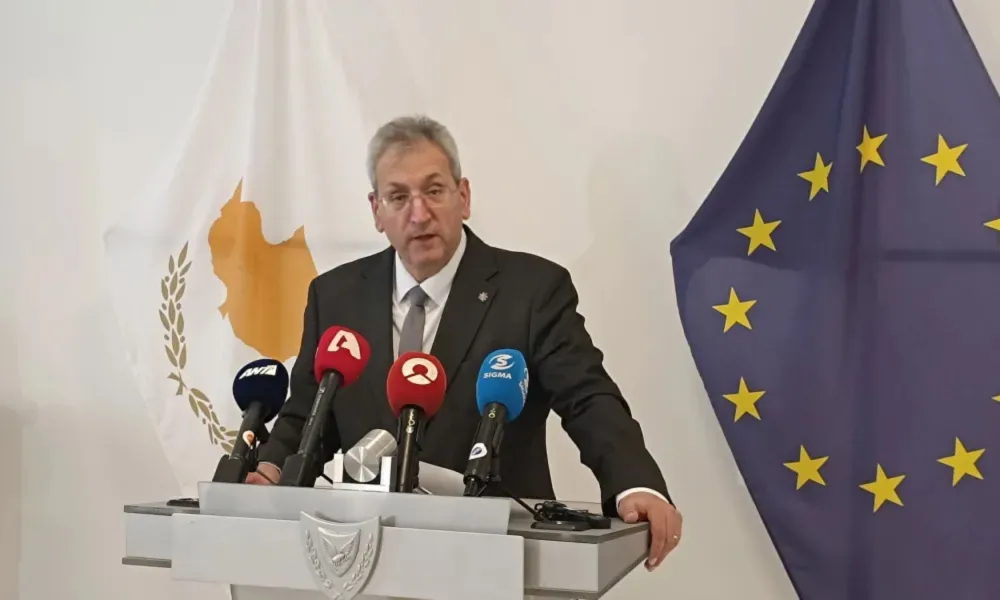



The House Finance Committee examined the Labour and Social Insurance Ministry’s priorities for 2027, as set out in its budget, on Monday, in the presence of Minister Marinos Mousiouttas. Committee chair and DIKO MP Chrysis Pantelides said the examination completed the review of the state budget as it relates to ministries.
According to the minister’s briefing note, the main priorities include implementing pension reform and continuing work on the second pillar of social insurance, boosting employment and meeting labour-market staffing needs. They also include modernising the framework for industrial relations, safeguarding industrial peace, protecting health and safety at work, developing skills and productivity, and digitally transforming the ministry’s services to improve service to the public.
The ministry’s expenditure is forecast at €998 million in 2027, €1.056 billion in 2028 and €1.131 billion in 2029, compared with €956 million in 2026. These represent increases of €42 million, €58 million and €75 million respectively. The figures exclude projects co-financed by the European Social Fund, amounting to €19 million in 2027, €9 million in 2028 and €5 million in 2029. Mousiouttas attributed the 2027 increase mainly to an additional €38 million for the General Government Contribution and €4 million for benefits, grants, schemes and projects.
The 2027 budget also includes funding for information campaigns and actuarial and consultancy services relating to pension reform. It allocates a further €5.5 million in national funds to continue the project “Reform of the Social Insurance System and Restructuring of the Social Insurance Services” after the Recovery and Resilience Plan ends.
Employment and the labour market
The labour market remains at full employment, the minister said, adding that unemployment stayed below 4% during the first six months of 2026. From January to September 2026, the average number of registered unemployed people was 10,662. The Public Employment Service received notifications of 27,333 vacancies and made 2,274 placements.
Employment Department grant schemes will continue in 2027 for hiring unemployed women, young people aged 15-29 not in education or training, unemployed people over 50, inactive women under flexible arrangements, people with disabilities or chronic conditions, and former prisoners. The scheme for unemployed women recorded 1,257 participants and has been exhausted; there were 657 placements of young people, 279 people over 50, 93 inactive women, 121 people with disabilities, 249 people with chronic conditions and 126 former prisoners.
DISY MP Andreas Constantinou called for the former prisoners’ employment rehabilitation scheme to be simplified, saying it was being used little or not at all. He also called for the possibility of employment in the public sector and local government to be examined. AKEL MP Argentoula Ioannou asked about the pay gap between men and women and whether the Committee for Equality in Employment was still operating and providing meaningful access to assistance on discrimination. Odysseas Michaelides of the Alma Movement requested figures on participation in HRDA programmes and their impact on productivity. He and ELAM MP Andreas Papacharalambous also asked about the gap between vacancies and placements.
Workers from third countries
From January to September 2026, the ministry received 3,210 employer applications to hire 21,057 third-country nationals. The 2027 goal, the minister said, is to maintain fast and reliable procedures, update the framework for employing foreign workers and further computerise procedures. Mousiouttas will provide written information requested by AKEL, ELAM and Alma on approvals and sectors of employment, as well as an answer to DISY MP Sávia Orfanidou’s question about delays. He noted that the need for foreign labour “will not disappear” given the conditions of near-full employment.
The minister said efforts were being made to combat illegal employment and that “under no circumstances should Cyprus get a bad name because the living conditions of foreigners are inhumane or because trafficking is taking place”. Antis Apostolou, director of the Department of Labour Relations, said the relevant function in the “ERGANI” system, which notifies employers when a worker’s asylum application is rejected, had not previously been available but would be available from the previous week onwards. He said 1,580 cases had been identified in which workers’ status had changed and they were no longer entitled to work, and their employers would be informed.
Responding to questions from ELAM MP Linos Hadjigeorgiou about protecting local workers and avoiding wage compression, Labour Department director Alexandros Alexandrou said the labour market is checked before a work permit is issued. If a Cypriot registered as unemployed is available, that person is referred to the job first; if the Cypriot is not hired, the employer is not granted a permit for a worker from a third country.
Collective agreements, minimum wages and pay transparency
Mousiouttas referred to two agreements with social partners implemented in 2026: the Permanent Agreement on the Cost-of-Living Allowance (CoLA), providing for its gradual restoration to 100%, and the adjustment of the minimum wage under a decree issued in December 2025. Priorities for 2027 include passing bills to align with European directives on adequate minimum wages, pay transparency and work on digital platforms, as well as extending leave rights and flexible working arrangements to foster parents.
AKEL MP and Labour Committee chair Giorgos Koukoumas described extending collective agreements as a challenge and asked what had been done under the government’s action plan. He also recalled that the directive on adequate minimum wages should have been transposed into law two years ago. The minister said the bills on pay transparency and adequate minimum wages were with the Legal Service for legal vetting and were expected to be submitted to the House at the end of December. He linked some of the delays to pension reform.
Andreas Constantinou raised the need for decent pay and youth unemployment, which, he said, reached 13.5% in 2025 among those aged 15-24, three times the overall rate. Direct Democracy MP Yiannis Laouris asked how the minimum wage would be linked to the real cost of living and how people not receiving CoLA would be protected. He also asked for average and median wage figures to be presented with and without the few large foreign companies that pay very high salaries, “so that we do not draw the wrong conclusions”.
Industrial peace and workplace safety
The Department of Labour Relations continues to play a central role in safeguarding industrial peace, the minister said. In the first half of 2026 it handled 67 mediation requests involving 15,756 workers, carried out 1,188 inspections on compliance with labour legislation, examined 879 complaints and informed more than 32,000 employers and workers.
Chrysis Pantelides requested written information about the Bank of Cyprus Oncology Centre, saying its board disregarded Labour Ministry decisions on employment matters. He also asked about the HRDA board and a possible conflict of interest arising from the participation of members of CCCI and OEB, which offer competing training programmes. Andreas Constantinou requested information on undeclared work, the effectiveness of inspections and the losses to the Social Insurance Fund. Odysseas Michaelides asked about violations found during workplace inspections, cases involving public contracts, penalties and the average time taken to examine complaints. Argentoula Ioannou asked whether social insurance contributions owed by employers arrested for undeclared work had been collected.
The workplace accident rate fell by 7.2% in 2025 and by 32% cumulatively over 2020-2025, the minister said. He also attributed the trend to targeted inspection campaigns: 4,871 inspections were conducted in 2025, 65% of them in construction, focusing on preventing falls from height and heat stress. Oversight of offshore oil and gas operations, ahead of the transition to production in Cyprus’s exclusive economic zone, will also be a 2027 priority. The minister will provide written answers to information requested by Michaelides on businesses reported and convictions.
Benefits, parental leave and arrears
DISY MP Sávia Orfanidou asked whether changes to maternity and paternity benefits were expected. Andreas Constantinou said he had raised the need to support working parents, extend maternity and paternity leave and modernise the calculation of the benefit. DISY MPs and DIKO MP Andreas Apostolou also raised support for families with children suffering from serious illnesses who must be absent from work for treatment and hospitalisation. Apostolou called for increased parental leave that could be taken continuously for as long as a child is hospitalised in Cyprus or abroad.
The minister said actuarial studies on paternity and parental leave would proceed in 2027, and that restrictions on parental leave were being lifted in specific cases. DISY MPs, Argentoula Ioannou, Odysseas Michaelides and Yiannis Laouris requested information on delays in processing benefit applications. Andreas Apostolou welcomed a substantial reduction in response times, while noting that specific benefits, such as maternity leave, needed further improvement. Mousiouttas cited understaffing in some departments and said he had asked all departments in a circular to express interest in overtime work to further reduce application assessment times.
Asked about debts to the Social Insurance Fund and the effectiveness of the 2026 repayment arrangement, the minister said the current scheme was the third for overdue debts, following crises in 2013, the pandemic and the recent energy crisis. He said the schemes helped both the Fund and individuals. There had been limited interest in the latest scheme, he noted, and the total debt of applicants stood at €118 million. The overwhelming majority of applications had been examined and met the criteria, but the minister stressed the need to prevent abuse.
Source: CNA