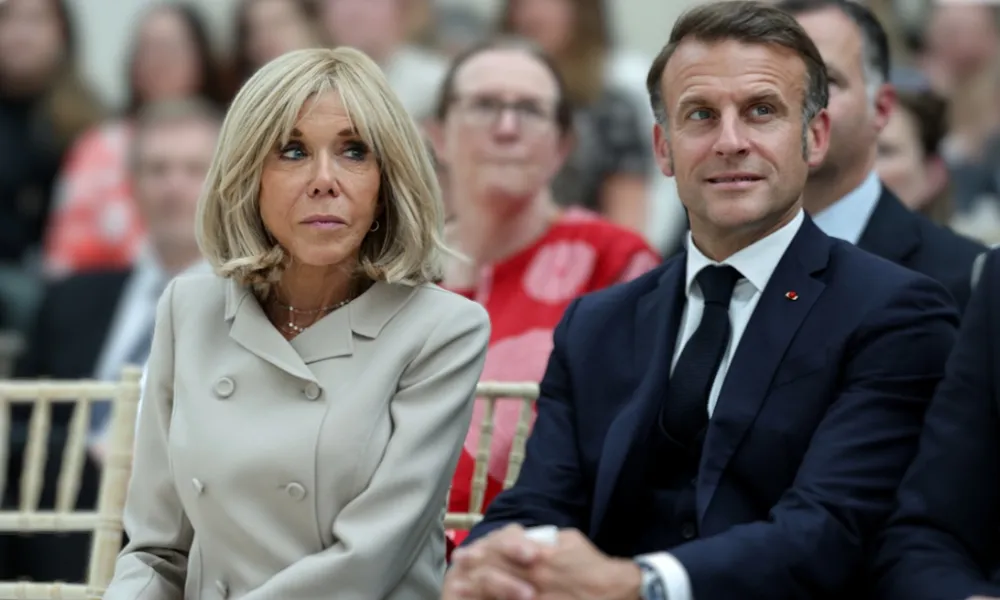

A new biography of French President Emmanuel Macron by political journalist Catherine Nay paints a deeply personal portrait of the French leader, focusing on his childhood, his close bond with his grandmother and his relationship with wife Brigitte Macron.
According to extracts reported by The Times, Macron told the author that he still feels like a child and never truly experienced adolescence.
"I am still a child. I was never a teenager. I don't like teenagers. I don't understand them. My wife understands them," the 48-year-old president is reported to have said.
The grandmother who shaped him
A central figure in the biography is Manette, Macron's grandmother, a retired school headteacher who is portrayed as a dominant influence during his upbringing.
Nay describes her as demanding and academically driven, with high expectations for her grandson's future.
According to the book, she reacted strongly when Macron, aged 14, began dating a girl. The future president is said to have attempted to repair the relationship by assuring her he would no longer be interested in girls.
The author argues that Macron's relationship with his grandmother was stronger than his bond with his parents and played a major role in shaping his personality.
Brigitte Macron is also quoted as reflecting on that influence.
"Emmanuel still hasn't buried his grandmother. He hasn't even replaced her. He should undergo psychoanalysis."
A relationship that drew attention
The biography revisits the beginnings of the relationship between Emmanuel and Brigitte Macron, which started when he was 15 and she was 39.
At the time, Brigitte was his drama teacher, was married and had three children. Macron was also a classmate of one of her children.
According to Nay, Macron pursued the relationship, suggesting they work together on a theatre project in order to spend more time together.
The book also claims Brigitte once asked whether he wanted children of his own.
"No, I want you to look after only me," he is quoted as replying.
Childhood experiences and political leadership
Beyond Macron's personal life, the biography attempts to link aspects of his childhood to his approach to politics.
Nay describes him as an exceptionally intelligent child who had relatively few friends and limited social interactions.
She argues that this tendency towards isolation continued into adulthood, with Macron spending much of his time focused on his work at the Élysée Palace.
The author also suggests that the self-confidence which helped propel his political rise is accompanied by difficulty accepting criticism or acknowledging mistakes.
Speaking to French broadcaster France Inter, Nay said:
"Self-reflection does not exist in his intellectual universe. Even when he apologises, he later returns to explain why he was right."
She links that characteristic to Macron's decision to call early parliamentary elections in 2024, a move that resulted in a fragmented parliament and prolonged political uncertainty in France.
The biography ultimately seeks to explain how the personal relationships and formative experiences of a president elected at the age of 39 continue to influence the way he governs today.
Source: The Times, via Proto Thema