
The process of securing European Union co-financing for the acquisition of two firefighting aircraft is at an advanced stage, Defence Minister Vasilis Palmas said on Monday.
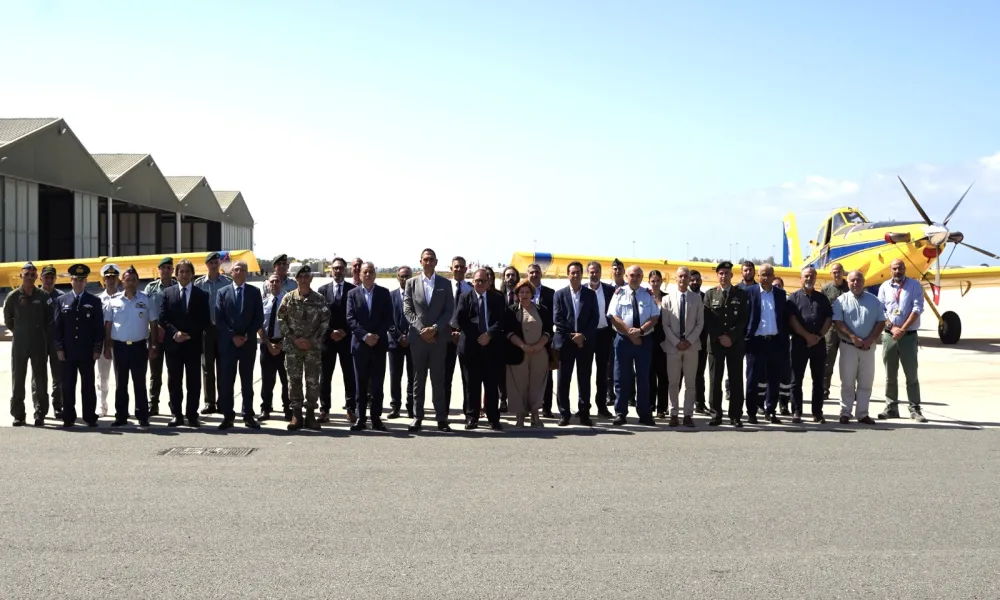
The aircraft would strengthen the operational capabilities of the Cyprus Regional Aerial Firefighting Station (CRAFS), based at the Andreas Papandreou Air Base in Paphos.
Palmas announced the development during the CRAFS Distinguished Visitors Day, saying the process was launched in consultation with the relevant EU directorate and was expected to conclude positively, with priority given to the countries of the Southern Neighbourhood.
“CRAFS will acquire operational wings of its own,” he said, adding that the development would create the conditions for the hub to further expand its role and mission.
A regional hub with a European mission
The defence minister described the event as an important milestone for CRAFS, which aims to develop into a regional hub with a European mission, broader regional reach and significant potential for further growth.
He recalled that the initiative began on 10 September 2025, when European Commission President Ursula von der Leyen announced the establishment of a new European firefighting hub in Cyprus.
According to Palmas, Cyprus was selected not only because of its geographical position, but also because of its wider strategic role in the EU’s Southern Neighbourhood and the Eastern Mediterranean.
“The selection of our country as the hub for this initiative reflects confidence in the Republic of Cyprus’ ability to assume responsibilities, build partnerships in a region of particular geostrategic importance and act as a reliable and stable partner,” he said.
Infrastructure completed at a cost of €802,000
The CRAFS infrastructure was completed on 15 April 2026 at a total cost of €802,000, according to the minister.
A transitional framework for the hub’s operation has already been established, while efforts are under way to secure its institutional status and long-term operation.
The Defence Ministry is responsible for the organisation, administration and operation of CRAFS, as well as planning and advancing the measures required for its institutional establishment. The Interior Ministry is responsible for its financial management and accounting arrangements.
Operational support and training
Under the existing plans, CRAFS will perform a dual strategic role.
It will operate as a regional support hub for aerial firefighting operations, responsible for the command and control of firefighting aircraft deployed or activated during missions. It will also provide technical expertise through the EU Civil Protection Mechanism.
CRAFS will also function as a centre of excellence, investing in personnel training and certification, common standards, operational simulations, research and knowledge production.
Particular emphasis will be placed on operational interoperability and the development of common protocols and communication standards.
Palmas said cooperation with the EU’s Emergency Response Coordination Centre, the operational core of the EU Civil Protection Mechanism, was also at an advanced stage.
First international workshop begins Tuesday
CRAFS will begin its first workshop on Tuesday, marking the start of the hub’s substantive activities.
Personnel from more than 10 countries will participate, along with representatives of European and international organisations. The workshop will present CRAFS’ mission, vision, capabilities and proposed operating model.
According to Palmas, the participation of countries from the Southern Neighbourhood and the Arabian Gulf demonstrates the existing interest in developing meaningful and lasting regional cooperation.
A new phase for CRAFS
Palmas said the event did not mark the end of the initiative but “the beginning of a new phase” requiring even closer cooperation.
The objective, he said, is to develop CRAFS into a fully integrated regional hub combining high operational readiness, training and certification, regional cooperation, research and innovation.
“The Republic of Cyprus has demonstrated that it is ready to assume this responsibility,” Palmas said, expressing hope that CRAFS would become a point of reference for Europe and the wider region.
He added that the hub should symbolise not only high operational readiness but also a commitment to investing in operational capacity, cooperation and security across the wider region.