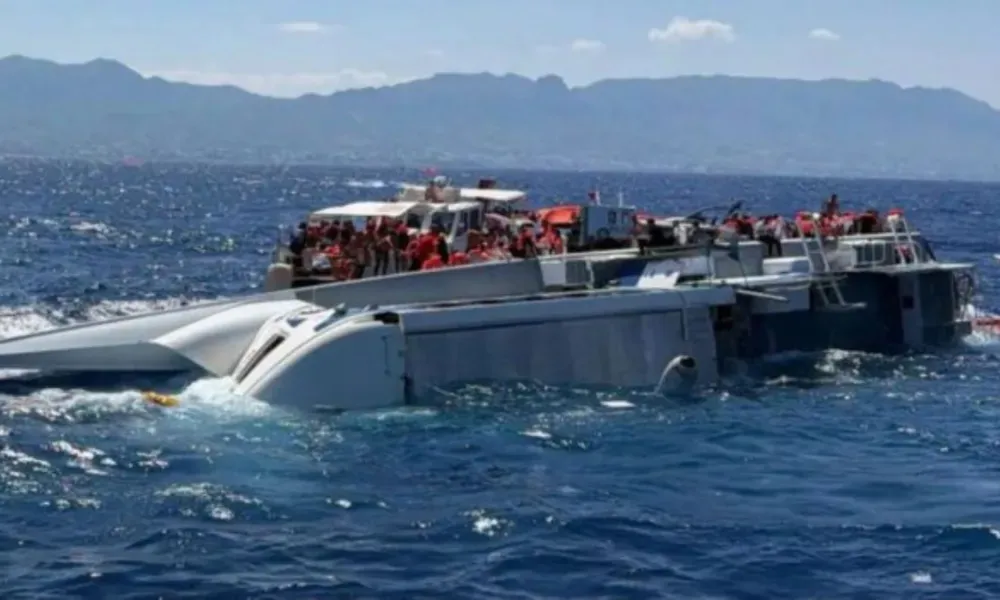

A maritime disaster off the coast of Kyrenia has left at least eight people dead and 17 others missing after the passenger catamaran FİLO JET overturned and sank in waters approximately 514 metres deep.
Rescue operations for the missing are continuing, while investigators seek to determine what caused the vessel, operating between Kyrenia and Taşucu in Türkiye's Mersin province, to capsize.
According to the so-called transport minister Erhan Arıklı, there were 259 passengers and eight crew members on board. Authorities say 242 people have been rescued, while search efforts continue both on the surface and underwater.
Specialist vessels and divers are expected to arrive from Türkiye to assist in the operation, which has become increasingly difficult due to the depth at which the vessel lies.
Departure after weather delay
The FİLO JET, operated by Filo Denizcilik, had originally been scheduled to sail the previous day, but the journey was postponed because of weather conditions.
The vessel eventually departed from Kyrenia on Sunday but encountered difficulties only a few nautical miles from shore.
Initial reports indicate that water began entering the vessel through the bow. The captain reportedly issued a distress signal and attempted to turn back towards Kyrenia, but during the manoeuvre the vessel suddenly listed and capsized.
Investigators are examining whether a structural failure in the front section of the vessel played a role. Reports have suggested possible damage to, or separation of, part of the bow.
The fact that the sailing had previously been postponed due to weather is also expected to form part of the investigation.
Arıklı stated that weather assessments conducted before departure did not prohibit the vessel from leaving port.
Erdoğan offers condolences
Turkish President Recep Tayyip Erdoğan expressed condolences to the families of those who died and wished the injured a speedy recovery.
He said all available state resources had been mobilised immediately after the accident and that search-and-rescue efforts were being conducted in full cooperation with the Turkish Cypriot authorities.
In a subsequent statement, Erdoğan said all necessary measures would be taken to establish the causes of the sinking and that responsibility would be assigned if negligence was identified.
"We hope to receive positive news" regarding the missing passengers, he said.
Rescue operation grows
The scale of the rescue effort expanded rapidly during the first few hours after the accident.
Initial reports spoke of 159 survivors, a figure that later rose to 172 and eventually to 242.
Those rescued were transported to Kyrenia harbour, where ambulances and medical personnel were on standby.
The operation has involved:
- Coastguard vessels.
- Private boats.
- Helicopters.
- Emergency medical services.
- Crisis-management teams on shore.
The vessel now rests at a depth of approximately 514 metres, requiring specialised equipment for any underwater examination.
Arıklı said a specialised Turkish search-and-rescue vessel was being dispatched, while so-called prime minister Ünal Üstel stated that the vessel belongs to the Turkish Navy and is capable of conducting operations at depths of up to 1,000 metres.
At the same time, authorities have launched a formal investigation into the circumstances surrounding the sinking.
The captain and seven crew members have been detained pending inquiries.
Üstel described the incident as "the worst maritime tragedy" experienced by Cyprus and said every aspect of the case would be examined.
Survivor accounts raise questions
Testimonies from survivors have raised serious questions about how the crew responded before and during the emergency.
Several passengers claimed they noticed water entering the vessel and alerted crew members, requesting that the vessel return to port. According to their accounts, those concerns were not acted upon.
One survivor alleged that after reporting water entering a cabin, a crew member replied that "we are used to this" and that "everything will be fine".
Other passengers alleged there was no timely information provided to travellers and no organised distribution of life jackets.
Some also claimed crew members left the vessel before passengers.
If confirmed by investigators, those accounts could raise questions regarding:
- Recognition of the danger.
- Passenger communication.
- Emergency procedures.
- Evacuation protocols.
- The availability and use of life jackets.
Authorities have not established any causal link between those allegations and the loss of life, but the claims are expected to form part of the investigation.
Republic of Cyprus offered assistance
The Joint Rescue Coordination Centre (JRCC) in the Republic of Cyprus said it received a distress signal at 12:13pm concerning the Turkish-flagged passenger vessel approximately five nautical miles north of Kyrenia.
Through the United Nations Peacekeeping Force in Cyprus and the relevant bicommunal mechanisms, the Republic conveyed its readiness to undertake search-and-rescue operations and deploy available air and naval assets, placing the saving of lives at sea as its sole priority.
According to the JRCC, the Turkish Cypriot side subsequently indicated that assistance was not required at that stage.
Government Spokesman Konstantinos Letymbiotis expressed "deep sorrow and concern" over the tragedy.
In messages issued in both Greek and Turkish, he reiterated that the Republic of Cyprus had been ready from the outset to provide any necessary search-and-rescue assistance.
"Our thoughts are with those who lost their lives, the injured, all those experiencing this tragedy and their families during these extremely difficult hours," he said.
He added: "In such moments, the protection of human life is above all else."
The opposition DISY party also expressed its condolences to the families of the victims and voiced hope that those still missing would be found alive and that the injured would recover quickly.
Sources: CNA, Komha.net, Kıbrıs Postası, CNN Türk, TRT