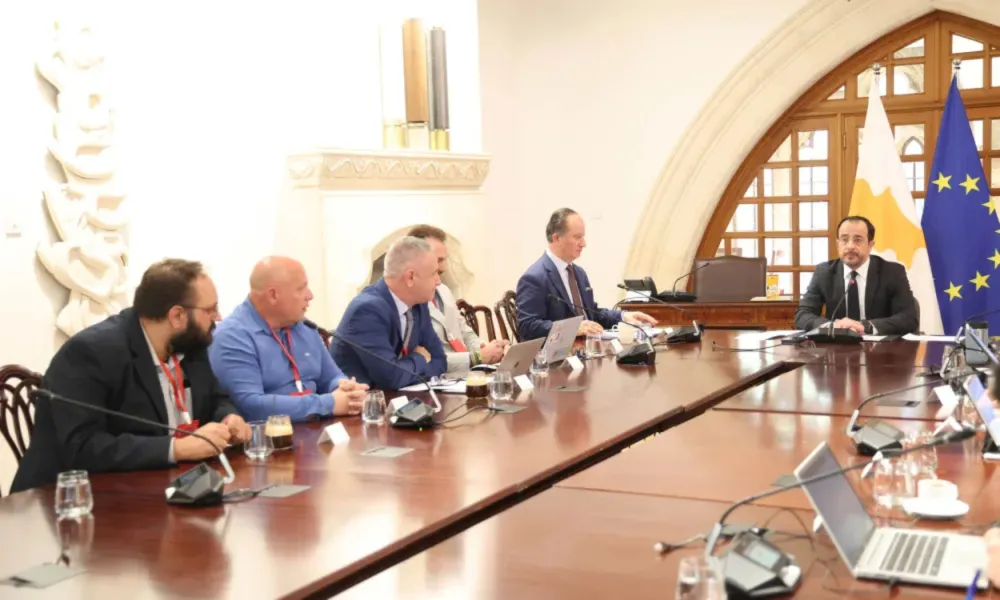

The long-awaited report prepared by the Scientific Committee for the Reconstruction of Cyprus's Livestock Sector, headed by Stavros Malas, has been delivered to President Nikos Christodoulides, providing the blueprint for government decisions on the post-foot-and-mouth disease recovery of the industry.
The report is expected to shape both short-term decisions, such as which affected livestock units will be allowed to resume operations once disinfection procedures are completed and veterinary approval is granted, and longer-term reforms aimed at improving the sector's productivity and resilience over the coming decade.
According to scientific assessments, if no new active cases of foot-and-mouth disease emerge, the first affected units could begin reopening between November and December.
Relocation and compensation
One of the most sensitive issues raised in the report concerns the government's decision on which affected farms will be permitted to reopen first.
According to information obtained by Politis, the Malas Report includes planning criteria setting out minimum separation distances between livestock units, aimed at preventing future outbreaks from spreading rapidly between neighbouring farms, as occurred during the recent crisis.
"Based on this criterion, and on declarations made by affected farmers regarding their intention to resume operations, some form of planning will be required," a source familiar with the report told Politis.
"As a result, some farmers will have to relocate from the areas where they currently operate," the source added.
Such a move would require political decisions on compensation and the ability to withstand external pressure from affected interests.
If no active cases are detected before November, some farmers are expected to be prioritised for reopening because their operations meet the required distancing criteria. Others may face a longer wait before they are allowed to resume activity.
The report also proposes changes in areas where livestock farms are concentrated. Smaller operations, for example those maintaining between five and 50 animals, may need to be consolidated with other units.
Meat sector weaknesses
Land-use planning is only one part of the report.
Particular attention is also given to the absence of a long-term strategy for the meat industry.
According to the report, Cyprus's livestock sector has become heavily dependent on halloumi production while the meat sector has been significantly neglected.
The Mala Committee reportedly concludes that this structural imbalance contributed to the circumstances that allowed foot-and-mouth disease to reach Cyprus.
According to sources familiar with the report, the failure to develop stable markets for sheep and goat meat encouraged illegal trade with the occupied areas.
Because production is largely geared towards halloumi, livestock farmers have struggled to market surplus meat, resulting in some products being channelled through illegal routes.
More productive and resilient animals
Another major theme of the report is the low productivity of Cyprus's sheep and goat sector.
The committee also identifies concerns regarding the weakening of the genetic identity of local livestock populations.
Its recommendations include the use of more productive breeds while maintaining animals capable of adapting to the high temperatures and environmental pressures associated with Cyprus's climate.
The report also highlights what it describes as insufficient research, innovation and development activity within the livestock sector.
The outbreak and the road ahead
The committee's work was commissioned in response to the foot-and-mouth disease outbreak, which has severely affected the livestock industry since the first case was detected on 20 February.
According to the figures cited:
- 52,632 sheep and goats were culled, representing 11.5% of the national herd.
- 24,483 pigs were destroyed, representing 7.8% of the pig population.
- 3,018 cattle were culled, representing 3.5% of the national cattle population.
- A total of 121 livestock units were infected.
The Veterinary Services expect the destruction of potentially contaminated materials at affected farms to be completed by the end of September.
Sentinel animals will then be introduced for a monitoring period of approximately 40 days.
If those animals remain disease-free and the sites are confirmed free of the virus, Veterinary Services are expected to authorise the reopening of eligible units between November and December.
According to the report, that moment will mark the beginning of the sector's "next day", with future reforms expected to be guided by the recommendations contained in the Mala Committee's findings.