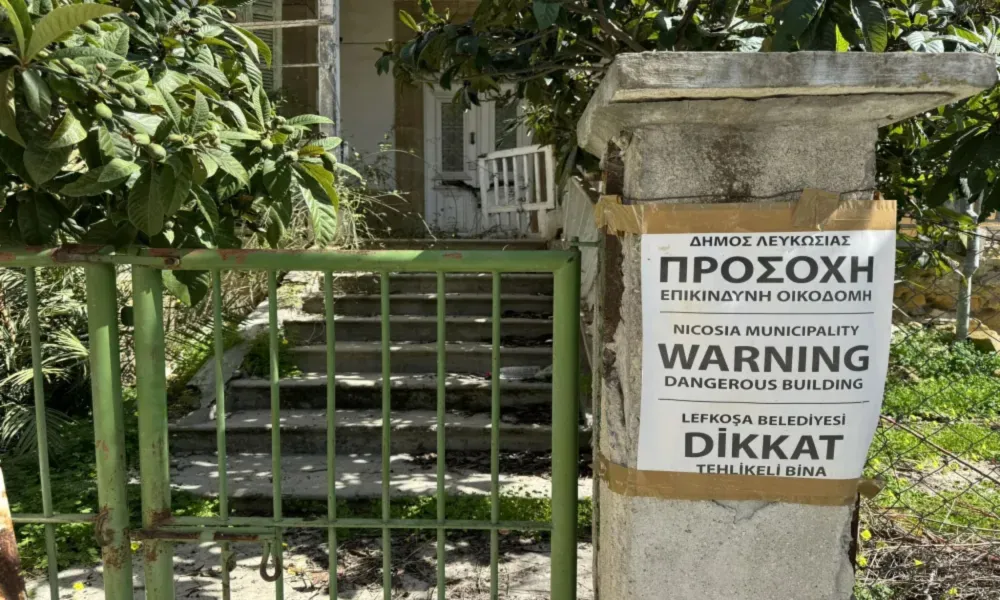

The House Interior Committee is seeking to establish a new legal framework governing dangerous buildings, following the fatal collapse in Limassol last April that claimed two lives.
When parliament resumes its work after the summer recess, legislators are expected to revisit the issue in an effort to address shortcomings identified in the current system and approve a modernised legislative framework.
The proposed amendments to the Streets and Buildings Regulation Law introduce extensive changes relating to the identification, classification and management of dangerous and potentially dangerous buildings, as well as the powers of competent authorities, the obligations of property owners and the system of administrative and criminal sanctions.
New definitions
The bill introduces a new category of "potentially dangerous building", defined as a building or part of a building that has deteriorated, suffered damage, defects, alterations or additions to such an extent that it may, within a short period, become dangerous to occupants, workers, passers-by or neighbouring properties.
At the same time, the definition of a "dangerous building" is expanded to include structures presenting risks due to age, lack of maintenance, poor workmanship, inadequate foundations, structural defects, corrosion, subsidence or deficiencies in fire protection that endanger public safety or health.
The proposal also introduces the legal concept of "sealing", a temporary measure preventing access to and use of a building.
Expanded powers for authorities
The proposed legislation broadens the authority of the competent agencies.
Under the amendments, the Director of Development Licensing at each District Local Government Organisation would be able to delegate powers concerning dangerous and potentially dangerous buildings to the head of the Building Licensing Sector, the head of the Enforcement Sector or the Director of Technical Services within the same organisation.
The bill also amends provisions governing court orders, clarifying that such orders may be issued by the competent District Court following an ex parte application by the relevant authority.
Framework for potentially dangerous buildings
A new procedure is proposed for dealing with buildings that are considered potentially dangerous.
Following a visual inspection, if the competent authority concludes that preventive measures are required, it may serve notice on the property's owner and occupier.
The notice must explain the reasons for the decision and require the owner, within a specified period, either:
- To appoint a qualified professional to prepare an assessment or repair study, or
- To undertake repairs, protective measures, fencing or other preventive actions specified by the authority.
Owners and occupiers would be entitled to submit written representations within 30 days of receiving the notice.
Municipalities and community councils would also be required to immediately notify the competent authority whenever they identify a potentially dangerous building within their jurisdiction.
Service of notices
The proposal specifies how notices may be served.
Service would be deemed valid through:
- Personal delivery to the owner, heirs or administrator.
- Delivery to the last known postal address.
- Posting the notice on the building itself.
- Publication on the official website of the competent authority.
Authorities would also have the option of publishing notices in two daily newspapers and sending them electronically where contact details are available.
Dangerous buildings
The bill substantially rewrites the framework governing buildings already deemed dangerous.
Following a visual inspection, authorities may require owners to appoint a qualified professional to prepare a report or study identifying the measures needed to remove the danger and restore the building.
Those measures could include partial or complete demolition.
In addition, authorities may require owners to:
- Repair the building.
- Remove hazardous elements.
- Demolish all or part of the structure.
- Protect or secure the property.
- Seal the building.
- Fence off the premises.
- Take any other necessary measure to eliminate the risk.
Authorities would also retain the right to carry out further inspections and impose additional measures if the danger persists.
Evacuation powers
Where authorities determine that a building poses a risk to its occupants, they may order owners and occupiers to vacate the property within a specified deadline.
If individuals refuse to leave, the authority may apply to court for an order allowing their removal and the evacuation of the building.
Following evacuation, the authority may proceed with sealing the property to prevent unauthorised access.
Non-compliance by owners
Where owners fail to comply with notices, authorities would gain a range of additional powers.
These include:
- Imposing administrative penalties.
- Ordering water disconnection.
- Requesting disconnection of electricity from the distribution system operator.
- Undertaking repairs, demolition, fencing, sealing or protective works directly.
The costs of the works, as well as the costs of appointing professionals, would be borne by the owner and recoverable through the courts as a civil debt.
Authorities would also be able to certify these expenses and register them with the District Land Registry as a charge against the affected property.
Scope of emergency measures
The proposal states that any action taken by the competent authority must be limited to what is strictly necessary to remove the immediate danger.
Measures may include:
- Sealing.
- Warning signage.
- Fencing.
- Structural shoring and support.
- Removal of dangerous construction elements.
- Partial demolition.
- Full demolition.
For residential properties, authorities would first need to obtain a court order before entering and carrying out the relevant measures.
Debt settlement option
Property owners would be given the right to apply for repayment arrangements relating to costs incurred by authorities.
Outstanding amounts could be paid in up to 36 equal monthly instalments, with an additional administrative fee not exceeding 2% of the total expenditure.
Additional access powers
Following the issuance of a court order, authorities would be able to enter dangerous buildings or surrounding areas on their own initiative and take whatever measures are necessary to protect public safety.
Police officers may accompany officials where there is concern that their duties could be obstructed.
The legislation also introduces the possibility of prohibiting the use or rental of buildings officially classified as dangerous.
Higher penalties
The proposal includes substantial increases in fines.
Maximum fines would rise:
- From €10,000 to €20,000 for first-category offences.
- From €20,000 to €40,000 for second-category offences.
A new fixed-penalty procedure would also be introduced.
Under the proposal:
- Failure to fence a dangerous building would carry an €2,000 fixed penalty.
- Failure to seal a dangerous building would carry a €1,000 fixed penalty.
Recipients would have 45 days to pay, while criminal proceedings could continue in cases of non-payment.
The bill also doubles the maximum administrative penalty that can be imposed on a person who fails to comply with a notice from the competent authority, increasing it from €20,000 to €40,000.
The proposal further includes a series of technical and legislative amendments to harmonise the relevant provisions of the existing law.