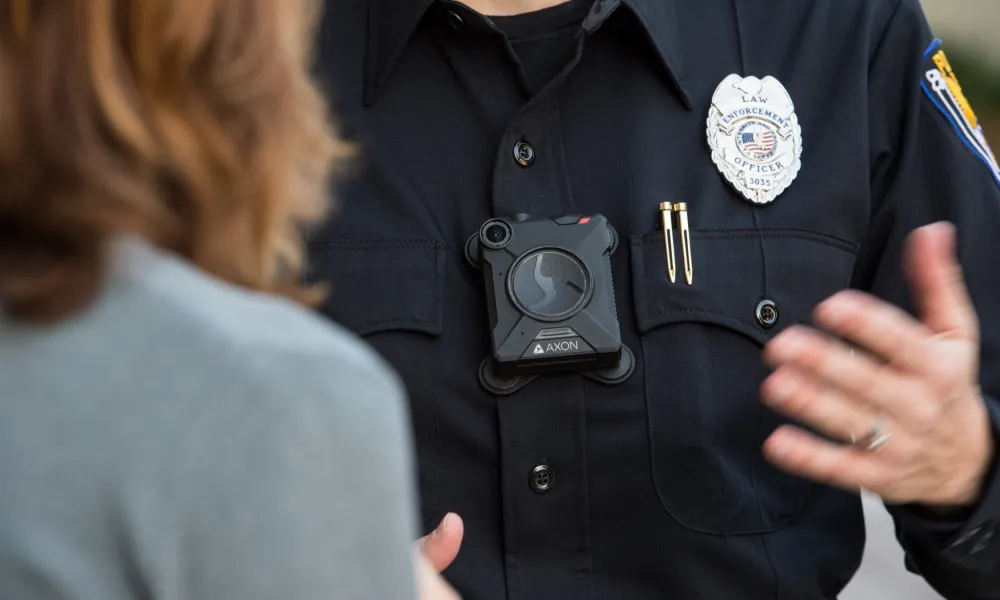

The law on police officers wearing body cameras, and on cameras in patrol cars to record police operations and incidents, is running behind schedule. Eight months after the law was passed, the procurement of body cameras is still at the stage of drawing up technical specifications. The tender has not been announced and the project's budget has not been set. At best, the measure will now come into force in 2028.
Justice Minister Costas Fitiris set out the timetable in a written reply to a question from MP Michalis Paraskevas. The procurement process, he said, is at the final stage of drawing up the technical specifications. These will then be reviewed and checked by an independent consultancy. After that, the budget will be set on the basis of financial data and market research, and an open tender will follow. According to the minister, the process is not expected to be completed before the end of 2027.
1,700 cameras
The tender will cover 1,200 body cameras for police officers and 500 cameras for police vehicles. It will also cover the necessary infrastructure, software, maintenance and technical support for the system, as well as staff training.
The Justice Ministry drove the legislation with three main aims: protecting police officers from false complaints, protecting the public from abuses by officers, and strengthening the evidence available in disciplinary and criminal proceedings.
Under the plan, the equipment will go to every police unit whose work falls under the law, such as patrols and searches. Instructions on how the system works will be issued alongside the procurement. Among other things, they will set out when cameras must be switched on and how cases where they were not switched on will be recorded. They will also cover who has access to the footage, and how it is kept and deleted.
As the minister explains in his letter, the instructions will be issued once the body cameras have been obtained and staff training has begun.
Protecting police officers
Body cameras are expected to raise the quality of policing and to help substantially reduce unfounded complaints by members of the public against police officers.
According to statistics from the Independent Authority for the Investigation of Allegations and Complaints Against the Police, more than 50% of complaints filed by members of the public against officers were dismissed as unfounded. The same figures show that most complaints came from one of two groups. One was members of the criminal underworld seeking revenge on officers who had exposed their illegal activities. The other was irregular migrants trying to extend their stay in the Republic of Cyprus.
It should be noted that since June 2024, a law has been in force making it a criminal offence to file false complaints against police officers with the authority.
The House plenary passed the law on a bill tabled by DISY Famagusta MP Nikos Georgiou. It provides: "Any person who knowingly makes a false statement to an investigator of the Independent Authority for the Investigation of Allegations and Complaints Against the Police, or to a person appointed by it, regarding or in connection with an imaginary criminal or disciplinary offence, is guilty of a criminal offence and, upon conviction, is liable to imprisonment not exceeding one year or a fine not exceeding €2,000, or both."
Protecting the public
Body cameras worn by police officers, both uniformed and plain-clothes, are also expected to deter abuses of power against members of the public.
According to official figures, in 2025, 11 police officers involved in five separate criminal cases were brought before the courts. The offences included degrading treatment, unlawful arrest, assault and abuse of power.
When the cameras will be switched on
Under the law, police body cameras will be switched on in the following situations:
- When arresting and/or searching a person.
- When pursuing any person or vehicle.
- When stopping a person or vehicle for a search, including while carrying out the search, and when reporting any offence.
- When entering premises for a search, including while carrying out the search.
- When officers arrive at the scene of an offence.
- When dealing with riots and large-scale violence.
- When carrying out operations.
The cameras will give off a light signal, so the public can see when they are recording. Officers will also be required by law to inform people, immediately after switching on a body camera, that it is recording sound and images.
Preserving the footage
On the public's rights, the minister explains in his letter that anyone concerned will be able to ask for recorded footage to be preserved, provided there is the necessary legal basis. They can do so by writing to Police Headquarters or the relevant police unit, or by going in person or through an authorised representative.
This will be particularly important in complaints or court proceedings, where the footage will serve as evidence. According to Fitiris, the public is expected to be informed of this right when the measure comes into force.