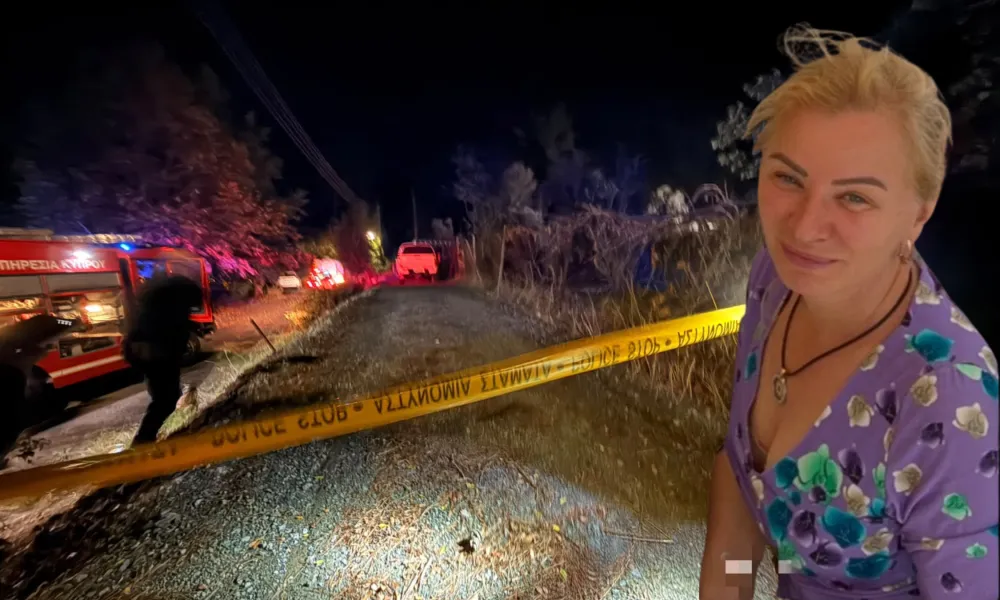

The killing of 61-year-old Olga Vasilieva, who had been missing in Limassol for days, has shocked Cyprus since it came to light on Saturday. According to police, the 43-year-old man she had been in a relationship with admitted killing her with a hammer at his home. He then moved her body the following day to her field in Moniatis, where he hid it in a sewage drainage shaft. On Saturday evening, he showed investigators the spot and the body was recovered.
Further details have since emerged. They include the suspect’s demands for money from Olga Vasilieva, his initial claims about her disappearance and his attempt to leave Cyprus. Her white Labrador played a key part in starting the search. Left alone at her home, it barked for days, which worried her neighbours. Her body was eventually found on the plot of land where she had planned to build a house.
Seven days before she was reported missing
Olga Vasilieva was last seen on 21 October, but she was reported missing to police only on 28 October, a week later. During that time she had not been in contact with her family, her mobile phone was switched off and she missed an important business appointment. Her car had been left at a specific location in Limassol. At her home, her dog was found alone and underfed, and its barking had alarmed the neighbours. According to witnesses, she always took the dog with her and was not in the habit of leaving it alone, let alone for days.
Investigators considered this particularly significant. Even before the body was found, an investigator told the court about the animal’s condition and Olga Vasilieva’s habits. He explained that, together with the other findings, there were strong indications that the 61-year-old was no longer alive and had been the victim of a crime.
Demands for money
Olga Vasilieva had been in a relationship with the 43-year-old for about five months. During the investigation into her disappearance, information emerged about persistent demands for money he had made, citing a supposed debt from a road accident.
According to what police presented in court, her lawyer, citing information from her son, said the 43-year-old had been asking her for €60,000 to €70,000. He claimed he was responsible for a road accident and that the other driver was demanding compensation. However, police records showed no trace of him being involved in any such accident.
According to police, the suspect admitted he had lied about the money demands in order to obtain money from her, though he claimed the sum he had asked for was €15,000 to €20,000. He also admitted that a necklace he had given her was fake and that he had made a forged certificate of authenticity, presenting it as jewellery worth around €10,000. He claimed that when Olga Vasilieva refused to give him money, she returned the necklace to him so that he could sell it.
The last meeting
Before his confession, the 43-year-old had admitted meeting Olga Vasilieva on 21 October in Linopetra, where she parked her car, and that they went together to his home. He claimed, however, that he later took her back to her car and that she had told him she would visit the north with a friend. Police checks found no record of such a crossing or of her leaving the Republic, and investigators identified contradictions in his account.
A neighbour of the 43-year-old also said that in the preceding days he had heard a woman screaming from his house, though he could not say on what date. Another neighbour described a vehicle reversing up to the front door and a person placing something in the boot before getting in and driving off alone.
Attempt to leave Cyprus
Based on the evidence gathered, police placed the 43-year-old under discreet surveillance before arresting him. His planned departure from Cyprus was another factor considered in the investigation. On 30 October, he was stopped at Larnaca airport, from where he was due to fly to Beirut, and was arrested shortly afterwards. Inquiries showed that he had bought the plane tickets at 5am on 29 October, a few hours after Olga Vasilieva’s disappearance was made public.
The confession and the evidence
On Saturday afternoon, the 43-year-old decided to talk. According to police, in a voluntary statement he admitted killing Olga Vasilieva, describing how he did it and where he had hidden her body. The confession contradicted his earlier claims that he had taken her back to her car after their meeting, and it led investigators to her field in Moniatis.
According to police, he admitted striking her repeatedly on the head with a hammer because, as he claimed, she had insulted him and he became angry. He then left the body in his house overnight. The following day, he put it in his car and drove it to her field in Moniatis, where he hid it in a sewage drainage shaft. He said he threw the hammer onto a wooden pergola at his home.
After his confession, he led officers from Limassol CID to the plot and showed them the shaft, from which members of the Disaster Response Unit (EMAK) recovered the body. A post-mortem examination by a state pathologist found head injuries. During searches on Saturday, the police forensic team (YPEGE) had already found significant evidence at his home, including traces of bloodstains. The examination of his car, which he used to transport the body to Moniatis, is also considered particularly important.
The field in Moniatis
The plot where Olga Vasilieva was found is in Moniatis, in the Saittas area. According to accounts from local residents obtained by Politis, she loved the land, visited it often and tended it with workers, as she planned to build a house there and move in search of a quieter life. She had already arranged for water and electricity to be connected. People in the area remember her from her visits and the work on the field, always accompanied by her white Labrador.
Remanded for eight days
On Sunday, the suspect appeared in court again, without a lawyer by his own choice, and was remanded in custody for eight days. The hammer has been located and was expected to be collected during Sunday’s searches. He had said he threw it onto a wooden pergola at his home.
Examinations of his car and the evidence are continuing. Police are also seeking bank and telecommunications data to establish, among other things, whether he managed to obtain money from the 61-year-old or gain access to her money before or after the killing.