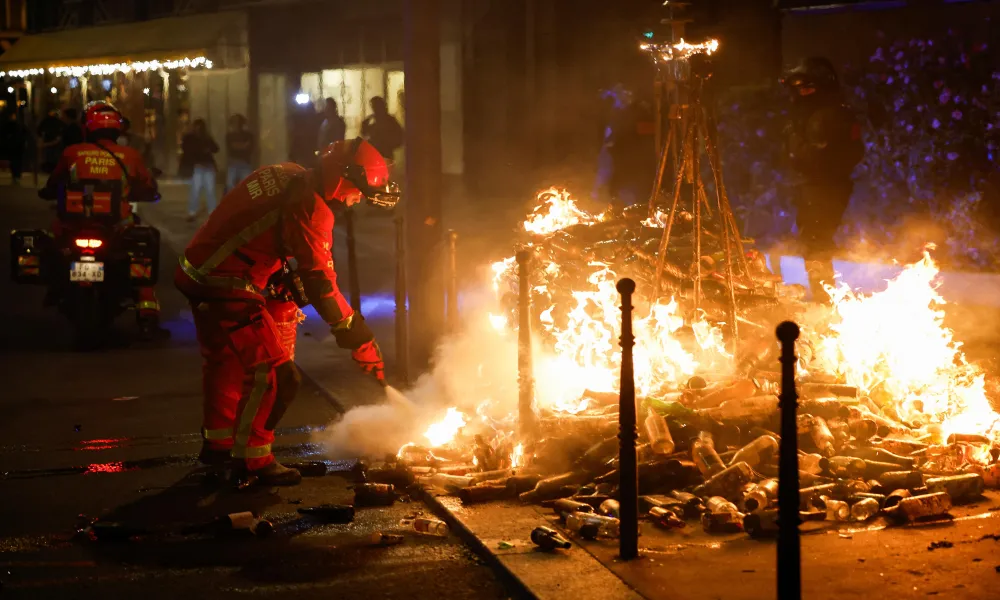

Ahead of Saturday’s protests against the high cost of living, France’s intelligence services had given assurances that 17 October “would not be the big night”. What followed was chaos, with the security services now accused of an unprecedented failure. Turnout was more than double the official forecast, and several major cities were overrun by vandals and looters.
Leaders admit failure
From President Emmanuel Macron on Sunday to the Prime Minister on Monday, as well as Interior Minister Laurent Nuñez and Justice Minister Gérald Darmanin, all have acknowledged a “failure of the intelligence services” and a “lack of foresight”.
Prime Minister Sébastien Lecornu described the situation as a real shambles.
Numbers far exceeded forecasts
The intelligence services had estimated that:
- 150,000 people would demonstrate in the regions
- 80,000 would take to the streets in Paris
According to official figures, the actual turnout was 550,000, including 110,000 in the capital.
More significantly, many cities, including Paris, Lyon, Marseille and Limoges, became the scene of vandalism and looting, with the security forces unable to control the situation.
“It does not know how to fight the far left”
“There were failures in the intelligence services (…) French intelligence is a leader in the fight against Islamist terrorism, it is strong against organised crime, it is important against foreign interference, but it clearly does not know how to properly fight the far left,” said Gérald Darmanin, who headed the Interior Ministry for around four years.
A recurring pattern
This is not the first time. During the “yellow vest” movement in autumn 2018, the government failed to anticipate the scale of the mobilisation, which went under the radar because the protests had no central coordination or organisation.
The same happened during the urban riots of June 2023, sparked by the death of Nahel, who was killed by a police officer in Nanterre, near Paris. Each time, the intelligence services underestimated the size of the mobilisations.
Warnings without figures
Last Thursday, Interior Ministry services explained that “incidents were expected” at the marches in Paris and major cities.
These were “marches which the far-left movement will probably seek to derail” through attacks on law enforcement and “attempted destruction” targeting symbols of power, the briefing said. It contained no precise figures.
“A loss of intelligence culture”
A senior police officer told Agence France-Presse (AFP) that this failure to assess movements stems from “the loss of intelligence culture”, following the dissolution in 2008 of the General Intelligence service (RG) and the departure of many experienced staff from the sector.
“Human intelligence has disappeared (…) They lack legal tools, particularly to get around the encryption of messaging apps, and they lack staff, because it is not enough to monitor social media platforms; you also have to verify what is written there so that law enforcement knows what to expect,” the officer added.
Fake news and AI-generated leaflets
A source from a security service, however, pointed to the volume of misinformation online. “There was a great deal of fake news” on social networks, including “leaflets generated by artificial intelligence. We verify everything, and as a result this reduces our capacity for analysis,” the source said.
An “unprecedented” alliance
The services also noted, but struggled to assess, that the movement was resonating with high school students and young people from working-class neighbourhoods.
“And everything went wrong. Young people from the neighbourhoods came out in large numbers, adding ‘fuel’ to the mobilisations. This alliance between the (extra-parliamentary) far left, the radical left and young people from the neighbourhoods is completely unprecedented,” the source continued.
The role of TikTok and Telegram
TikTok also played an “unprecedented accelerating role”, as did Telegram, both before and during the day, a police source said.
Another security source described the events as a “spontaneous and unorganised explosion of anger”.
With information from AFP