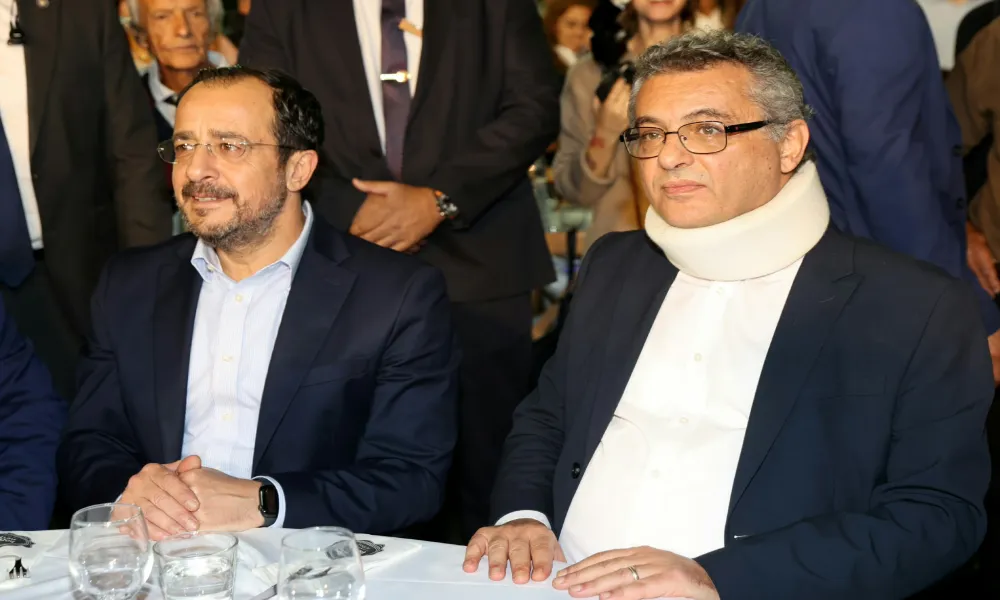

President Nikos Christodoulides and Turkish Cypriot leader Tufan Erhürman meet again today in an effort to keep a window of communication open, shortly before UN Secretary-General’s Personal Envoy María Ángela Holguín arrives in Nicosia. Unfortunately, the meeting is unlikely to take place against the positive backdrop created, however briefly, by last Saturday’s bicommunal event in Pyla, which worked well on a symbolic level. Instead, the two leaders will once again try to dispel a climate soured by Holguín’s article in Politis last Saturday, Erhürman’s interview with the same newspaper, and the President’s swift reactions to both.
A process at breaking point
It is plain that the Cyprus problem is going through what may be its last critical diplomatic stalemate, now accompanied by open warnings from the United Nations and intense internal friction. The latest war of words inevitably spills over into matters of substance, widening the gap between the two sides and shrinking the scope for convergence on the issues raised by the UN Secretary-General.
The spearhead of the past few days, and in all likelihood a central topic at today’s meeting, has been Holguín’s intervention in Politis last Saturday. It provoked a reaction from the President of the Republic, which was then broadened and amplified by the Turkish Cypriot leader’s interview the following day.
In short, despite the positive social contact at the bicommunal festival, the picture of recent days reflects a deep lack of trust, setting the stage for unfavourable and precarious developments.
Warning and deadlock over CBMs
Holguín’s position served as an alarm bell warning of complete deadlock. The UN envoy stressed that, despite efforts spanning almost two years, the two sides have failed to agree even on the obvious, such as opening a single crossing point.
She pointedly asked how the parties could expect to agree on a complex political, economic and social model for overcoming division when they are unable to cooperate on practical, everyday issues and Confidence-Building Measures.
At the same time, responding indirectly to pressure from the Greek Cypriot side to make public, for comment, documents or recorded convergences from previous years, Holguín made clear that she would not put anything on the table that could cause further friction and new setbacks. She stated that the decision to resume negotiations rests solely with the leaders, calling on them to agree on workable rules of dialogue based on political equality.
Reactions
The heavy climate was further burdened by Erhürman’s exclusive interview with Politis. The Turkish Cypriot leader adopted a logic of apportioning blame, stating bluntly that he has never received any formal written proposal from President Christodoulides, codified as the “19 points” being discussed in public debate.
Erhürman also put forward his own proposals for opening four crossing points as a strong CBM that should come first, setting conditions for the path towards a five-party conference. He noted that there had been no substantive proposal from Christodoulides on the issue of the fenced-off town of Varosha.
The Turkish Cypriot leader was equally clear on political equality and the rotating presidency, as well as on the four points of his own methodology, to which, he argues, the President of the Republic has not responded.
“For example, the first point of my methodology concerns political equality. And the rotating presidency is one of its key pillars. So far, I have not heard the Greek Cypriot leader say: ‘I accept, in principle, the rotating presidency,’” he said.
Substance is on the table
These positions prompted an immediate and sharp reaction from the Presidential Palace. Responding to Erhürman through public statements, President Christodoulides rejected claims that he had made no proposals and stressed that substance and sincerity of intentions are shown at the negotiating table, not in communication strategies.
He also made no secret of his displeasure with Holguín herself, pointedly suggesting that had the UN envoy been closely present at their meetings, she would have understood which side is genuinely taking a productive stance on opening crossing points and advancing CBMs. In short, Christodoulides is casting doubt on how fully the Secretary-General’s envoy is carrying out her duties.
Permanent deadlock?
The picture emerging from this sequence of statements and reactions shows that the two leaders are moving in entirely different orbits, each seeking to make the other bear the cost of an increasingly likely collapse. Mutual suspicion has completely undermined the prospect of genuine understanding.
In light of Holguín’s latest warnings, the Cyprus talks appear trapped in a deep and potentially permanent deadlock. When dialogue is consumed by disputes over documents never received, crossing points that remain closed, and differing approaches to core convergences such as political equality, issues that are the hard-won achievements of years of negotiations, the framework of a bizonal, bicommunal federation risks becoming a theoretical reference with no connection whatsoever to political reality on the ground.
The inability to agree even on procedural matters shows that the crisis in the Cyprus problem has moved beyond simple mistrust, leaving open the possibility that the international community could completely reassess its stance in the next UN report.