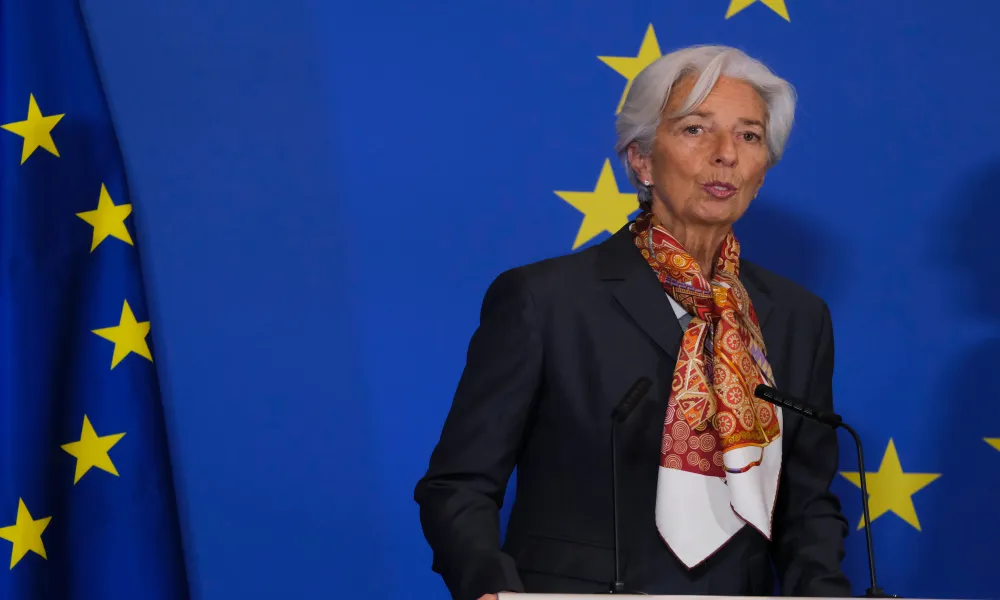

The European Central Bank believes the new inflationary shock in the eurozone will last longer than initially expected, as ongoing geopolitical tension in the Middle East and damage to refining infrastructure push up energy costs and transmit pressure across the wider economy.
ECB President Christine Lagarde, in an interview with the French newspaper Ouest-France, defended the central bank's decision to raise key interest rates by 25 basis points, noting that inflation in the eurozone now stands at 3.3%, significantly above the medium-term target of 2%.
"There has been a major shock, and it will probably last longer than we expected," Lagarde said, explaining that the rise in prices is due not only to the conflict in the Middle East but also to the destruction of refining capacity worldwide, particularly in Russia.
The result, she warned, is higher energy costs, which "push up all prices." Given these conditions, and the resilience of the European economy, the ECB believes it is obliged to respond.
The ECB chief acknowledged, however, that the rate increase could weigh on economic growth. Responding to economists who argue that monetary tightening is risky when inflation is driven by an external shock, Lagarde said that logic only holds when the shock is temporary.
"Today's shock has greater duration. The conflict is ongoing, and we expect volatility and pressure on energy prices to continue," she said.
Growth and reforms
Lagarde stressed that the ECB cannot base its decisions on the performance of a single country but must treat the eurozone as a single economy. Referring specifically to France, where growth remains weak, she underlined the need to push forward structural reforms.
Among other points, she voiced support for completing the Capital Markets Union, simplifying administrative procedures and further reforming labour markets. She also noted that Europe cannot continue operating with pension models designed decades ago, given rising life expectancy.
The ECB president expressed cautious optimism about Europe's growth prospects despite demographic ageing, saying that rising productivity could offset a shrinking workforce.
"Europe has talent, a highly educated population and substantial savings, but we are not doing enough to make use of them," she said, calling on European governments to act faster and more decisively.
Public debt and artificial intelligence
Lagarde dismissed fears of a repeat of the 2008 and 2011 sovereign debt crises, stressing that Europe's financial sector is significantly stronger today.
She explained, however, that the rise in long-term interest rates is linked both to the state of public finances and to the growing financing needs of investment in artificial intelligence. Rising demand for capital from technology companies is creating competition for sovereign debt issuers, pushing up borrowing costs.
She also warned that valuations of AI companies have reached particularly high levels. A market correction is entirely possible, although its timing cannot be predicted.
Of particular concern, she said, is so-called circular risk, whereby companies take stakes in one another and then enter into commercial agreements, potentially creating artificially inflated valuations.
Finally, Lagarde confirmed that she will step down from the ECB in 2027, without giving further details on whether she will complete her current term, which runs until October 2027.
Source: Ouest-France