
The discussion of a new United Nations initiative on the Cyprus problem began, almost reflexively, in the same tiresome way as all the previous ones. Before any official text even existed, the denunciations began about a "Turkish plan", a "sell-out" and "treason". The recent press reports that the Secretary-General's personal envoy, Maria Angela Holguin, is examining a looser federal structure, with limited central competences and two strong constituent states, reignited the familiar fears, which began to intensify after the announcement that UN Secretary-General Antonio Guterres will pay a three-day visit to Cyprus. In reality, no one has submitted an official UN plan, yet everyone recognises that the older formulas which were rejected in one way or another will, in the context of a new plan, have to be placed under review, guided by what Ms Holguin has said many times, "that we must all now think outside the box".
This does not mean that the reports should be ignored, nor that any formula christened a "federation" is automatically acceptable. Serious criticism is essential. But it is one thing to examine the actual provisions and quite another to reject a process in advance as "treasonous", simply because it attempts to bridge the distance created by half a century of occupation, separate administration and failed negotiations.
The plan condemned before it is written
The current mobility is not imaginary. Antonio Guterres is attempting, before the end of his term at the close of 2026, to give a new push, and this is what he will convey to the two leaders on 28 July when he arrives in Cyprus. Maria Angela Holguin held contacts in June in Cyprus, Ankara, Athens and Brussels, while a new enlarged meeting is being prepared with the two communities, the three guarantor powers and the UN. President Nikos Christodoulides himself has stated that there may be developments leading even to a peace plan within the year. At the same time, the UN's institutional basis has not officially changed. The Security Council continues to support a solution of a bizonal, bicommunal federation with political equality, as reaffirmed in resolution 2815 of January 2026. The reports of new ideas must therefore be treated as a search for a way of implementing or adapting the federal architecture and not, at least at the present stage, as its official abandonment.
The conjuncture is different from that of previous years. In the Turkish Cypriot community, Tufan Erhurman was elected in October 2025 with a clear mandate to return to the discussion of a federal solution, rejecting the immobility of the Tatar period. His election does not by itself alter Ankara's policy, nor does it erase the major differences over political equality, guarantees and the presence of Turkish troops. It does, however, create a window that did not exist when the Turkish Cypriot leadership was demanding advance recognition of "sovereign equality" and two states.
At the same time, the European Union is attempting to acquire a more substantive role. On 8 July, Antonio Costa and Ursula von der Leyen discussed the Secretary-General's efforts with Tayyip Erdogan and called on Turkey to make use of the "new dynamic" for a solution through the UN process. In parallel, on 13 July the executive vice-president of the European Commission, Raffaele Fitto, was appointed special representative of the European Commission for the Cyprus problem.
Linking the Cyprus problem to the Euro-Turkish relationship is not in itself a concession to Ankara. It can become the most significant lever for offering incentives to Turkey, but also for demanding concrete moves from it.
The 'Turkish solution' already exists
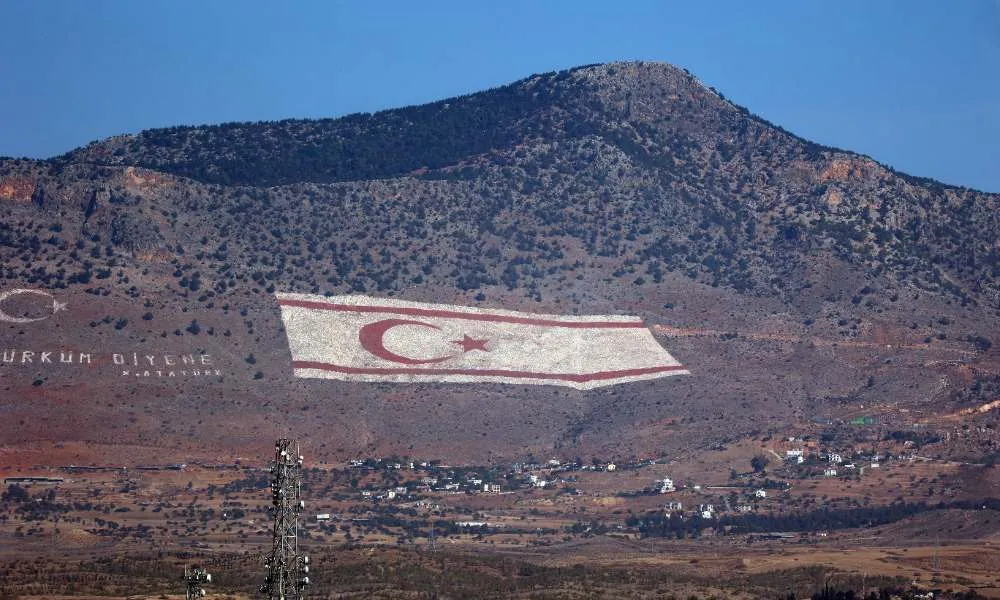
The basic error of part of the Greek Cypriot debate is that it presents the current status quo as the safer refuge and every compromise as a slide towards a "Turkish solution". In reality, the solution that Turkey imposed by force has been in effect since 1974. It consists of military control of the northern part of the island, separate administration, the displacement of Greek Cypriots, the continued presence of tens of thousands of troops and an entity recognised only by Ankara. The fact that partition has not acquired international legitimacy does not mean it is not producing political, economic, demographic and property faits accomplis every single day.
The passage of time does not operate neutrally. It does not freeze the situation of 1974 until an ideal solution appears. It turns the temporary into the normal, strengthens the economic and institutional dependence of the occupied areas on Turkey, widens the distance between the two communities and makes the return of territory, the restitution of properties and shared governance ever more difficult. Nationalist pressure in Turkey does not conceal its final horizon. After Erhurman's election, Devlet Bahceli, Erdogan's governing partner, called even for the union of the northern part with Turkey.
Under the circumstances, the phrase "no solution is better than a bad solution" could be acceptable as a general principle but certainly not as a strategy, since non-solution has content, cost and a final destination. Non-solution does not preserve the Republic of Cyprus intact until the balance of power changes. It preserves a ceasefire line facing a far stronger army, while allowing Turkey to choose when to raise or lower the tension.
The Green Line is not a normal European border and must not be turned into one politically and psychologically. It is the trace of an unfinished conflict. Seeking to make it function as an ever harder border may offer the illusion of control, but at the same time it reinforces the image of two separate territories and prepares the ground for the official partition we are supposedly trying to prevent.
The strike by an unmanned aircraft on the British Bases at Akrotiri on 2 March 2026, even with limited material damage and no casualties, showed how quickly regional instability can reach Cyprus. It caused alarm, fear among residents and the mobilisation of military assets, even though the target was the British Bases and not the Republic of Cyprus. The presence of European forces in the region as a gesture of solidarity with Cyprus did, of course, create expectations of a relaunch of discussions on a European security pillar. In reality, what appears more realistic is the further involvement of the EU in NATO, as Donald Trump has repeatedly demanded, a NATO to which Turkey also belongs.
Consequently, a serious incident on the line of confrontation, which would potentially have far heavier consequences for the country's security image, tourism, investment, air transport and confidence in the economy, would probably not reactivate European solidarity as we saw it in the case of the drone. Speaking cynically, geography does not permit Cyprus to regard the pending situation as harmless. As long as the line of confrontation is maintained, the Republic of Cyprus continues to compete on a pitch where Turkey holds military superiority and the capacity to create or sustain crises.
The EU is not a slogan
The greatest strategic value of an agreement to solve the Cyprus problem is not simply that it would remove barbed wire or open roads. It is that it would allow the whole of Cyprus to function genuinely within the European legal order. Legally, the entire Republic of Cyprus constitutes territory of the European Union, but the acquis communautaire has been suspended in the areas where the government does not exercise effective control. Protocol 10 explicitly provides that, in the event of a solution, the suspension will be lifted and the Union will adapt the terms of application of the acquis for the Turkish Cypriot community.
This is the real field on which any new idea must be judged. Not by its name, but by whether it creates a state with one international personality, one sovereignty and one citizenship. By whether it possesses central institutions capable of applying European law, representing Cyprus effectively abroad and taking decisions without incessant constitutional crises.
It must also be judged by whether it secures effective participation of the Turkish Cypriots without establishing a permanent right of paralysis, and whether it includes implementable arrangements on territory, properties, settlers and the return of refugees. Political equality cannot mean numerical equality in every institution, nor a right of one community to block all decisions. But neither can it be reduced to a symbolic presence that leaves the Turkish Cypriot community without real participation in governance.
Security and guarantees must be assessed with the same rigour. The system of 1960, which allowed three third countries to invoke rights of intervention, cannot be the foundation of a European Cyprus of the 21st century. An acceptable agreement must provide for the termination of unilateral rights of intervention, a clear and binding timetable for the withdrawal of troops, an international implementation mechanism and strong participation of the EU, and even of NATO if that helps.
A declaration of good intentions is not enough. What is needed are clauses, oversight, stages of implementation and consequences in the event of violation, with referendums coming afterwards to ratify the implementation of the solution and not to legitimise the signing of an agreement that risks never being applied. The experience of previous decades demands an agreement that will rest not only on trust between leaders, but on institutions that will function even when trust is tested.
The real question
The Greek Cypriot side is not being asked today to say "yes" or "no" to an unknown text. It is being asked to decide whether it will come to the process with self-confidence, specific red lines and positive proposals, or whether it will return to the familiar comfort of the complaint that everyone is out to get us. The premature demonisation of the UN has a paradoxical result, since it relieves Turkey of the pressure to reveal whether it is prepared to abandon the two-state solution, to discuss territorial adjustments, to accept the application of the acquis and to drastically limit its military role.
There is, of course, responsibility on the other side too. Erhurman must prove that the return to federal terminology is not simply a more digestible packaging for two almost sovereign states. Ankara must show in practice that the "new dynamic" invoked by the EU means abandoning the demand for prior recognition of separate sovereignty. And the UN must avoid creative ambiguity on issues that can later dissolve the state.
But the Greek Cypriots too must see the big picture. The choice is not between the Republic of Cyprus as we would like it to be and a painful federation. It is between today's mutilated reality, which is evolving under Turkey's military and political balance of power, and an effort to change that balance through international law and the European Union.
In short, a solution must not be rejected because it requires compromises or because it does not restore Cyprus to an idealised pre-1974 condition. Time is not working for reunification. It is working towards the finalisation of partition.
The real dilemma of the coming years, therefore, will not simply be another "yes" or "no" in a referendum. It will be whether Cyprus regains a common political and European future, or whether the ceasefire line is transformed, first in people's consciousness and then officially, into a permanent border.
And in that dilemma, immobility is not neutrality. It is a vote of confidence in favour of the Turkish solution that is already being imposed on the ground.