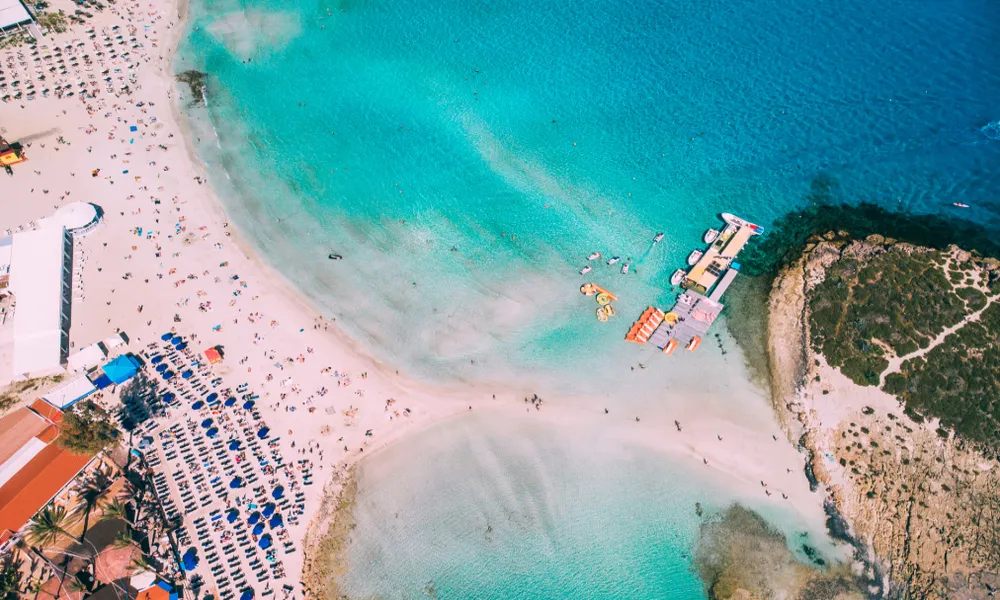

We are all after a swim on hot summer days, whether at home or on holiday abroad. But how can we be sure it is safe to get in the water? This year's report by the European Environment Agency, based on 2025 data, confirms that the quality of bathing waters in the EU has improved significantly over recent decades, with Cyprus recording the highest score, despite last year's episode with the water analyses at Lady's Mile, when the British Bases detected elevated levels of enterococci in the waters of the beach, causing considerable alarm among bathers, while the Limassol Municipality gave assurances that the waters were safe for swimming.
The rankings
According to the findings, in 2025 more than 85 per cent of bathing waters at over 22,000 sites across the EU, Albania and Switzerland were assessed as excellent, while 96 per cent met at least the minimum standards. This means that most bathing waters showed no bacterial contamination harmful to human health.
The EU countries with the highest share of bathing sites with excellent water quality, at 95 per cent or above, were Cyprus (100%), Greece (97.1%), Bulgaria (96.9%) and Austria (96.5%). At the other end, the countries with the lowest share of excellent bathing waters, at 70 per cent or less, were Slovakia (70%), Belgium (67.9%), Hungary (64%), Poland (58.7%) and Estonia (56.9%).
Pollution problems
Around 1.5 per cent of the EU's bathing waters were, however, of poor quality, and the report notes that water management measures in these areas were not always adequate or effectively applied. Quality differs by type of water. Coastal areas lead, with 88 per cent assessed as excellent, lakes follow at 78 per cent, while rivers lag behind, with just 47 per cent of the roughly 1,200 river sites meeting the criteria. The main culprit is bacterial contamination from E.coli and intestinal enterococci, usually from sewage or manure runoff after heavy rains.
Nevertheless, the number of bathing waters classified as poor has stabilised in recent years. In 2025, of the 332 bathing sites in the EU-27 characterised as poor in 2024, 88 improved to at least sufficient quality, 203 remained poor, while the remaining 41 either lost their designation as bathing waters or could not be assessed, because the required measures had not been applied or there were insufficient monitoring samples.
In 2025, in three EU countries, 3 per cent or more of bathing waters were classified as poor: Estonia with 3 bathing sites (4.6 per cent of the country's total), the Netherlands with 31 sites (4.1 per cent) and France with 112 sites (3.3 per cent).
Contamination problems continue to be observed in areas frequently affected by short-term pollution. Such phenomena typically appear after heavy rainfall, when wastewater treatment systems lack sufficient capacity and untreated sewage ends up in the water.
Why it matters
The quality of bathing waters is particularly important because swimming in water contaminated with bacteria can cause stomach upsets, infections of the ears, eyes and respiratory tract, and at times other more serious infectious diseases.
The first European legislation on bathing water quality was adopted 50 years ago, in 1976. For the past 20 years, local and national authorities have been monitoring bathing water quality under the current Bathing Water Directive. Water samples are collected before and during the bathing season and tested for E.coli and intestinal enterococci, which indicate faecal contamination from sewage or manure. Water quality is then classified as "excellent", "good", "sufficient" or "poor" based on the bacteria levels detected, allowing the authorities to prohibit swimming in waters that are not safe.
Lakes and rivers
In 2025, 7,428 bathing sites on rivers and lakes were monitored in 25 EU member states, plus Albania and Switzerland. In total, 78.3 per cent of these inland bathing waters were classified as excellent, with almost 84 per cent of all inland sites located on lakes. In Austria, Finland, Denmark, Luxembourg and Germany, 90 per cent or more of inland bathing waters rated excellent, while fewer than 60 per cent did so in Slovenia, Portugal, Poland, Croatia and Spain.
Swimming in rivers was for centuries a popular recreational activity across Europe, but the rapid urbanisation and pollution that accompanied the Industrial Revolution seriously degraded water quality in many European rivers, leading during the 20th century to restrictions or outright bans on swimming in many cities. In recent years, a citizens' movement promoting the return of river swimming has been growing across Europe, fuelled by the increasing need for access to nature during ever hotter summers and the desire to reconnect cities with their rivers. Water quality in many urban rivers has improved significantly thanks to European water protection policies, now permitting safe swimming in several European cities.
Rivers therefore constitute important and increasingly popular recreational spaces in Europe. Even so, in many countries only a small share of officially designated bathing areas is found on rivers, roughly 1,200 sites or just 5.5 per cent of all bathing waters. The relatively low share of river waters classified as excellent highlights the challenges of ensuring stable microbiological quality in flowing waters, particularly when rivers are affected by multiple pollution sources upstream.