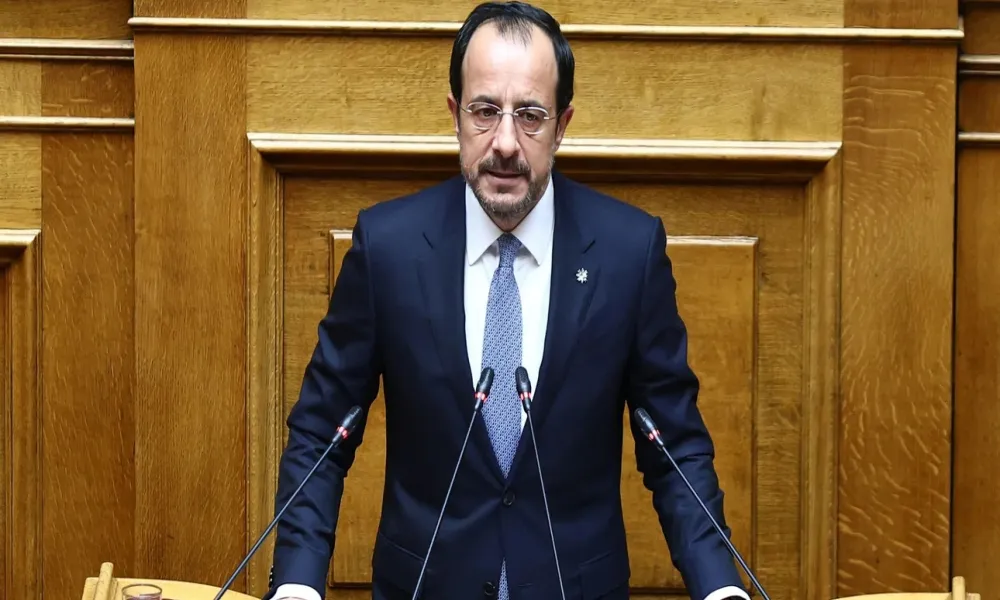
President Nikos Christodoulides addressed the plenary of the Hellenic Parliament on Thursday, following an official invitation by the House. His speech focused on the Cyprus problem, relations between Nicosia and Athens, European strategic autonomy and Cyprus’ role during its Presidency of the Council of the European Union.
No Discussion of a Two-State Solution
President Christodoulides said that, for the Greek Cypriot side, a two-state solution “does not exist even as a thought”. He stated that Cyprus would never accept the legalisation of illegality or the permanent political, administrative and territorial division of the Republic of Cyprus.
The President also said that the Cyprus problem is “also a European problem”, arguing that EU law can act as a catalyst for a functional and viable settlement.
Greece’s Support After Akrotiri Drone Attack
Christodoulides referred to Greece’s immediate defence support following the recent drone attack on the British military base at Akrotiri. He thanked Greek Prime Minister Kyriakos Mitsotakis, saying the response carried both practical and symbolic weight and helped restore, in moral terms, a historic wound linked to the phrase “Cyprus lies far away”.
Economy and EU Presidency
The President also referred to Cyprus’ economic performance, saying the country recorded 3% growth in the first quarter of 2026, the highest rate in the EU, according to preliminary estimates. He said Cyprus’ fiscal position allows it to exercise the Presidency of the Council of the EU with confidence, with priorities including European autonomy, social policy, defence and institutional modernisation.
Full Speech by the President
It is with feelings of the deepest respect and unlimited appreciation that I have the particular honour and privilege of addressing, on behalf of the Cypriot people, the plenary of the Hellenic Parliament, in the presence of the Prime Minister and the entire political leadership of the country.
Mr President, please accept my warmest thanks for the invitation you extended to me to address this special session. I convey a message of brotherly love and eternal gratitude to every Greek woman and man, both in metropolitan Hellenism and in the diaspora across the world.
My presence here, in the Temple of Democracy, in the country that gave birth to Democracy thousands of years ago, is accompanied by the historic duty to begin my speech by commemorating the Greeks of Cyprus who took part in all national struggles.
In every corner of Greek territory and beyond, lie the bones of fighters from the Megalonisos who sacrificed themselves for freedom, for the establishment of the independent Greek state and for the restoration of Democracy. Some of these prominent Greek Cypriots have, at times, honoured the benches of the Hellenic Parliament with their presence, while several others served Greece from various other important positions.
Likewise, we are proud and grateful because the soil of Cyprus is soaked with the blood of our Greek brothers, who rushed to defend the independence and territorial integrity of my homeland, remaining faithful until the end to their encounter with history and the national imperative for freedom, as defined through the depths of the centuries.
We bow before the heroic Greek officers, soldiers and civilians who answered with a resounding “present” and sacrificed the most precious thing they had in order to prevent Turkey’s partitionist plans, initially in 1963, only three years after the creation of the independent Cypriot state, and subsequently in 1974, with the illegal, barbaric invasion of Attila, which continues to occupy 37% of the territory of the Republic of Cyprus.
We also bow before our Greek brothers who, so many years later, remain missing, assuring their loved ones that we will never rest unless the fate of the last missing person of the Cyprus Tragedy is determined.
Our duty is even greater when we consider that, through their sacrifice, they placed balm on the wound caused by the most modern tragedy of Hellenism, a wound that continues to bleed to this day.
They held high the banner of dignity and earned a place in the pantheon of the immortals, alongside Leonidas, Kolokotronis, Pallikaridis, Afxentiou and many others, continuers of our historic path.
Our gratitude will also be eternal towards our Greek brothers who opened their homes and hosted children from Cyprus in the black summer of 1974, who offered work and food to thousands of my compatriots, who gave generations of Cypriots the opportunity to conquer the light of knowledge at the universities of Greece. We will never forget the help you offered us in those difficult hours, when our people, our fathers and our grandfathers, were seeking a support of hope in order to remain standing.
On the honoured columns of our monuments in Cyprus and Greece are engraved the names of the heroes who fell in glorious struggles from ancient times until today.
On the tombstone of the Monument of the Unknown Soldier in Syntagma, a few metres from here, the name of Cyprus is engraved, next to other places where Greeks fought. All these heroes are the joints that unite our common struggles, our common values and our common visions, which, according to Herodotus, compose our national identity and our consciousness: common blood, common language, common religion and common way of life.
Ladies and gentlemen,
This historic space of the Hellenic Parliament, the wider area of the centre of Athens that surrounds it, every square and neighbourhood of the city, as of course in all cities of Greece, are silent witnesses to major events that marked the modern history of Cyprus and Greece: from the 1950s, when the Greeks of Cyprus rose up demanding the self-evident, to the black seven-year dictatorship of the Colonels that led to the treacherous coup of 15 July 1974, which Turkey used as a pretext for the illegal invasion, Freedom remains to this day the fundamental stake.
From that black summer of 1974 until today, Turkey has been committing, through the force of arms, one of the greatest crimes in the post-war history of Europe and is accountable for the murder of thousands of civilians and soldiers, several of whom remain missing. What is happening in Ukraine, and rightly provokes the strongest reaction of the international community, was committed in Cyprus half a century ago and, unfortunately, continues to exist today.
The evidence against Turkey is overwhelming. Specifically:
For 52 whole years, it has continued the illegal occupation of 37% of the territory of the Republic of Cyprus, an independent and sovereign member state of the European Union and the United Nations.
It prohibits the return of refugees to their homes and properties.
It refuses to allow access to the archives of the occupying army for the determination of the fate of missing persons, Greek Cypriots and Greeks from Greece, a purely humanitarian issue.
It violates basic freedoms and fundamental rights of all lawful residents of Cyprus, Greek Cypriots, Turkish Cypriots, Maronites, Armenians and Latins.
It expands illegal settlement and the alteration of the demographic character of our country.
It intensifies the economic, political, religious and social manipulation of Turkish Cypriots.
It persecutes citizens of the Republic of Cyprus who remain enclaved in the occupied areas.
It destroys our religious and cultural heritage.
It prevents all of us from moving, settling and living freely in any part of our homeland that we wish.
All that I have mentioned are only some of the evidence of a prolonged Turkish crime that flagrantly violates International and European Law and the Charter of the United Nations, against the sovereignty, independence and territorial integrity of the Republic of Cyprus. It constitutes an indisputable violation of the fundamental freedoms and human rights of all Cypriot European citizens, including, of course, our Turkish Cypriot compatriots.
Ladies and gentlemen,
The unvindicated dead and missing of the Cyprus Tragedy, the refugees, the enclaved and those who have suffered, every family that continues for 52 years now to suffer from this continuing crime, define the duty we have to be freed from the bonds of occupation and to liberate our homeland, so that we may ensure for the citizens of our country the right to live in conditions of security and prosperity and to enjoy the same rights as all European citizens.
Having, therefore, as our mandate from the sovereign people the liberation and reunification of our homeland, we work tirelessly to create the conditions for the resumption of negotiations for a comprehensive settlement of the Cyprus problem, on the basis of the agreed United Nations framework, the negotiating acquis and, of course, the principles, values and law of the EU.
And I am absolutely convinced that EU law can act as a catalyst for the settlement of the Cyprus problem, and also as the most important safeguard for the implementation of a functional and viable solution to the Cyprus problem.
From the first day of assuming the responsibility of governing the country, more than three years ago, having clear political will and with assertive realism, we sought, on the basis of a specific plan and design, to rekindle international interest in the Cyprus problem. Amid global turmoil caused by two wars, in Ukraine and in the Middle East, we managed to end the seven-year stalemate, as the United Nations Secretary-General himself publicly stated, and an initiative for the resumption of talks is under way.
Despite the continuous obstacles and delaying tactics of the Turkish side, despite the problems, difficulties and challenges, which I in no way underestimate, we are investing in the negotiating effort and in the clear political will of Mr Guterres, in the belief that there will soon be tangible results.
Mr Prime Minister, Mr President of the Hellenic Parliament, ladies and gentlemen members of Parliament,
In this great effort we are making to be freed from the bonds of occupation, we do not feel that we are alone. We have the support, first and foremost, of Greece, which remains our most consistent and selfless ally. And I would like once again to express our gratitude for its longstanding support. The support we have from our partners in the European Union is also important. I note with satisfaction the fact that, following our own painstaking efforts, the heads of the European Commission and the European Council jointly addressed the Secretary-General, recording in a historic letter, if I may use the term, in the most official way, not only the European Union’s interest in the Cyprus problem, but also the framework that its solution must ensure.
The joint letter, together with the conclusions of the European Council of April 2024, in which there is a clear link between Euro-Turkish relations and progress on the Cyprus problem, strengthen our diplomatic and political armoury and make clear in every direction that the Cyprus problem is also a European problem.
With the initiatives we undertake, with our multi-level and dynamic foreign policy, with the strengthening of ties with strategic partners, our creative role within the European Union and in the wider region, with the change in the image and reputation of our country and the strengthening of our economy, by strengthening, in other words, all the factors of power of the Republic of Cyprus, internal and external, we have achieved the reactivation of the international factor and the start of the relevant processes, which we hope will very soon lead to the next step.
The facts are difficult, the challenges are many, but as you know very well, things in the Cyprus problem have never been easy. However, every step is important, because it strengthens our great effort towards achieving our sole objective, which is nothing other than the end of occupation and the reunification of Cyprus.
I want, from this historic podium, in the most official way, to stress that for us, a two-state solution does not exist even as a thought. We will never accept discussion of the legalisation of illegality. And we will never sign the perpetuation and legalisation of the administrative, political and territorial mutilation of the Republic of Cyprus.
In our own visions, the future of Cyprus is secured through the reunification of the country from one end to the other: from the Cape of Apostle Andreas to martyred Tillyria and from Kyrenia to Limassol and Famagusta.
Ladies and gentlemen,
In the history of Hellenism, there have been sufferings born in the womb of division, because of reckless and disastrous choices.
Fortunately, however, there are bright examples in which Hellenism recorded successes when conditions of understanding prevailed and clear strategic pursuits existed, with vision, with objective and with plan. The glorious pages of our history were written in golden letters whenever we Greeks acted united in pursuit of noble aims, guided by assertive realism, a rational reading of international developments and the correct calculation of the balance of power with sound judgement and pragmatism.
And we are proud because the accession of the Republic of Cyprus to the European Union in 2004, the most drastic change after independence in 1960 and our most important diplomatic success since the establishment of the Republic of Cyprus, was precisely the result of assertive realism and the excellent cooperation between Cyprus and Greece. This supreme achievement, which literally changed the fate of the country, is due to a great extent also to the firm support of Greece. Beyond the support of Greek governments over time and of the political leadership as a whole, I must highlight the essential contribution of the Hellenic Parliament, which, through a resolution, had made clear to all that it would not ratify the enlargement of the European Union if it did not include the Republic of Cyprus.
That position of the Hellenic Parliament acted as a catalyst for the achievement of the major national objective of the accession of the Republic of Cyprus to the European Union.
Twenty-two years later, Cyprus is now a mature member, a creative partner, with a decisive contribution to European affairs. With a clear and distinct political orientation on major issues, with administrative and organisational capacity, the Republic of Cyprus is exercising, during the current semester, with confidence and pride the Presidency of the Council of the European Union, at a time of intense geopolitical and geoeconomic challenges that test the resilience of the Union and put at stake our unity and cohesion.
There is no longer any doubt that the autonomy of the Union in all vital sectors is indispensable for the process towards further European integration, for an autonomous, independent and strong Union, capable of protecting its citizens, its borders and its interests. And it is precisely for this Union that we are working as the Cypriot Presidency.
Ladies and gentlemen,
Very recently, we strongly experienced the need for Europe’s readiness and autonomy in the field of defence and security, when the British military base at Akrotiri, which is located within the territory of the Republic of Cyprus, was attacked by an unmanned aerial vehicle.
The immediate response of the Greek government to our request for reinforcement of our defence capacity was the precursor to the creation of an unprecedented wave of solidarity in practice from other European countries as well. And I want once again to thank the Prime Minister for the practical assistance. Beyond the substantive strengthening of the sense of security caused by the dispatch of Greek assistance, your immediate response also served, to the highest degree, the powerful symbolism that needs no explanation.
It was, if you like, the moral restoration of a historic pending issue that traumatically marked the collective memory, especially of my own generation, with the phrase “Cyprus lies far away”.
Ladies and gentlemen,
Beyond the historical bonds, Cyprus and Greece, two legally recognised entities in the international community, operate independently but also jointly, based on the common principles and values to which I referred earlier.
I am particularly pleased because, in recent years, this bilateral relationship has not been circumstantial. The Cyprus-Greece Intergovernmental Cooperation, which was agreed and began in 2023 during my first visit to Athens, immediately after my election, is an institutionalised mechanism of strategic cooperation. It is not just another political meeting, but a permanent governance mechanism, with continuity, accountability and tangible results, which essentially establishes our bilateral relations.
The Intergovernmental Cooperation covers a broad thematic spectrum that goes beyond strictly national issues and extends to areas such as Education, Health, Environment and Climate Policy, State Modernisation, Research and Innovation, Culture and many other sectors.
The added value of the Intergovernmental Cooperation lies in the fact that it focuses on policies that directly affect the daily lives of our citizens.
Particularly important is also the fact that the Intergovernmental Cooperation functions as a framework for strategic coordination within the European Union, especially in the context of the current Cypriot Presidency of the Council of the European Union and the Greek Presidency in the second half of 2027.
The Cyprus-Greece Intergovernmental Cooperation also proves in practice that the two countries can cooperate not only as historic partners, but as modern European states that jointly shape policies.
And it is on this solid foundation that the institutional cooperation we have developed over the past three years at the highest level is based.
And I am truly pleased because Cyprus-Greece relations are at the best point they have ever been, as a result of the methodical, completely sincere and effective cooperation we are developing on a series of issues, with absolute respect for possible disagreements and different approaches.
Ladies and gentlemen,
As the first President of the Republic of Cyprus of the post-war generation, a father of four children, I understand the historical weight I have assumed towards my people, to work and to do everything humanly possible to hand over a homeland without an occupying army, without barbed wire, without the fear that wounded the lives of my generation, without the insecurity caused by the fragile status quo.
At the same time, equally heavy is the responsibility we have assumed to modernise the Cypriot state, to upgrade the services it offers to the citizen, to make it more effective, faster, more accessible, friendly and humane. In this context, our effort is relentless for bold reforms for the modernisation of institutions, the strengthening of the Rule of Law, the combating of corruption, the handling of migration, the strengthening of the deterrent power of our homeland, investment in social welfare and the strengthening of citizens’ sense of security in all areas.
A prerequisite for all these, which undoubtedly also strengthen the external footprint of our country and the standing of the Republic of Cyprus, is a strong and resilient economy, through responsible fiscal policy that ensures a development path for the benefit of all our people and allows us to exercise targeted social policy.
On the basis of Social Liberalism, which constitutes our ideological and political framework, we address each issue through a human-centred approach that combines individual progress with social solidarity, strengthens the welfare state and, at the same time, activates all levers of economic and social development.
And I am truly proud that the performance of the Cypriot economy is remarkable and compares favourably with economically larger countries in Europe, especially at a time of geopolitical challenges.
Only yesterday it was announced that, according to the preliminary estimate, Cyprus recorded a growth rate of 3% in the first quarter of 2026, the highest in the European Union, a fact that confirms the resilience and momentum of its economy.
These high growth rates, combined with the significant fiscal surplus, limited public debt and low inflation, allow us to address internal and external challenges in a targeted way.
The strong fiscal base, sound fundamentals and resilient banking system of the country strengthen the capacity of the Cypriot economy and allow us to invest in sectors of particular social added value, such as Health, Education, Housing and the Welfare State.
Ladies and gentlemen,
From this place of institutional standing, historic weight and strong symbolism, I send to Greek women and men everywhere the optimistic message that Cyprus and Greece are walking together on the road of progress, prosperity, development and security, with the certainty that the days to come for our countries and our citizens will be even better.
We draw lessons, strength and examples from the inexhaustible sources of our historic past, which functions as a foundation for building a resilient future in a sustainable and pragmatic way.
I mentally shake the hand of all of you, and together with my warm thanks for this particularly honourable hospitality by the Hellenic Parliament, I convey to you the sincere assurance that I will continue to work for the achievement of our major national objectives for mutual benefit.
The liberation and reunification of Cyprus is the vow that unites us all, in Cyprus and Greece, regardless of party choices or ideological preferences.
The heavy debt towards all those in Cyprus and Greece who fought for the universal ideals of Freedom, Democracy and Justice, and the duty towards all those who sacrificed themselves so that we may be free, do not allow us to reconcile ourselves with anything less.
Standing firmly on their legacy, we look to tomorrow with optimism, with the certainty of the poet that a little longer and we shall see the almond trees blossom, the marble shine in the sun, the sea ripple. A little longer, let us rise, a little higher.
Thank you very much.