
The United Kingdom is undeniably one of the planet's greatest musical superpowers. As the birthplace of The Beatles, Queen, David Bowie, Oasis, and Adele, British artists routinely dominate global streaming charts. Yet, when it comes to the Eurovision Song Contest, the outcome for the country remains a predictable cycle of disappointment, public awkwardness, and last-place finishes.
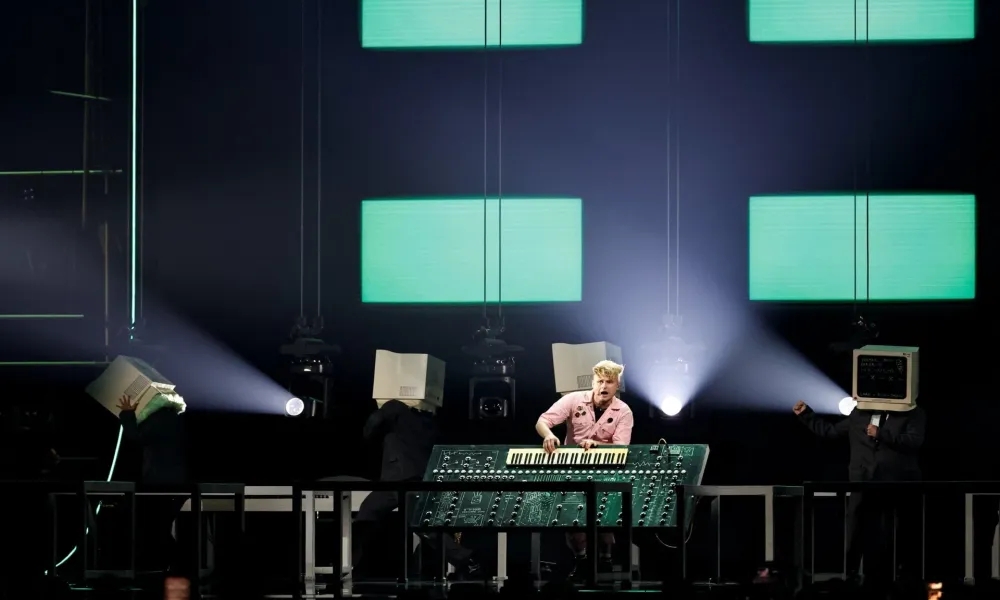
The 2026 contest proved to be no exception to this historical pattern. British representative Sam Battle, known professionally as Look Mum No Computer, collapsed at the bottom of the scoreboard in Vienna, securing just one solitary point. The result marks the third time the United Kingdom has finished dead last since 2020, having managed to enter the top 10 only once since 2010. Furthermore, for the second time in three years, the British entry received an absolute score of zero points from the public televote.
Paradoxical entries and chaotic risks
In a detailed post-mortem analysis, the BBC addressed the systematic failure of the British delegation, rejecting the simplistic political alibi that European audiences are merely penalising the country for Brexit. Instead, experts point to deep-seated structural issues in song selection and staging.
For years, the BBC faced heavy criticism for selecting excessively safe, generic pop tracks that failed to generate enthusiasm. However, when the broadcaster decided to take a definitive creative risk for the 2026 contest, it swung to the opposite extreme. Battle performed a frenetic synth-pop track titled "Eins, Zwei, Drei" while dressed in a hot pink boiler suit, singing a bizarre narrative about an office employee who quits his job to move to Germany and count to three.
While certain British commentators praised the entry's eccentric ambition as uniquely British, European juries and televoters found the performance chaotic and bewildering. National juries awarded the track a single point, while the global viewing public rejected it completely.
The "poisoned chalice" of the British music industry
A core obstacle to British success is the toxic reputation Eurovision holds within the domestic music market. Major recording artists and independent labels continue to treat the contest with condescension, viewing it as a career hazard rather than a promotional springboard. Well-known artist Will Young famously labeled the competition a "poisoned chalice" after turning down an invitation to represent the country.
Even when established stars accept the challenge, they often leave the competition professionally bruised. In 2024, pop star Olly Alexander finished in a disappointing 18th place, receiving zero points from the public televote despite his existing international profile. Alexander later described the high-pressure environment as brutal, publicly advising future contestants to secure a good therapist before signing up.
Consequently, major record labels routinely withhold their premier talent and financial backing from the project. This forces the BBC to rely on unaligned independent acts or lesser-known performers who lack the institutional machinery, marketing budgets, and extensive pre-show promotion required to compete against top-tier European pop stars.
The Finnish blueprint for success
To find a path forward, Eurovision analysts suggest the UK look closely at the modern trajectory of Finland. Following their landmark victory with Lordi in 2006, the Finns endured a severe 15-year competitive slump, frequently failing to clear the semi-final stages.
However, the country completely revitalised its fortunes by launching a massive, transparent televised selection show known as UMK. According to Finnish show producers, the turning point arrived when the country stopped feeling embarrassed by its own musical oddities. By fully embracing highly distinctive, unapologetically eccentric entries—such as Käärijä’s wildly successful "Cha Cha Cha" in 2023—Finland transformed its structural distinctiveness into massive televoting capital.
Resolving the identity crisis
The ultimate failure of the United Kingdom stems from a fundamental identity crisis. The BBC has yet to decide whether it views Eurovision as a serious contemporary music platform or a camp television parody.
To break the curse and replicate the isolated success of Sam Ryder, who secured a brilliant second-place finish with "Space Man" in 2022, the broadcaster must establish a coherent long-term strategy.
Critics argue the delegation must actively involve major radio network programmers and senior industry executives to identify upcoming viral talent, rather than relying on insular production circles. Until the UK learns to balance musical authenticity with spectacular staging, the world's most successful pop market will remain entirely illiterate in the mechanics of the world's biggest pop competition.