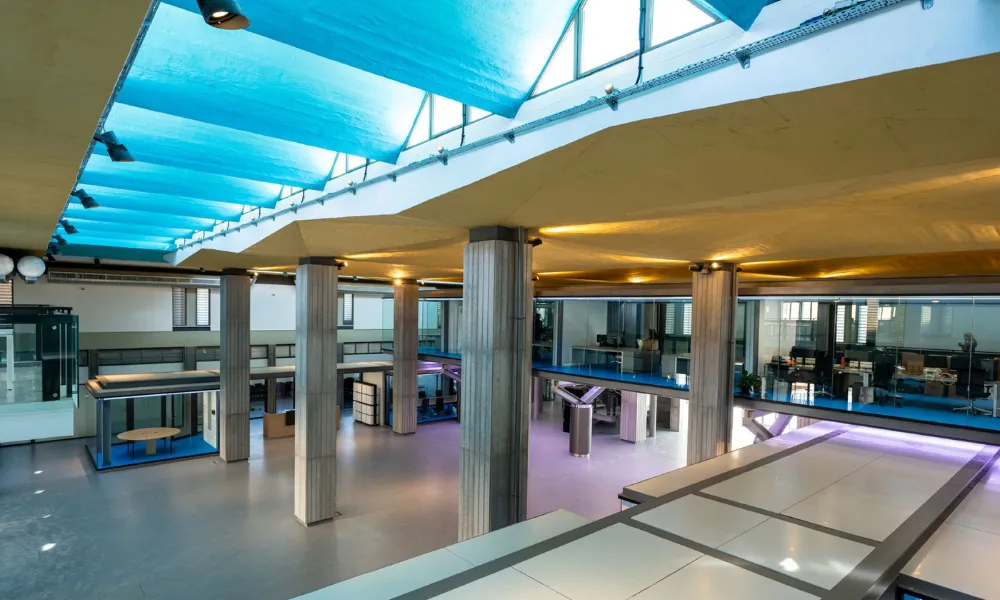

A former derelict food market in central Nicosia has been transformed into a thriving research and innovation hub, with the CYENS Centre of Excellence becoming a regional centre for immersive technologies, artificial intelligence and smart systems, Euronews reported.
Partly funded by the European Union, CYENS employs around 110 researchers, developers and technicians working across more than 50 projects, ranging from interactive media and virtual reality to data science, healthcare and environmental management.
Among its projects are AI-powered urban mapping tools that provide real-time information on traffic, noise, pollution and environmental conditions, as well as virtual recreations of historical monuments with restricted public access.
"Virtual reality is one of those technologies that can enable different modes of interaction with visual elements," said Panayiotis Charalambous, computer scientist and team leader at CYENS.
"One of the things that can enable you [to do] is to be immersed in an environment that maybe it's difficult for you to go to. Either because it's in a remote location, something in a different country, or maybe you also have mobility issues. Being immersed in that environment allows you to feel like, yes, I'm there, right?"
Interactive theatre
Researchers are also developing tools that allow users to create interactive theatrical experiences.
"You can basically give the actors in the scene different emotional temperaments, different actions that they can do and effectively create your own play," said game engineer programmer Ismail Hadjri.
"There's also the stage designer table where functionally you place the different objects in the space, you tell the actors where they need to go, you put spotlights where they need to be."
Another CYENS spin-off, Senssos, uses wearable sensors to monitor body movement and muscle activity, with applications ranging from physiotherapy and rehabilitation to music performance and sports science.
"We have developed our own hardware to replace the commercially available systems with something which is cheaper, easy to install and fast. So, it can be easy for consumers to use this either at home or at jobs during rehabilitation, during training, to enhance performance and for rehabilitation reasons as well," said Christos Ioannou, co-founder of Senssos.
Similar technologies are already being used by athletes to measure real-time performance indicators including cadence, heart rate and ground-contact time.
Tackling brain drain
CYENS chief executive Yiorgos Chrysanthou said the centre was helping Cyprus tackle the long-standing challenge of brain drain by creating opportunities for highly skilled researchers and engineers.
"Cyprus is a small place, and we cannot really compete with heavy industry or anything else," he said.
"I believe the only way to help the economy and take it forward and move a little bit beyond tourism, which was the main economic driving force for all these years, is to keep this critical mass of talent. And build it and expand it to create an economic activity which relates on technology."
Projects under development also include artificial intelligence tools for agriculture, platforms to help municipalities manage urban trees and green spaces, and systems to identify illegal dumping sites.
The city of Nicosia, a founding partner of CYENS, already uses some of the technologies developed at the centre.
"We are between Europe, Asia, and Africa. And this is very attractive for people from the wider region to come," Nicosia Mayor Charalambos Prountzos told Euronews.
"The presence of CYENS in Nicosia brings together top-class academics and top-class research together with the municipality, the city, and of course the business community in order to create research that will be used in the sphere of innovation, but also to create applicable solutions."
The centre is also supporting projects in medical AI, cultural heritage and digital arts, while a recent arts festival co-hosted by CYENS brought together works from 60 artists representing 15 countries.
Source: Euronews