
Cyprus has unveiled its first domestically built satellites and activated a new AI-powered space weather monitoring centre, marking a major milestone in the country's growing space sector.
The announcement was made by the Cyprus Space Exploration Organisation (CSEO) at the completed Mission Control Centre of the Cyprus Space Research and Innovation Centre (C-SpaRC) in Nicosia.
The organisation introduced the Kyrenia³ satellite fleet, consisting of three CubeSats: Kyrenia³ A (1U), Kyrenia³ B (3U) and Kyrenia³ C (6U).
Three satellites instead of one
"When we started C-SpaRC, we promised Cyprus its first satellite; today we deliver three," said George A. Danos, President of CSEO and Director of C-SpaRC.
The satellites, named after the ancient Kyrenia ship depicted on Cyprus euro coins and blessed by the Metropolitan of Kyrenia, will carry Earth observation cameras and scientific experiments.
The programme will also allow messages from the President of the Republic of Cyprus and schoolchildren to be carried onboard future missions.
International partnerships
The Kyrenia³ programme is supported by a number of international collaborations.
Alongside satellite engineering and ground-station cooperation with the Budapest University of Technology and Economics (BME), scientists at NASA's Marshall Space Flight Center have committed to flying NASA's CARLO sensor aboard the third satellite, Kyrenia³ C.
The instrument will monitor solar-storm electrical turbulence in the upper atmosphere, helping improve protection for GPS navigation systems, aircraft and ships worldwide.
The programme also builds on Cyprus' participation in the NASA Artemis Accords, while C-SpaRC said it is pursuing strategic partnerships with Lockheed Martin and major Japanese corporations to modernise satellite communications in the maritime sector.
Satellite factory completed
C-SpaRC also announced the completion of what it describes as the Eastern Mediterranean's only open-access, end-to-end microsatellite manufacturing facility under one roof.
The centre includes:
- 3D metal printing facilities
- An ISO-7 cleanroom
- Launch and space qualification testing facilities
- Hardware certification capabilities up to the 64U satellite class
The facility will be available to startups, companies, universities and research centres seeking certification to European ECSS and international ISO standards without having to send equipment abroad.
AI-powered space weather monitoring
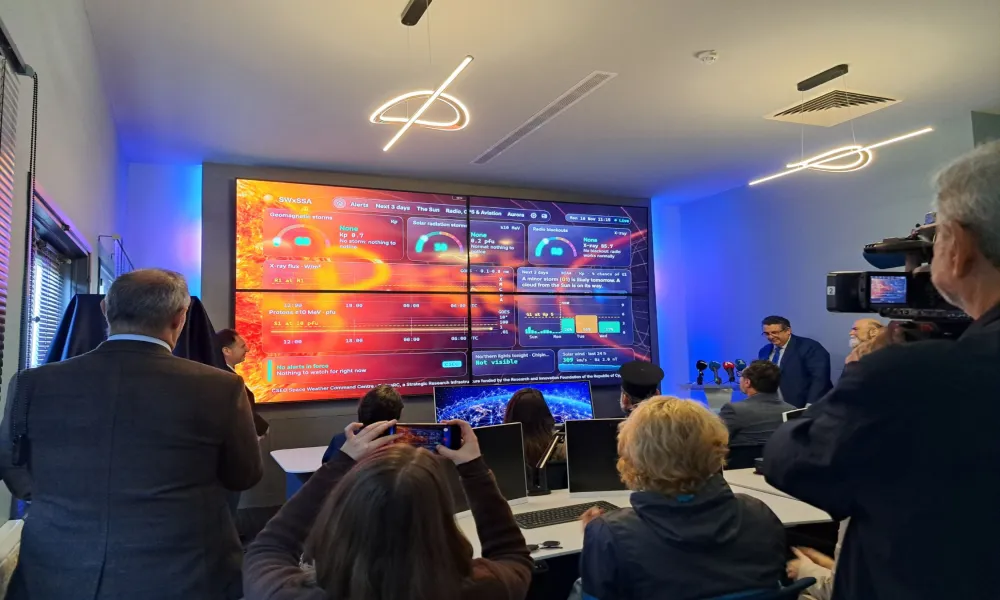
Another major announcement was the launch of Cyprus' new 24/7 AI Space Weather Command Centre, officially opened by Chief Scientist Demetris Skourides.
Accessible through the Space Weather Application, the system operates using CSEO computing infrastructure and analyses 27 live data streams.
Machine-learning models are used to forecast solar storms and powerful solar flares that could affect satellites, aviation, navigation systems and power networks.
Breakthroughs in space medicine
CSEO also highlighted findings from research conducted with partners including NASA's Translational Research Institute for Space Health (TRISH), the Cyprus Institute of Neurology and Genetics (CING) and Aretaeion Hospital.
Researchers identified 11 human genes affected by microgravity and used artificial intelligence to identify 10 existing medicines that could help protect the hearts of astronauts and patients on Earth.
Professor George Spyrou led the CING contribution to the research effort.
Space for schools
A new national initiative dubbed Space For Schools will allow pupils across Cyprus to communicate with satellites using equipment built in their schools.
The programme, presented by Don Koulaouzos, Director of Workforce Development and Global Partnerships at CSEO, will involve schools in Nicosia, Limassol, Larnaca, Paphos, Famagusta and Kyrenia.
Working alongside Skytrek and the Cyprus Amateur Radio Society, students will send messages of peace and Cypriot culture into space and receive them back through student-built satellite receivers.
Reversing brain drain
CSEO said the project is also helping transform "brain drain" into "brain gain" by attracting internationally recognised scientists to work alongside young Cypriot engineers.
The organisation added that the EU-registered Cyprus Space Cluster now includes more than 60 companies and institutions, supported by Cyprus' status as an Associate Member of the European Space Agency (ESA).
Official inauguration this week
C-SpaRC will be officially inaugurated on 19 November 2026 at 6.30pm by Deputy Minister to the President Irene Piki, alongside US Ambassador John Breslow, the Research and Innovation Foundation (RIF) and COSPAR.
Chief Scientist Demetris Skourides described the achievement as proof of Cyprus' scientific and technological progress.
"When Cyprus first took its early steps in the space sector years ago, there were some who smiled sceptically, believing that space belonged only to superpowers. Today, everybody can see the successes and strides achieved," he said.
Additional photographs from the launch event are available here.