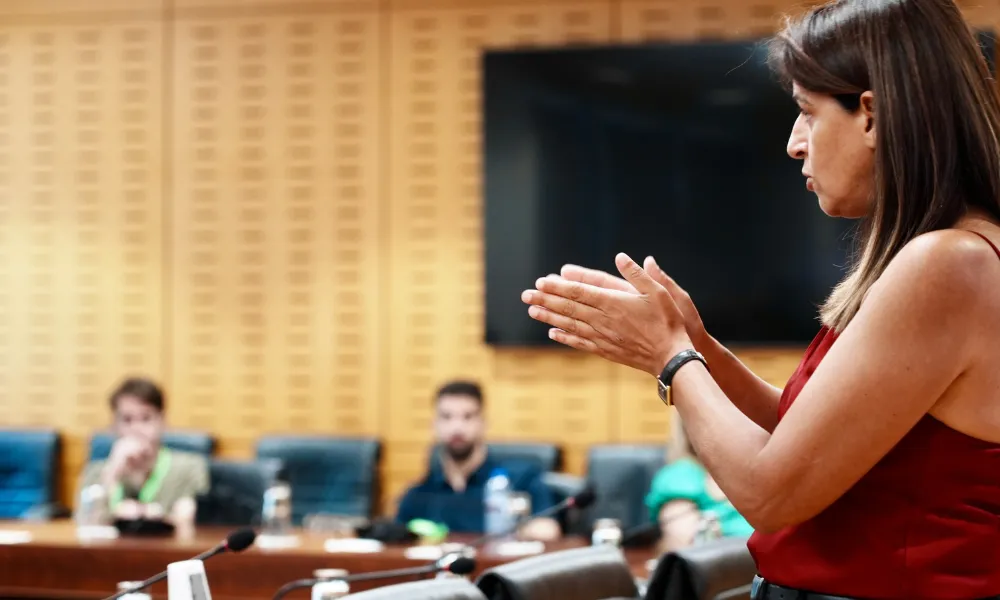

On the second day of the series, Commissioner for Gender Equality Josie Christodoulou explains the different forms gender-based violence can take. She also sets out the warning signs that can help a woman recognise abuse, even when it leaves no visible marks.
Day 2: What is gender-based violence, and what forms can it take? How can a woman recognise that she is experiencing violence, even when it is not physical?
Josie Christodoulou: "Gender-based violence is any act of violence directed against a person because of their gender. This type of violence disproportionately affects women.
It can take many forms. Physical and sexual violence entails physical harm. Psychological violence involves threats, intimidation, humiliation, manipulation, isolation and controlling behaviour. Economic violence occurs when a woman is deprived of access to financial resources, prevented from working or forced into financial dependence. Online violenceincludes cyberstalking, harassment, threats, the non-consensual sharing of intimate images and other forms of digital abuse. At its most extreme and ultimate manifestation, gender-based violence leads to femicide: the killing of a woman.
Recognising violence is not always easy, particularly when it leaves no visible marks. A woman may be experiencing abuse if she constantly feels afraid of her partner's reactions, has to justify her decisions, is monitored or controlled, is isolated from family and friends, or is made to feel worthless, guilty or responsible for someone else's behaviour. If she is denied access to money, pressured into unwanted activities, or feels that she has lost her freedom to make decisions about her own life, these are also warning signs.
Therefore, the message is that violence is not always about physical force. It is also about power, control and the gradual erosion of a woman's autonomy, dignity and sense of self. No woman should have to wait for physical violence to occur before recognising that she is experiencing abuse. Violence is never justified, and responsibility always lies with the perpetrator, never with the victim."
What the 16 Days of Activism are
The 16 Days of Activism against Gender-Based Violence is an international campaign that runs every year from 25 November to 10 December.
It begins on the International Day for the Elimination of Violence against Women and ends on Human Rights Day. The dates frame violence against women as a human rights issue.
The theme for 2026, set by the United Nations UNiTE campaign, is "UNiTE to End Violence Against Women and Girls: Ensure justice, protect survivors, end impunity".
Why the series matters
Gender-based violence is the most extreme form of inequality. Preventing it is not only a matter for the justice system and the police. It also requires changes in attitudes, education and institutions.
The series will cover four main themes:
- The roots of violence: stereotypes, unequal power relations and control
- Prevention: the role of education, the workplace and the media
- Justice for survivors: the barriers to reporting abuse and accessing justice
- Equality policies: the National Strategy for Gender Equality
The Commissioner's role
In Cyprus, policy on violence against women is coordinated by the National Coordinating Body for the Prevention and Combating of Violence against Women at the Ministry of Justice and Public Order.
The Commissioner for Gender Equality focuses on what lies behind the violence: unequal power relations and the gender stereotypes that allow it to happen.
Her role is set out in the Commissioner for Gender Equality and Related Matters Law of 2024. Under this law, the Commissioner designs the National Strategy for Gender Equality and coordinates how it is put into practice.
About Josie Christodoulou
Josie Christodoulou was appointed Commissioner for Gender Equality on 1 March 2023. She coordinates and monitors the National Strategy for Gender Equality, working with all ministries and deputy ministries.
She chairs the National Machinery for Women's Rights and founded the Civil Society Platform, which aims to strengthen social dialogue on gender equality.
She previously worked as Policy Coordinator at the Mediterranean Institute of Gender Studies (MIGS). She also served as Adviser to the Minister of Foreign Affairs on including a gender perspective in foreign policy.
She holds a degree in Psychology from the University of Indianapolis in the United States and a master's degree in Gender Studies from Middlesex University in the United Kingdom.