
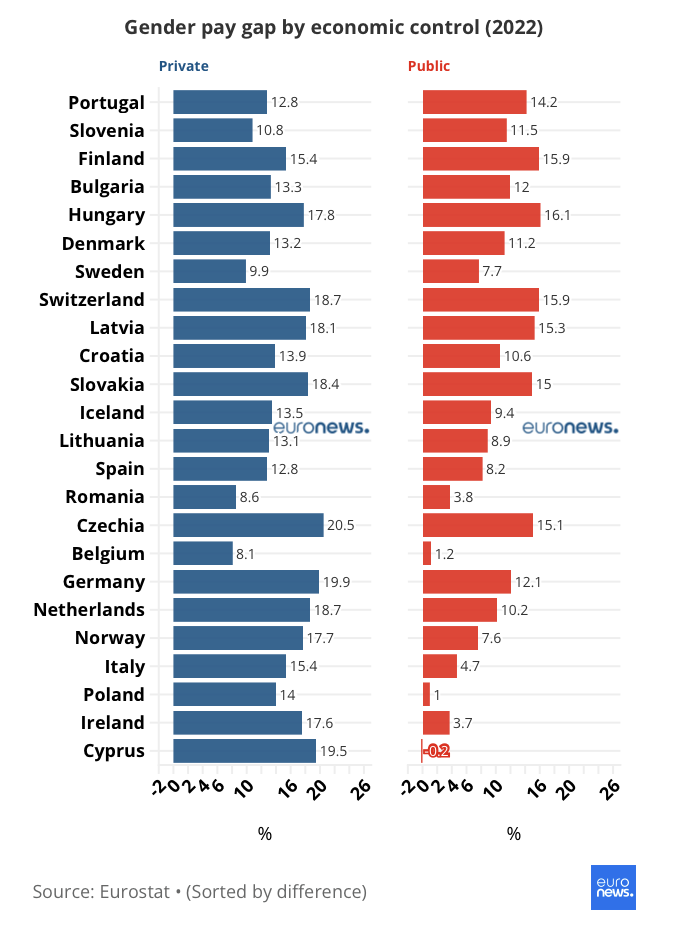
Women working in Cyprus' public sector earned slightly more than men in 2022. In the private sector, however, they earned 19.5% less. That gives Cyprus the largest gap between the two sectors of 24 European countries analysed by Euronews using Eurostat data.
Cyprus also had the lowest share of women in management in the EU, even though its overall gender pay gap was below the EU average.
Cyprus' overall gender pay gap
The unadjusted gender pay gap measures the difference between men's and women's average gross hourly earnings. It is expressed as a percentage of men's earnings. It does not take into account education, age, hours worked or type of job.
- In 2022, women in Cyprus earned 10.2% less per hour than men, the same as in Malta.
- This was below the EU average of 12.7%.
- In practice, women in Cyprus earned about €89.80 for every €100 earned by men.
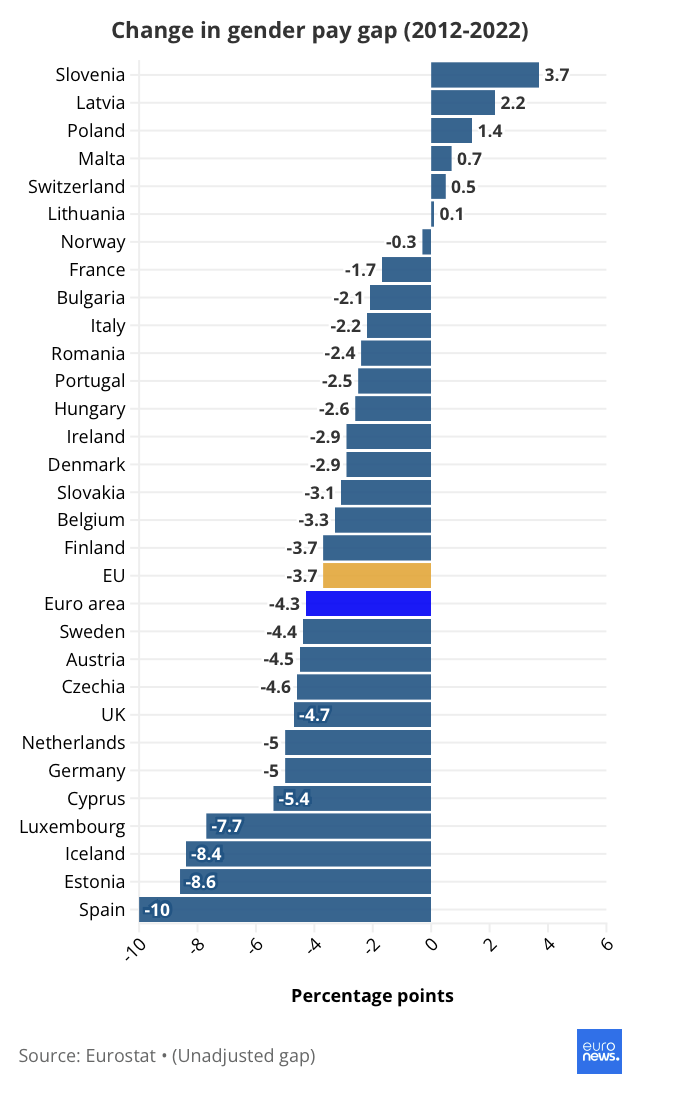
- Between 2012 and 2022, the gap in Cyprus narrowed by 5.4 percentage points, more than the EU average fall of 3.7 points.
The public and private sector divide
The difference between Cyprus' public and private sectors stands out in the data:
- In the public sector, Cyprus recorded a negative gap of -0.2%, meaning women were paid slightly more than men.
- In the private sector, the gap was 19.5%, the third highest among the countries analysed, after Czechia (20.5%)and Germany (19.9%).
- The difference of 19.7 percentage points between the two sectors was the highest in Europe.
According to the EU's statistics agency Eurostat, the gap is generally smaller in the public sector. This may be because public sector pay is mostly set by transparent wage grids that apply equally to men and women.
Fewest women in management
In 2021, women made up only 21% of managers in Cyprus, the lowest share in the EU. Luxembourg (22%) and the Netherlands (26%) followed. Across the EU, women held 35% of management positions, and no EU country had a share above 50%. Latvia (46%), Poland and Sweden (both 43%) had the highest shares.
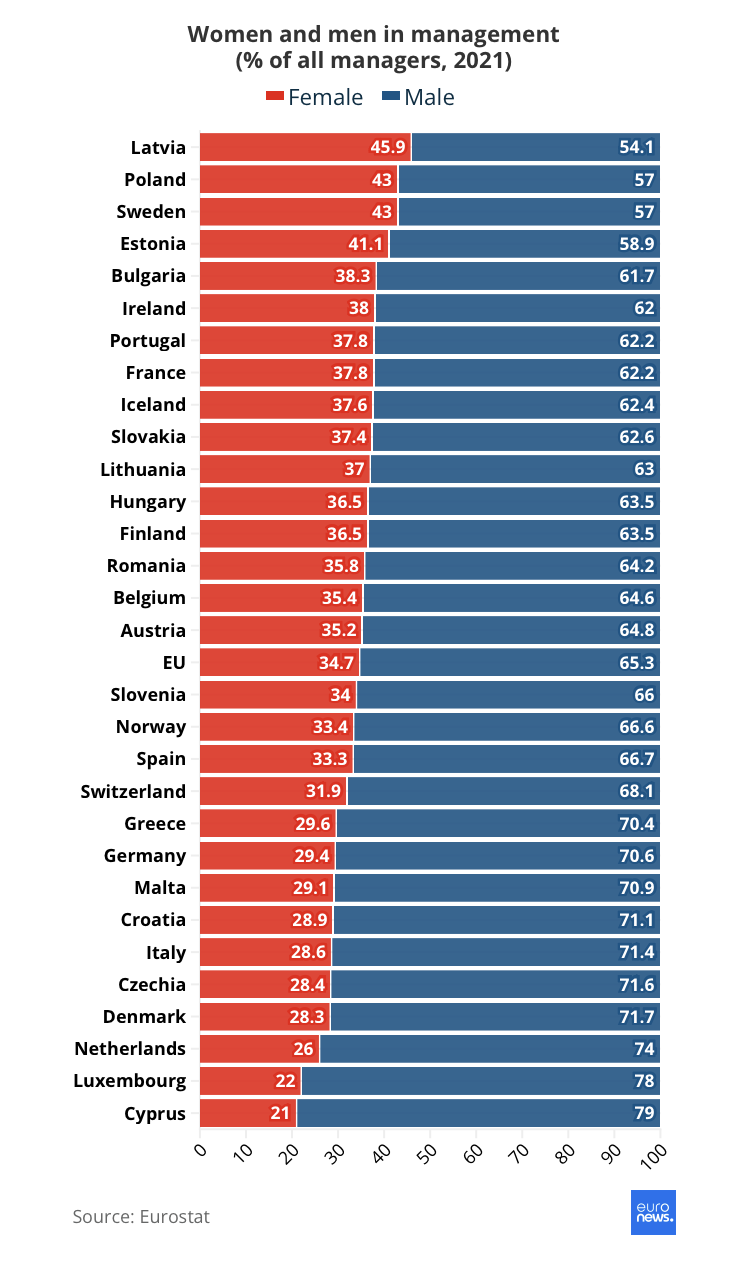
This matters for pay: managers were the profession with the largest difference in hourly earnings in the EU, with women earning 23% less than men.
Employment and labour force participation in Cyprus
The gap between men and women in Cyprus is also visible in employment:
- The employment rate for women aged 15 to 64 was 67.3%, compared with 78.5% for men.
- That gap of 11.2 percentage points was wider than the EU average of 9.8 points.
In labour force participation, Cyprus has made significant progress, according to OECD data:
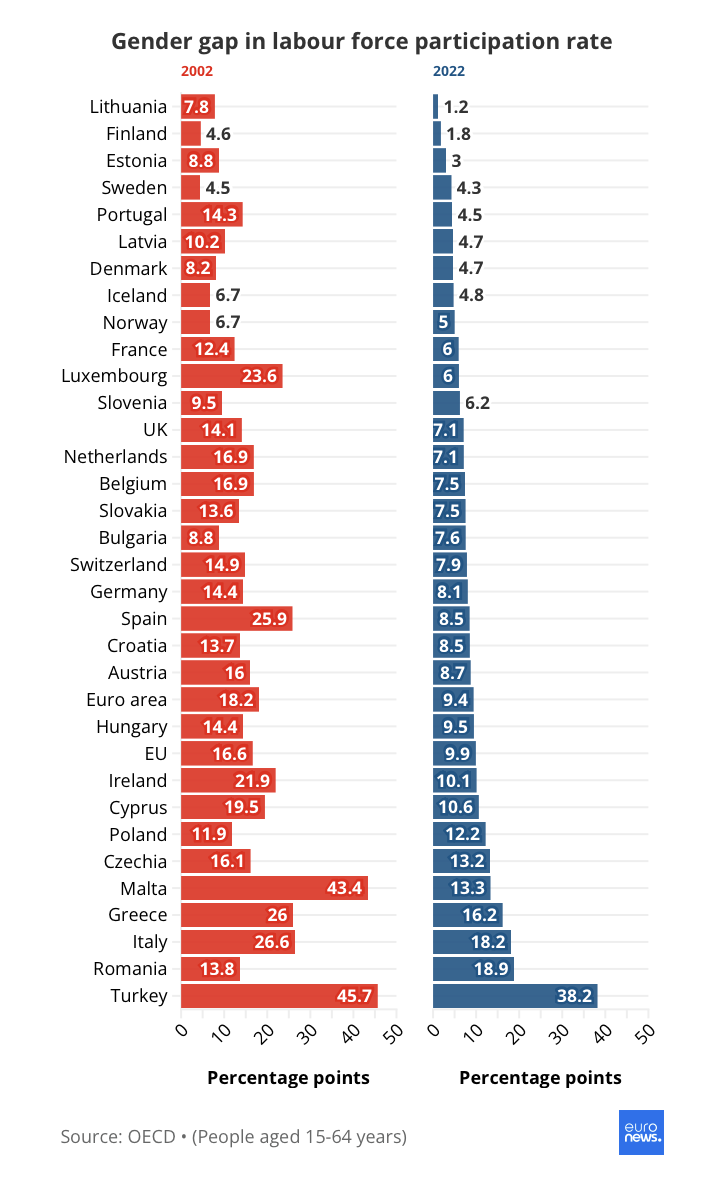
- The gap between men and women narrowed from 19.5 percentage points in 2002 to 10.6 points in 2022.
- Even so, Cyprus remains one of eight EU countries where the gap is still above 10 points.
The European picture
Across the EU, women earned €87.30 for every €100 earned by men in 2022. In other words, they would need to work about an extra 1.5 months to make up the difference.
The gap varied widely between countries:
- Estonia had the highest gap at 21.3%, followed by Austria (18.4%), Switzerland and Czechia (both 17.9%).
- Luxembourg (-0.7%) was the only country with a negative gap, meaning women earned slightly more than men.
- Italy, Romania and Belgium had gaps of less than 5%.
- Among the EU's "Big Four" economies, Germany (17.7%) and France (13.9%) were above the EU average.
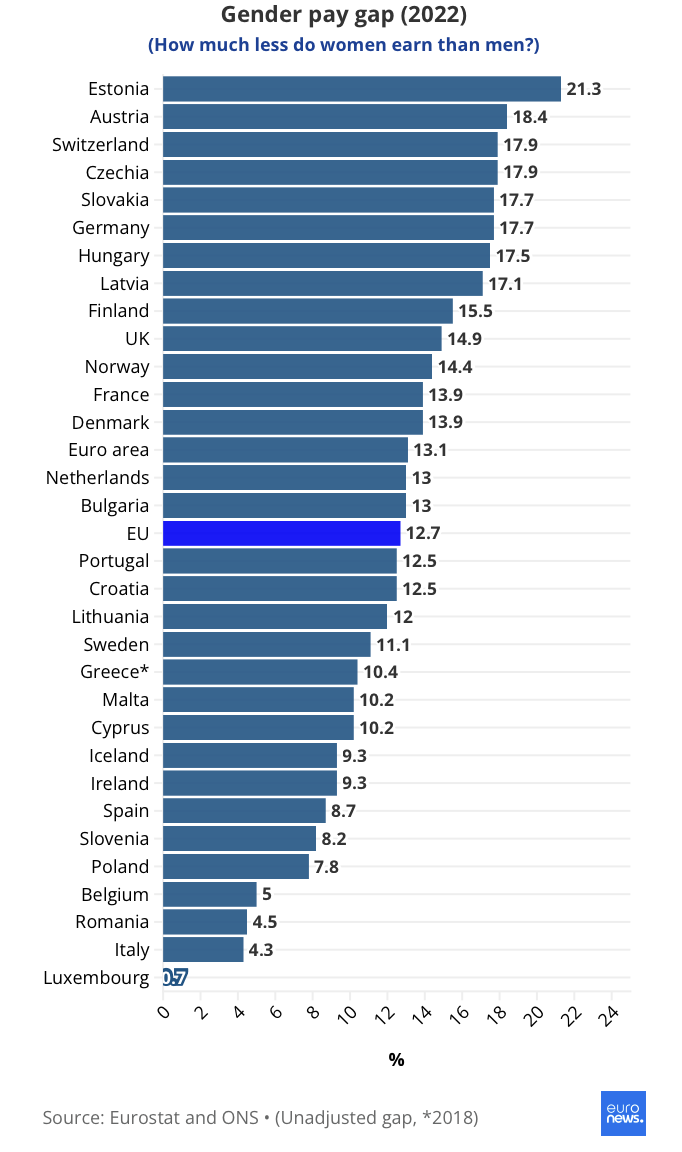
Progress has been steady but slow. Between 2012 and 2022, the EU gap fell from 16.4% to 12.7%:
- Spain recorded the biggest improvement, a fall of 10 percentage points. It was followed by Estonia (8.6), Iceland (8.4) and Luxembourg (7.6).
- Germany and the UK also recorded considerable falls, of 5 and 4.7 points respectively.
- The gap widened in six countries: Slovenia, Latvia, Poland, Malta, Switzerland and Lithuania. The increases ranged from 0.1 to 3.7 points.
The gap was higher in the private sector than in the public sector in 21 of 24 European countries. The exceptions were Portugal, Slovenia and Finland. In five countries, including Cyprus, the difference between the two sectors was more than 10 percentage points.
Why women earn less
According to the European Commission, the gender pay gap goes beyond equal pay for equal work. It reflects a range of inequalities women face in access to work, progression and rewards. The main reasons it identifies are:
- Sectoral segregation: Around 24% of the gap is linked to women being overrepresented in relatively low-paying sectors such as care, health and education.
- Part-time work: In 2022, 28% of women in the EU worked part-time, compared with 8% of men.
- Pay discrimination: In some cases, women earn less than men for doing equal work or work of equal value.
- Unpaid work: Women spend more hours on unpaid work and are much more likely to stop working to care for children and relatives. This is why the EU promotes equal sharing of parental leave.
- The glass ceiling: Men generally hold higher positions, which come with higher pay.
More educated, less employed
In 2022, 37.1% of women in the EU had tertiary education, compared with 31.4% of men. Women's share was higher in almost every EU country, except Germany and Austria. However, the employment rate for women (83.6%) was lower than for men (88.9%).
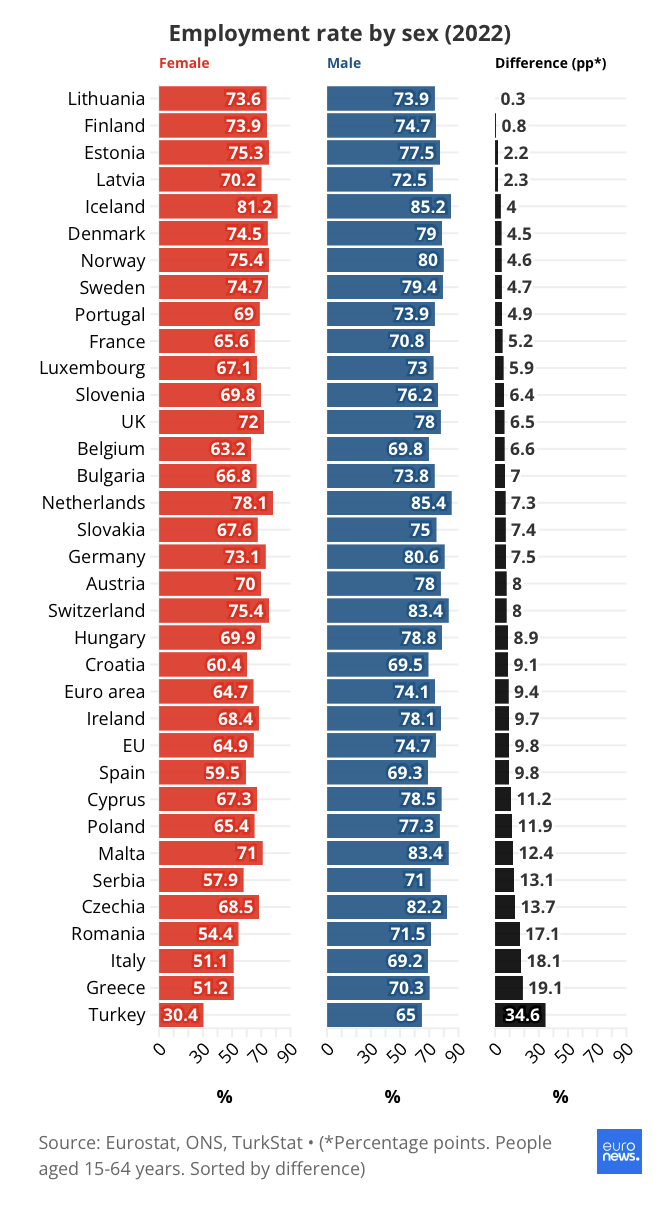
Among people aged 15 to 64, the EU employment rate for men was 74.7%, compared with 64.9% for women, a gap of 9.8 percentage points. Men's employment rate was higher in every EU country. The gap ranged from 0.3 points in Lithuania to 19.1 points in Greece. Turkey, a candidate country, was an outlier at 34.6 points.
Labour force participation tells a similar story. The EU gap narrowed from 16.6 points in 2002 to 9.9 points in 2022. Almost every country improved, except Romania. Spain, Malta and Luxembourg recorded some of the largest improvements.
With information from Euronews