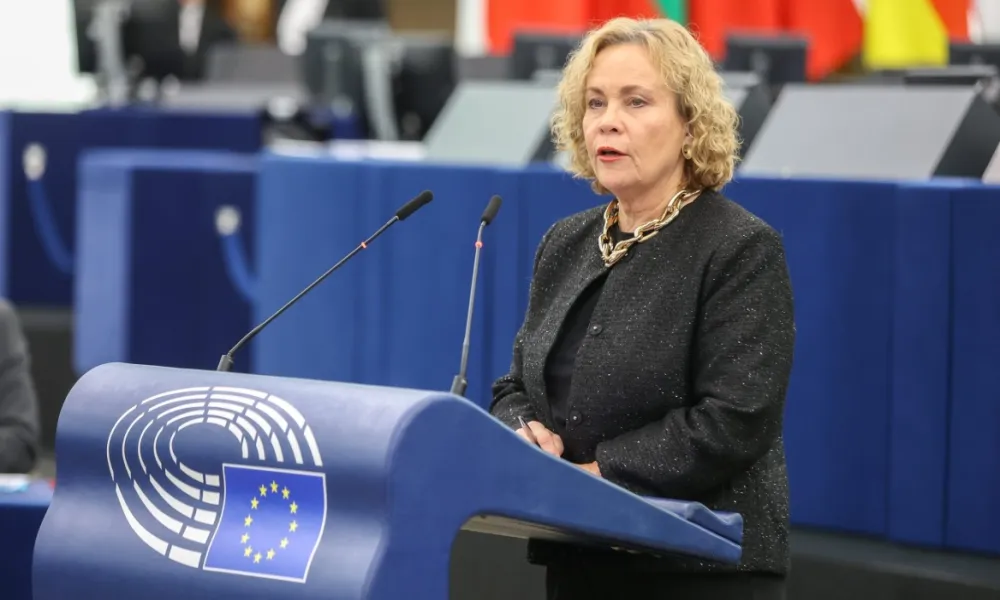

Hybrid threats affect the entire European Union, not only countries bordering Russia, Lithuanian MEP Rasa Juknevičienė told CNA, calling for a coordinated European response.
Juknevičienė, a member of the European People's Party and a former Lithuanian defence minister, served as rapporteur for a European Parliament report on hybrid warfare and the protection of the EU's territorial integrity and critical security and defence infrastructure. The report was approved during Parliament's September plenary session.
She said there could be no "100% preparedness" because both the conditions and the means used in hybrid operations are constantly evolving. As an example, she pointed to the war in Ukraine, where attention has shifted from "classic" battle tanks to drones, air defence systems and long-range weapons.
According to Juknevičienė, military officials in NATO countries have sent a clear message that "no capital in the EU is safe today". While the threat is more visible on the alliance's eastern flank, she said Russia possesses capabilities that can reach any European capital.
"This is not only about regional defence, it is about our common European defence," she said, linking the issue to the protection of critical infrastructure and EU sovereignty.
She said hybrid threats were increasing, while awareness of them was also growing.
Russian influence and disinformation
Referring to Cyprus, Juknevičienė said the European response should include scrutiny of Russian influence structures operating within the EU.
She made specific reference to the Russian Cultural Centre in Cyprus, noting that similar centres operate in European countries and cities.
Citing public assessments by Estonian intelligence services, she said such centres could be used by Russian intelligence agencies. Referring to their presence in EU member states, including Cyprus and Belgium, she questioned whether European countries were treating hybrid threats with sufficient seriousness.
Hybrid operations can include sabotage, arson attacks, disinformation campaigns, cyberattacks, signal jamming, drone incursions, the use of explosives and the recruitment of individuals inside European territory, she said.
Juknevičienė also highlighted the role of social media platforms, YouTube, bloggers and large numbers of fake accounts. According to her, these tools can be used by Russia to amplify social tensions, including around migration, and to influence public debate.
The MEP further said that some political forces in Europe reproduce narratives which, in her view, coincide with Kremlin positions, citing statements by Germany's AfD on Russia and support for Ukraine.
She argued that the EU must change the way it perceives the threat and develop both conventional and other response tools. Europe has significant strengths in cyberspace, she said, adding that the EU should respond more decisively to Russian actions and should not avoid reacting out of fear of escalation.
At the same time, she called on member-state governments to develop a common understanding of the threat environment. She described the current situation as a "grey-zone war", saying Russia seeks to operate below the threshold that could trigger NATO's Article 5 collective defence clause.
Hybrid activities, she added, may aim to instil fear in European societies, shift public opinion against Ukraine and interfere in member states' electoral processes.
Lithuania's experience
Speaking about Lithuania, the former defence minister referred to incidents involving meteorological balloons launched from Belarus, which were used mainly for cigarette smuggling. She said the incidents declined after Lithuanian authorities introduced countermeasures.
She also referred to migration pressures on the Lithuania-Belarus border since 2021, describing them as the organised instrumentalisation of migrants by Belarus and Russia. Lithuania responded, among other measures, by constructing a physical barrier along the border, reducing the flows, although the tactic could be used again.
The most serious concern, she said, is drones.
Citing information from Lithuanian authorities and intelligence services, she raised the possibility of "false flag" operations in which military equipment could be made to appear Ukrainian, complicating efforts to identify the source of an attack.
She added that security at Lithuania's liquefied natural gas terminal had been strengthened. She also referred to concerns over nuclear installations in neighbouring Belarus and the possibility that civil protection and security systems could be tested through incidents requiring evacuations.
According to Juknevičienė, better European coordination is needed so that incidents occurring in different countries are not examined solely as isolated events.
She cited signal-jamming incidents, military-related events, attempts to damage railway infrastructure, explosives and drone-related incidents in different countries as examples.
"The EU needs mechanisms to gather the overall picture and better coordination between member states," she said.
Georgia and the European path
As a member of the European Parliament's EU-Georgia Parliamentary Association Committee, Juknevičienė said Georgia's current political leadership is moving away from the European path, while Georgian society remains pro-European.
She referred to demonstrations, the imprisonment of opposition politicians and journalists, and related discussions in the European Parliament.
She linked developments in Georgia to Russian influence in the region and said the EU should continue supporting pro-European forces and civil society.
She added that Georgia's visa-free regime with the EU is linked to compliance with specific conditions.
Concluding, Juknevičienė argued that Europe needs a common strategy towards Russia.
According to her, the war in Ukraine is directly linked to Europe's future security and European support for Ukraine should continue.
Source: CNA