By Kenan Şener & Yusuf Kanlı
UN envoy María Ángela Holguín wants Cyprus’s two leaders to put an agreement on four new crossings and mine clearance in writing when they meet on Monday. She said progress on the package was essential to convening wider talks before UN Secretary-General António Guterres leaves office. Turkish Foreign Minister Hakan Fidan reaffirmed Ankara’s support for a two-state settlement on Friday. Well-placed political and diplomatic sources told ANKA Review that Türkiye could reconsider that position if it saw sufficient grounds and a need to do so.
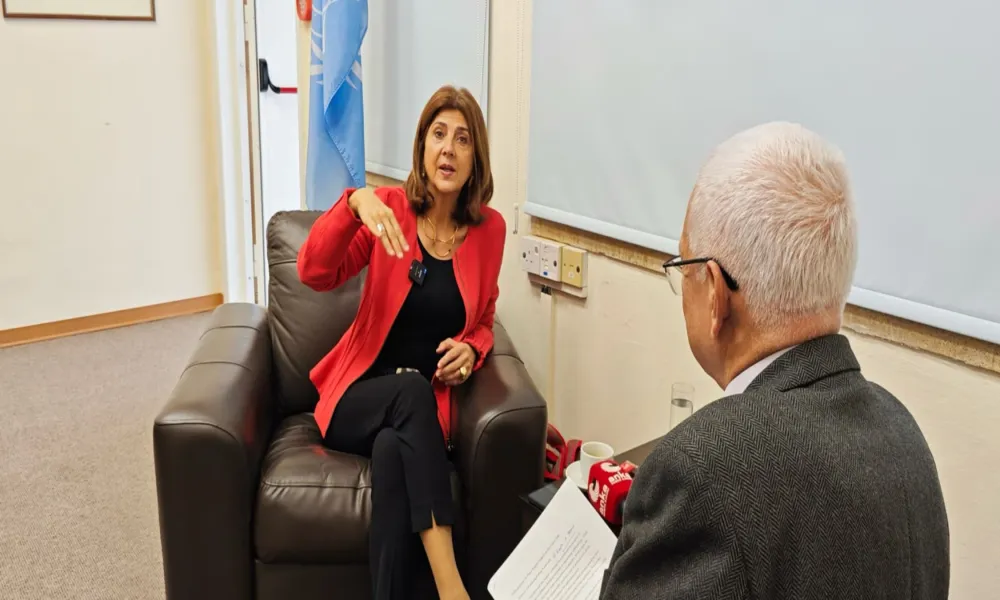
Holguín, the Secretary-General’s Personal Envoy for Cyprus, spoke to ANKA in the UN buffer zone on Friday as Fidan met Turkish Cypriot leader Tufan Erhürman at the Presidential Complex. She said her immediate aim was to secure a package that Erhürman and Greek Cypriot leader Nikos Christodoulides could agree on and put into effect.
“We will see on Monday,” Holguín said when asked whether the two sides would agree on crossings and demining. If the meeting produced no result, she said, that was what she would report to Guterres. “Bye-bye everybody,” she said, referring to the approaching end of her own mandate and Guterres’s term. “But if it’s still alive, we can … keep pushing until next year.”
Holguín said the leaders’ discussions had been productive and that the next step was to put the results in writing. The package was still being prepared, she said, and its final form depended on the leaders. Without progress on confidence-building measures, she said, there would be no 5+1 meeting before the end of the year. Guterres wanted the groundwork laid before bringing the two leaders and the three guarantor countries together.
Monday’s meeting and the two formats that could follow
On Monday, 9 November, Holguín is due to receive Erhürman and Nikos Christodoulides at the head of mission’s residence in the UN Protected Area. That meeting is about the confidence package. A later 2+1 would bring the two leaders together with Guterres. A 5+1 would bring in Türkiye, Greece and the United Kingdom alongside the two leaders, with the Secretary-General convening.
When ANKA put the sequence of a 2+1 followed by a 5+1 to Holguín, she replied, “Yes, this is the idea.” She said she would consult Guterres once she had a final package. He might prefer a three-way meeting first or decide to go straight to a wider meeting. “I don’t know the dates, I don’t know what he thinks,” she said, adding that Guterres had become more sceptical after July.
Holguín drew a distinction between the work under way and the opening of negotiations. Asked whether the process would continue or fail, she objected to the word fail, saying negotiations had yet to begin. “The start is in 5+1,” she said. The leaders still had work to do on the procedure and substance a wider meeting would take up.
Four routes and a first step towards a mine-free island
ANKA’s diplomatic reporting identified four routes in the proposed package. They are Haspolat - Mia Milia, Kiracıköy - Athienou, Gaziler - Pyroi, Eğlence - Aglantzia, Akıncılar - Louroujina, Limya -Lymbia, and Kambo- Kambos, Gemikonağı - Karavostasi. Holguín said she hoped that substituting Kambo for Erenköy (Kokkina) would help secure an agreement. The value of the crossings will depend on where people can enter and exit, who can use them and when they open. Those details determine how much time a new crossing will save people on journeys they make every day.
On mine clearance, the proposed first phase covers 70,000 square metres on each side near UN checkpoint No. 10 in the Derinya area. Asked about the Turkish Cypriot preference for a broader commitment to demining, Holguín said the goal remained “an island without mines” and that both sides were committed to it. She defended starting with equal areas while work continued on the wider question. “We have to start with something,” she said. “The perfect is the enemy of the good.”
The unresolved issue is how that first phase would lead to further clearance. The Greek Cypriot side wants the removal of anti-tank mines discussed under security. A written agreement could identify the first sites and set out who clears them and how the work is verified. That would give the sides a practical basis for discussing the next phase.
Phileleftheros reported that Christodoulides had responded positively to the package. He has also said the discussions cover the method and substance of renewed negotiations. Erhürman has objected to presenting measures already carried out as new and has highlighted proposals with a direct bearing on Turkish Cypriots, including citizenship for children of mixed marriages. A common text would show where the leaders’ priorities overlap and which commitments have dates attached.
Political will for practical steps has taken the process only so far
Holguín told ANKA that the leaders had shown political will on confidence-building measures. She had expected more by this stage. After a year and a half, or nearly two years, she said, she had hoped they would have “much more in common” on methodology, procedural steps and the framework for future negotiations. “Life is step-by-step,” she said.
The clearest example is political equality. Holguín said the sides had agreed on the principle on 11 December. She described a rotating presidency as part of political equality and said it could be understood as covered by that general agreement. Erhürman wants rotation named explicitly. When ANKA put to her the risk that political equality would remain an empty formula if its contents were left undefined, Holguín said those details had to be filled in “in a negotiation, not before the negotiation.”
She also explained why she thought it would be “very difficult” to ask Christodoulides to confirm rotation in advance. Her reference was Crans-Montana, where the rotating presidency and the question of troops became linked in the negotiations. In her reading, that experience still shapes Greek Cypriot calculations. It also helps explain Erhürman’s insistence on prior confirmation. If rotation remains implicit, the Turkish Cypriot side could find itself bargaining over an arrangement it regards as part of political equality. The argument is over which understandings the leaders carry into the room and which they leave open once they sit down.
Holguín sees the repeated return to past negotiations as a sign of the depth of mistrust. She told ANKA she was under no illusion that the sides would suddenly trust one another. She wanted them to consider ideas whose merits could be judged without replaying every previous dispute. Erhürman’s four points are themselves a response to those experiences. For him, the prospect of a fresh start depends in part on whether the next process preserves what was achieved in earlier rounds.
Fidan restates Ankara’s two-state position as sources point to room for a shift
The Turkish Cypriot presidency said Hakan Fidan and Tufan Erhürman met privately for 80 minutes. Fidan also met Prime Minister Ünal Üstel and Foreign Minister Tahsin Ertuğruloğlu. After the visit, he reaffirmed Türkiye’s support as a guarantor and reiterated Ankara’s view that two states living side by side offered the most realistic settlement.
Well-placed political and diplomatic sources familiar with the Cyprus file told ANKA Review that Türkiye could reconsider its two-state position if it saw sufficient reason and a need to do so. They said the policy took shape in the aftermath of the collapse of the Crans-Montana talks in 2017, an experience they described as traumatic for Ankara. In their assessment, any shift would depend on whether a new process offered credible grounds for reopening the question of a settlement. Fidan’s public remarks reaffirmed the policy Ankara holds today.
That distinction matters for the next round of diplomacy. Political equality under the UN framework concerns power-sharing and effective participation within a federation. The sovereign equality Ankara advocates concerns the standing and international status of two states. A deal on crossings and mine clearance can proceed while those positions remain apart. A 5+1 intended to launch formal negotiations would put the basis of those talks back before the leaders and guarantors. The sources’ assessment leaves open how Ankara might respond if the leaders can agree on a credible way forward.
Holguín told ANKA that Türkiye had “a very big role to play” if negotiations resumed and said the guarantor countries should back any agreement reached by the two Cypriot leaders. A written deal on Monday would give Erhürman and Christodoulides a basis for seeking the guarantors’ support for wider talks.
As this article was being written on Saturday, Erhürman received Türkiye’s Chief of the General Staff, Gen. Selçuk Bayraktaroğlu, at the Presidential Complex. Lt. Gen. Ertan İnaltekin, commander of the Turkish Cypriot Peace Forces, and Maj. Gen. Şükrü Bilir, commander of the Security Forces, also attended. The meeting followed Foreign Minister Hakan Fidan’s visit a day earlier. The back-to-back visits by Türkiye’s top diplomat and senior military officer signalled Ankara’s determination to stand behind the Turkish Cypriot side ahead of Monday’s meeting with Christodoulides and Holguín.
What would survive another breakdown?
Erhürman’s four points call for political equality, including rotation and effective participation, a time limit for negotiations, preservation of earlier convergences and safeguards against an automatic return to the status quo if talks fail through no fault of the Turkish Cypriot side.
Holguín pressed for specifics. What would Erhürman want to happen if the other side left the table? Which measures would take effect, and who would have the authority to deliver them? She said the leaders should prepare for those questions before a possible 2+1. “I don’t know if alone or together,” she said, but the work had to be done.
She raised trade, flights and contacts as examples of what Erhürman might prioritise. When ANKA suggested direct trade with the EU was the immediate priority, she replied, “We need in this equation the European Union.” She described the UN as a facilitator that could help the leaders consider options. The EU’s existing Green Line rules govern movement across the line. Direct trade with the EU would require a separate arrangement and decisions beyond the authority of the two leaders and the UN.
Varosha and the difference between a transfer and a permission
Holguín understood Christodoulides’s proposal on Varosha and Famagusta port as a response to Erhürman’s four points. She said placing Varosha under temporary UN administration could be irreversible. “I don’t know if Famagusta and direct trade is irreversible or not,” she added. When ANKA pointed out that a permission could be withdrawn, she agreed. The parties would have to decide whether the two sides were taking steps of comparable permanence.
Even agreement on the political terms would leave the question of who could administer Varosha and at what cost. “It’s not something small, it’s a city,” Holguín said. When reconstruction came up, she pointed to the resources needed simply to provide security. If the sides agreed, she said, the UN could go to the Security Council to seek funding.
Her experience of the Colombian peace process informs her objection to the rule that “nothing is agreed until everything is agreed.” She called it “a bad thing” and argued that some measures should take effect while negotiations are under way. A crossing with a defined route and opening date offers a straightforward test of that approach. Varosha would require agreement on administration, security and funding, as well as reciprocal measures whose durability both sides could assess.
What people would see change
Asked about citizenship and passport difficulties, Holguín referred to Guterres’s reply to a letter from Erhürman. Practices that erode confidence, she said, do little to create “the cooperation atmosphere that we need.” The process will also be judged by what happens to people whose daily lives are affected by unresolved disputes over documents or access.
Holguín spoke most warmly about the bicommunal technical committees and the young people working with them. She recalled an entrepreneurship event at Ledra Palace where some young Greek Cypriots shared a table with young Turkish Cypriots for the first time. An earlier gathering had drawn about 180 young people, she said. For her, the value lay in young people meeting and doing something together before the political dispute was settled.
She applied the same logic to emergencies. Work is under way on an arrangement that would allow a faster joint response to fires and other disasters. When an emergency breaks out, she said, the two sides should be able to act without “15 calls.” She described the crime committee as a practical channel for cooperation under present conditions, while saying the ideal would be direct work between the two police forces.
The political calendar is tightening
Holguín told ANKA that recurring election campaigns complicate the Cyprus process. In the north, the 6 December elections will shape the political environment in which Erhürman conducts any talks. The CTP under Sıla Usar İncirli has put an independent anti-corruption authority and greater transparency in public procurement on its public agenda. Household costs, public services and relations with Ankara will also occupy the next administration.
The regional calendar carries its own risks. Reuters reported on 6 November that Greece had completed licensing procedures for survey and cable work on the Great Sea Interconnector. The project remains caught up in Greek–Turkish differences over maritime jurisdiction. If the cable dispute intensifies, two of the governments whose support Holguín seeks for a 5+1 would also be managing a confrontation at sea.
An agreement on Monday that names the crossings, identifies the mine clearance areas and assigns responsibility for the work would give Holguín something specific to take to Guterres. Before convening a 5+1, the Secretary-General would still have to assess whether the leaders have done enough work on political equality, the rules of the talks and the consequences of another breakdown to make the meeting worth holding.