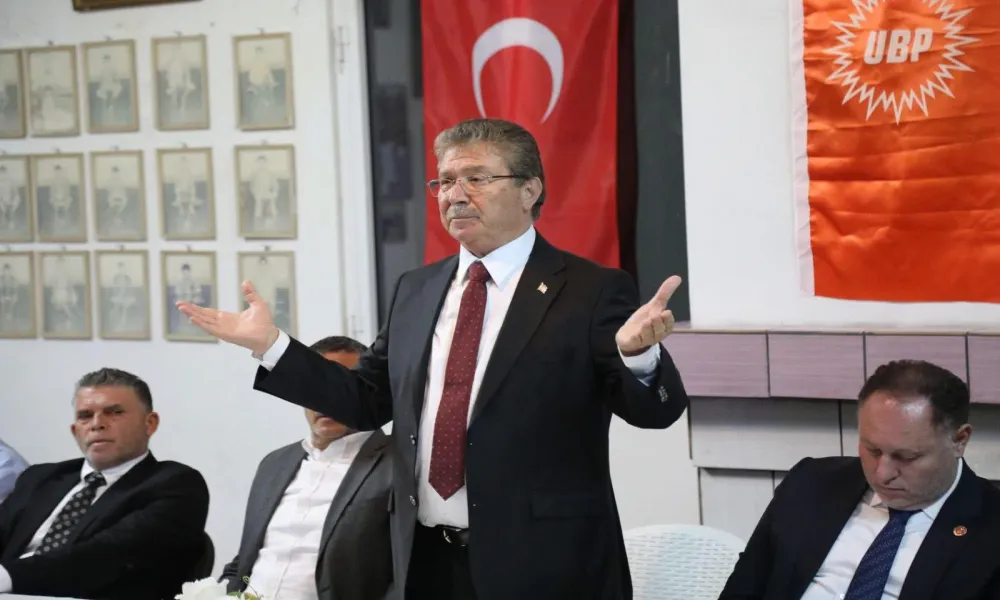
Turkish Cypriot "prime minister" Ünal Üstel has announced plans for a new arrangement granting 49-year usage rights over properties in the occupied north, including assets allocated to Turkish Cypriots after 1974, many of which belong to displaced Greek Cypriots.
According to Üstel, the proposed regulation would allow beneficiaries to transfer those rights to their heirs and use them as collateral for bank loans.
Speaking during an interview on a television programme in the north, Üstel presented the initiative as an attempt to address unresolved issues relating to properties allocated following the Turkish invasion.
He said the proposal was developed after approximately one year of consultations with organisations representing displaced Turkish Cypriots and legal experts.
Üstel also claimed the measure would not affect the operation of the so-called Immovable Property Commission.
The proposal covers both residential properties and land parcels and, according to Üstel, was submitted to the "attorney-general's" office on 3 June for legal review. No opinion has yet been issued.
Under the proposed legislation, users would receive rights over properties for a period of 49 years, with those rights capable of being inherited and used as security for borrowing.
The proposal raises significant questions regarding the rights of lawful property owners, as the granting of long-term usage rights, inheritance rights and the ability to leverage properties for loans could add further complexity to the already sensitive property issue.
"The cable from Turkey is being built"
Üstel also spoke extensively about energy projects, claiming that construction is under way on a submarine electricity cable designed to transfer power from Turkey to the north.
He said feasibility studies had been completed and claimed that Turkish President Recep Tayyip Erdoğan had instructed officials to proceed with the project.
According to Üstel, the interconnection cable is expected to be completed within approximately 18 months.
He attributed delays to objections from the Republic of Cyprus, claiming that because Turkey is connected to the European electricity grid, international approvals are required.
Plans for natural gas
Üstel further claimed that work had begun on plans to transport natural gas from Turkey to the north through a submarine pipeline.
According to his remarks, a protocol has already been signed with Ankara and studies are under way to determine the route of the pipeline.
He alleged that the Republic of Cyprus is attempting to block the project through international interventions.
At the same time, he announced plans for two natural gas-fired power stations, each with a capacity of 150 megawatts.
Referring to the so-called KIB-TEK electricity authority, Üstel claimed its "administration" had invested around $200 million in energy infrastructure and that seven mobile generators supplied by Turkey had already been integrated into the system.
Planning based on a population of 490,000
Üstel also made notable references to the population of the north.
He said government planning is based on an estimated population of 490,000, although he did not present data from a new census.
According to Üstel, population registration will be conducted through a digital address system, which he argued removes the need for a traditional census.
He also outlined a plan to invest approximately $100 million in a fibre-optic network, with the project expected to be completed within a year.
Promise of 15,000 homes
The Turkish Cypriot leader also unveiled a series of pre-election pledges, including the construction of 15,000 homes, of which 5,000 would be allocated to young people.
Additional proposals include:
- Tax exemptions for young people purchasing electronic devices and vehicles.
- A subsidy covering 50% of nursery and childcare costs for working mothers.
- Financial support for non-working mothers.
- Changes to cost-of-living allowance arrangements so that lower-paid workers receive greater support than higher earners.
Üstel said he was confident that the National Unity Party (UBP) would finish first in the 6 December "elections" and form the next "administration," presenting the announcements as part of his programme for the next five years.