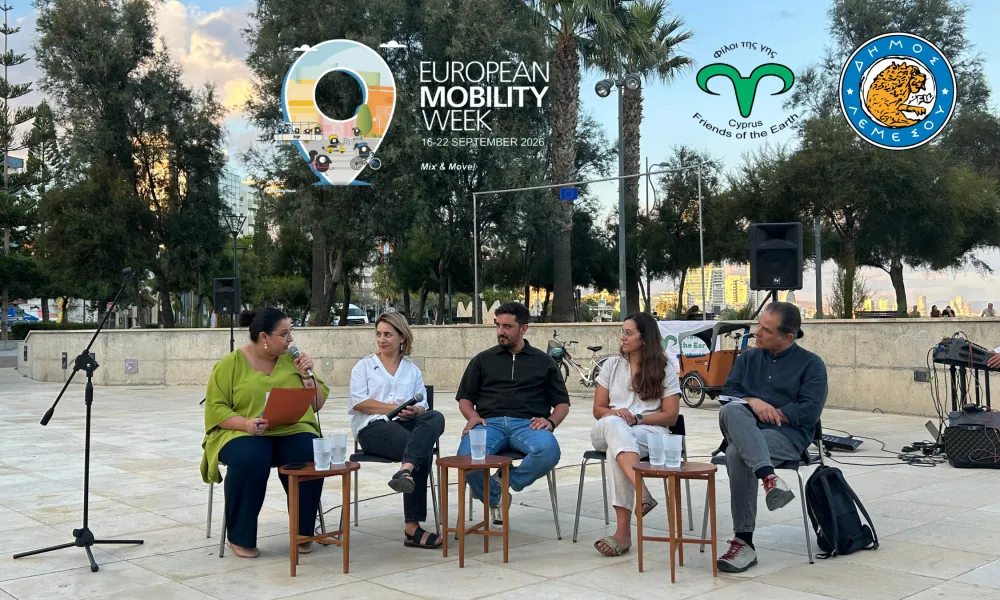

Fragmented policymaking, a state quick to back down in the face of objections and a framework of rules that places the burden on the most vulnerable road users are keeping Cyprus tied to the car. That was the shared conclusion of academics, civil society representatives and micromobility users at a public discussion in Limassol.
The discussion, titled "Creating an Inclusive City", took place on 18 September at the Molos amphitheatre. It was co-organised by Friends of the Earth Cyprus and Limassol municipality as part of European Mobility Week 2026. Its starting point was a single figure: 92% of journeys in Limassol are made by car. The speakers were Dr Paris Nikolaou, a lecturer at the Cyprus University of Technology (TEPAK), where he heads its transport engineering lab; Socrates Stratis, architect, urban planner and professor in the Department of Architecture at the University of Cyprus; Anastasia Korai, vice-president of Friends of the Earth Cyprus; and Dr Vasiliki Yiatrou, a Limassol resident who gets around the city every day by cargo bike with her child.
Culture as an excuse
Nikolaou rejected the argument that Cypriots do not cycle because of their culture. Decision-makers, he said, use culture as an excuse instead of designing shaded cycle lanes and a unified network of bus lanes. "I would say our problem is political culture," he said. "I have seen people in high positions tell me that Cyprus's problem is infrastructure, that it needs more roads, flyovers. And to see this from people who make decisions. That is political culture."
He cited the northern section of Makariou Avenue in Nicosia as an example. Residents were presented with a single, unified plan, but the works were carried out piecemeal, so they failed to deliver what the study had promised. As long as the mindset remains car-oriented, he said, every isolated measure will fail and breed public distrust. The same applies to the bus lanes, which, as far as he knows, were not designed in consultation with the company that operates the buses.
The Limassol bollards
The most recent example discussed was the orange bollards on Limassol's new cycle lanes, which drew objections from residents and drivers. Korai said Friends of the Earth had asked the Transport Ministry in writing for the plans and a visualisation of the project, but received nothing. "Residents woke up one day and saw thousands of orange bollards outside their doors. They had no idea, they didn't expect it," she said.
Beyond the lack of information, she also criticised the quality of the intervention. In a project with European funding, she said, one would expect permanent infrastructure, such as a pavement extension, rather than a rubber strip that can easily be pulled out. She called for better cooperation between the ministry and the municipality, so that neither shifts responsibility onto the other and the public knows the plan in advance.
Nikolaou described the episode as a symptom of an absence of policy. "When people come out and then we, as the state, come along and withdraw our measure, the bollards come out, it gives a foothold to those making the noise: you're right," he said. He pointed to Stockholm, where a congestion charge was piloted in 2006. Public opinion was initially opposed, but after traffic fell by around 20%, residents asked for the measure to stay. "If we have a vision and a plan that is right, we must persist with it and people will see the result," he said.
Twenty-one offences for e-scooters
Korai argued that the legislation treats micromobility with hostility. E-scooter users face 21 offences carrying fines, she said, yet the rules are not communicated to the users themselves, most of whom are foreigners. "We see an attempt to regulate the issue by placing the blame on users, rather than through proven road safety measures," she said. Those measures, in her view, include expanding 30 km/h zones in cities, banning the import of e-scooters that exceed 25 km/h and requiring the registration and insurance of vehicles that go beyond the speed limit.
By cargo bike through Limassol
Yiatrou lived for years in Germany, where, she said, one in two families gets around by cargo bike. When the family decided to return to Cyprus two years ago, she gave her husband a condition: either the bike came with them or they would not move. The advantages, she said, are that she can stop wherever she likes, never has to look for parking and sees Limassol through different eyes. The drawbacks are exhaust fumes, the lack of shade and, above all, safety. Many cycle lanes, she said, do not even have a ramp to get onto them. "I often wonder whether the person who designed them has ever ridden a bike in Limassol," she said. On one of her routes, 80% was cycle lane. The remaining 20%, a few missing metres here and there, made it difficult.
The public response, however, is positive. Passers-by stop her to ask where she got it. "I once happened to hear a grandmother shouting to me from the sea: I want one too," she said. She noted that the Republic of Cyprus used to offer a subsidy for the purchase of cargo bikes, alongside electric cars.
An unequal city
Stratis described a city developing at two different paces, where growth comes with deep social injustice. As an example, he cited the cabinet's decision to grant additional building density on Limassol's seafront. Those millions, he said, could have funded a cycle lane or electric buses for every primary school. He also referred to an exercise by his lab at the University of Cyprus, prompted by the debate over whether Makariou Avenue in Nicosia should reopen to cars. They calculated that one shopping mall is equivalent to one and a half Makariou avenues. With two malls, Nicosia effectively has three "Makariou avenues" outside the centre, competing with the real one. Makariou's problem, he concluded, is not car access.
Yiatrou also dwelt on the social dimension. In her view, the obstacle lies neither with the upper nor the lower classes but with the middle class, which fears what people will say if they see it travelling by bicycle or by anything other than a car.
Low-cost solutions
Asked for a low-cost intervention that could be applied in many neighbourhoods at once, Stratis proposed lowering the speed limit on neighbourhood streets to 20 km/h. Cars sharing the road with other modes, he said, builds a culture of respect towards anyone who travels differently. He also suggested mapping the catchment areas of primary schools to show how many minutes a child needs to walk to school, and creating safe routes with volunteer parents accompanying children every morning. It is, he said, a measure with zero financial cost but a high political one.
Korai proposed removing parking spaces from school yards and turning them back into playgrounds, open at weekends. "We see school streets abroad, and here we turn school yards into car parks," she said. For Nikolaou, the one measure for the next five years would be a unified network of bus lanes. "Even if I don't see a result in five years. I will see a result in the long term," he said.
The role of universities and citizens
Stratis argued that the academic community works more effectively with local government than with central government, and that research should draw on practice to produce knowledge. He cited the analysis of thousands of public comments on the new Heroes' Square. "Only through examples can citizens be convinced that things can be done," he said. Korai described the role of civil society: cycling lessons, for example for women with a migrant background, lessons on the rules of the road, information on what a future intervention will look like, and workshops and consultations with local residents.
Asked what we would see on Limassol's streets if, in five years, the city had taken a decisive step, Nikolaou replied that with the current way of working nothing would change. If the will is there, however, people will embrace it, as they showed with the linear parks. Yiatrou disagrees with the pessimism. "I came two years ago and I already see a big change in Limassol," she said.