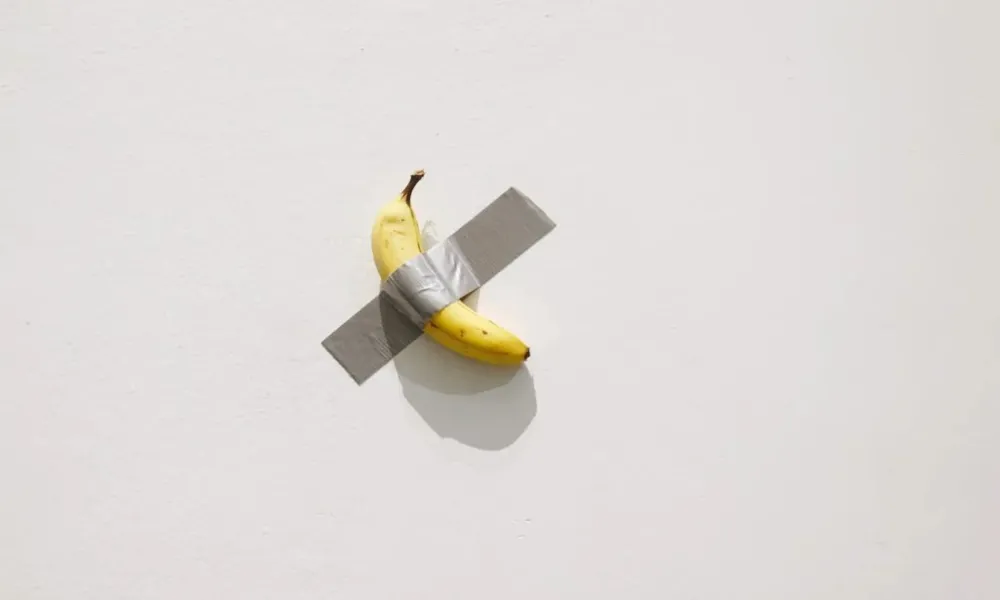

When Maurizio Cattelan unveiled Comedian at Art Basel Miami Beach in December 2019, the ingredients could hardly have been simpler: a banana, silver duct tape and a wall.
Yet the work quickly became one of contemporary art’s most recognisable and controversial images.
Two editions initially sold for $120,000 each, while a third fetched $150,000. Buyers were not purchasing a particular piece of fruit, which naturally had to be replaced, but a certificate of authenticity and instructions specifying how the work should be displayed.
Within days, Comedian had become a viral phenomenon, generating memes, ridicule and heated arguments over what constitutes art.
Its market value subsequently climbed dramatically. In 2024, one edition sold at auction for $6.24m, reigniting arguments over the extraordinary sums paid for conceptual art.
Controversy as an artistic tool
Cattelan’s success with Comedian fits into a much older tradition in which artists have used controversy to attract attention and challenge accepted ideas.
Provocation is hardly new to art. Caravaggio disturbed contemporary audiences with the violence, sexuality and darkness of his religious paintings, while later artists including JMW Turner, Manet, Monet and Cézanne faced ridicule for approaches now considered revolutionary.
Cattelan, however, often uses provocation differently. His work tends to rely on instantly recognisable images and dark humour rather than difficult artistic theory.
Among his best-known works are La Nona Ora, depicting Pope John Paul II struck by a meteorite, and Him, which presents a kneeling childlike figure with the face of Adolf Hitler.
His satire frequently takes aim at powerful institutions, including the art world itself.
The joke is partly on the art market
In A Perfect Day in 1999, Cattelan used duct tape to attach his Milan art dealer, Massimo De Carlo, to a gallery wall.
Twenty years later, Comedian used the same unmistakable silver tape.
The connection suggests that the banana was not simply intended as an absurd object. It also functioned as a joke about the values, spectacle and enormous prices surrounding events such as Art Basel Miami Beach.
In that sense, Comedian behaves almost like an art-world one-liner: the more people argue about whether it deserves attention, the more successful the joke becomes.
Why a banana?
The banana itself also comes with substantial artistic baggage.
Artists including Giorgio de Chirico, Andy Warhol and the Guerrilla Girls have previously incorporated bananas into their work.
But Comedian can be traced even further back through the history of art.
Food has appeared in still-life painting for centuries, often serving as a reminder of mortality and the fleeting nature of physical existence. Cattelan’s banana takes that idea literally: rather than painting a piece of fruit that will survive indefinitely on canvas, he displays an actual banana that will inevitably rot and need replacing.
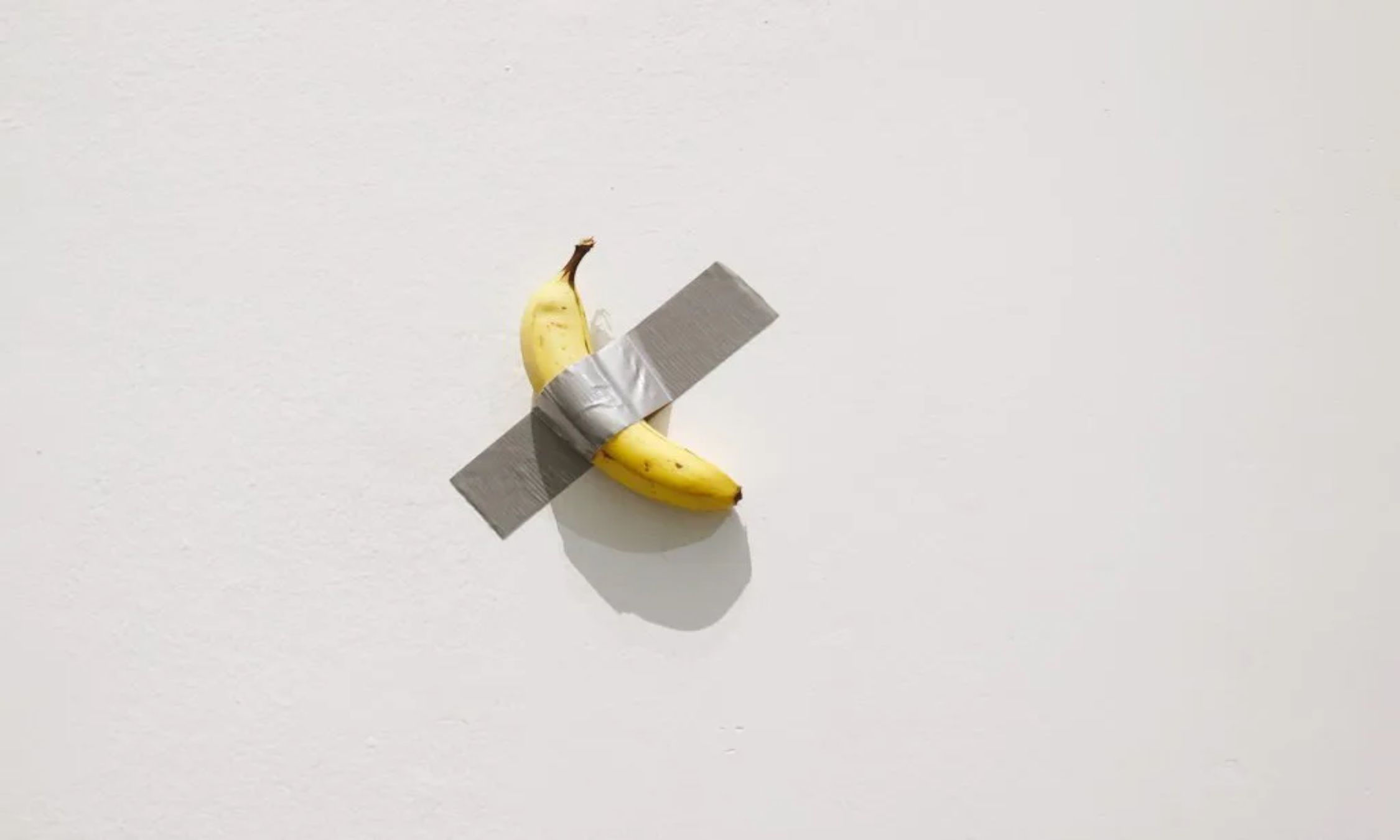
The seemingly radical gesture is therefore connected to a tradition stretching back hundreds of years.
Even the ‘real object as art’ idea is old
Cattelan was not the first artist to take an ordinary object and declare it art either.
More than a century before Comedian, Marcel Duchamp transformed ideas about artistic authorship through his “readymades”, presenting manufactured objects including a bottle rack, bicycle wheel and, most famously, a urinal as artworks.
Duchamp challenged audiences to consider whether an object could become art simply because an artist selected it and placed it in an artistic context.
Comedian plays with essentially the same question, only with a banana that must periodically be replaced.
Nothing quite as radical as it looks
The genius, or irritation, of Comedian may ultimately lie in how efficiently Cattelan combined existing artistic strategies.
Its ingredients include satire, controversy, familiar imagery, still-life traditions and the century-old concept of the readymade.
By 2019, Cattelan was already an experienced provocateur who understood how to turn an apparently ridiculous gesture into an international conversation.
For all the outrage surrounding the banana and its multimillion-dollar price, the work’s strangest secret may therefore be that very little about it is genuinely unprecedented.
Its ability to provoke, however, remains remarkably effective.
Cattelan’s work is also the subject of NIGHT, an exhibition that opened at Berlin’s Neue Nationalgalerie on 10 September 2026.
Source: BBC