The issue of civil marriage for same-sex couples in Cyprus was effectively resolved through the introduction of civil cohabitation agreements. This legal mechanism has been predominantly utilized by different-sex couples, who account for over 90 per cent of its usage—out of 5,000 cohabitation agreements signed, approximately 400 involve same-sex couples. Consequently, same-sex partners share identical statutory rights to different-sex couples, including survivors' pensions.
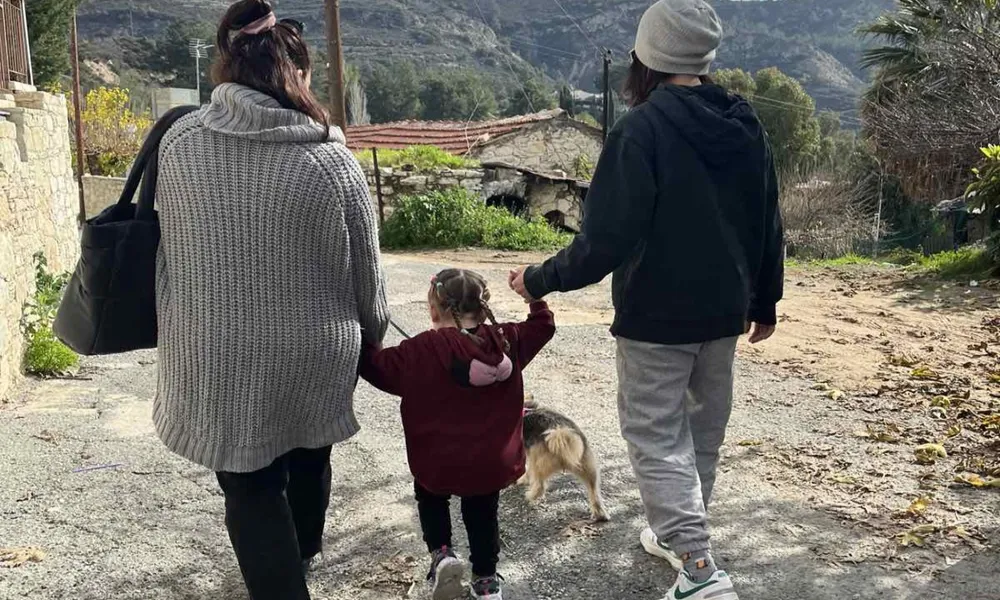
However, the question of legal adoption and parental recognition remains entirely unresolved, frequently exploited by conservative political elements to mobilize voters during election campaigns. Despite ideological rhetoric, same-sex parenting is an existing social reality on the island, with 50 children currently raised in families structured around two mothers or two fathers. These children currently lack basic institutional protection, leaving them and their parents legally vulnerable.
Closed doors to formal adoption
To mark the International Day Against Homophobia, Transphobia, and Biphobia on 17 May, Politis spoke with Elena Efstathiou, the vice-president of Accept-LGBT Cyprus and co-founder of the "Rainbow Families Cyprus" community. Efstathiou and her wife have been together for 14 years and decided seven years ago to explore paths toward expanding their family.
Efstathiou noted that their initial efforts focused on standard adoption, but they found every administrative door firmly closed. They subsequently investigated foster care, where they encountered semi-closed institutional reactions and complex procedural risks. Efforts to adopt internationally yielded identical results, forcing the couple to consider alternative reproductive methods.
Following consultation with their gynecologist, the couple opted for assisted reproduction via an anonymous donor, leading to a successful pregnancy. Efstathiou noted that while many same-sex couples harbor extensive apprehensions prior to embarking on this path, they chose to focus strictly on building their family.
The legal vulnerability of the non-biological parent
A primary source of anxiety for prospective same-sex parents is the complete absence of legal status for the non-biological parent. Efstathiou acknowledged this concern as entirely valid, pointing out that in the event of a relationship breakdown, the non-biological mother possesses zero statutory rights to maintain contact with the child—a vulnerability that biological parents in different-sex divorces cannot easily exploit because their parental rights are legally codified.
"In our case, it has never crossed my wife's mind that I would ever attempt to deprive her of our daughter, and as the biological mother, I would consider that profoundly unjust. However, for couples still discussing whether to have a child, the fact that the non-biological parent is not legally recognized as a parent remains a massive deterrent." — Elena Efstathiou, Vice-President of Accept-LGBT Cyprus
This lack of institutional recognition impacts multiple facets of daily life. Prospective parents worry that their children will be denied equal inheritance and social welfare rights compared to children of different-sex couples, or face discrimination when non-biological parents interact with state departments and public services. Many fear their children will face targeted bullying at school due to their parents' sexual orientation.
Widespread social acceptance versus systemic inertia
Despite these pre-parenting anxieties, Efstathiou emphasized that their actual experience within Cypriot society has been characterized by complete social acceptance. The family has encountered zero discrimination or social barriers from gynecologists, pediatricians, child psychologists, or everyday citizens in public spaces.
The obstacles remain exclusively systemic. On the child's official birth certificate, Efstathiou's name is recorded under the maternal field, while the paternal field remains entirely blank. This institutional gap creates recurring friction at domestic border checkpoints. Cypriot airport authorities routinely demand a signed father's travel authorization certificate when Efstathiou travels alone with her daughter—a protocol that never occurs at international airports.
When enrolling her daughter in public primary school, Efstathiou provided her personal data and uploaded the birth certificate to satisfy the paternal information fields, choosing to calmly explain the situation to administrators rather than engage in conflict. Over four years of nursery education, the family encountered no institutional friction, becoming fully integrated members of the school community.
The demand for legislative modernization
For Efstathiou, the core problem lies strictly within the state apparatus and the denial of human rights. She noted that conservative political factions frequently evoke the ideal of the "traditional Cypriot family" to oppose legislative updates, a concept she considers outdated.
"What traditional family are they referring to? The one my grandmother experienced 50 years ago? I was cooking for myself at six years old because my mother had to work. No one can challenge the values and the love we provide to our child. My sole concern is for the House of Representatives to modernize our laws and administrative practices for human rights reasons. That is what Accept Cyprus is demanding: formal legal anchoring." — Elena Efstathiou, Vice-President of Accept-LGBT Cyprus
The primary anxiety shared by all same-sex parents in Cyprus centers on child guardianship in the event of a tragedy. Under current laws, if the biological mother passes away, the non-biological mother has no automatic legal right to custody, leaving the child's future dependent on whether extended family members support a custody petition. To mitigate this risk, most same-sex couples draft comprehensive legal wills and ensure non-biological parents enroll the children into private life insurance policies to establish financial safety nets.
Diverse family structures and regional data
Efstathiou argued that the state's refusal to regulate same-sex parenting devalues diverse family structures, including foster families, adoptive households, and single-parent families. She noted that her household functions identically to any classic Cypriot family, participating in traditional Easter baking, family beach outings, and weekend gatherings with grandparents who fully support the relationship.
According to data compiled by Accept-LGBT Cyprus, there are currently approximately 50 same-sex couples with children living on the island, with additional couples currently navigating reproductive procedures.
Among these 50 households, six involve male same-sex couples. Efstathiou pointed out that gay men face significantly higher structural barriers to parenthood. Since domestic adoption is legally prohibited and surrogacy regulations exclude same-sex male couples, these individuals are forced to pursue exceptionally expensive gestational surrogacy pathways abroad. She concluded that if the state granted same-sex couples the statutory right to adopt domestically, the number of children currently residing in state-run care homes would decrease dramatically.
Source: Politis Newspaper