One week before the legislative elections scheduled for next Sunday, the Cypriot political scene has entered its most volatile phase in fifteen years. The volume of the uncommitted vote remains remarkably high, encompassing roughly one in five voters.
According to the latest Noverna poll conducted on behalf of Politis between 1 to 12 May 2026, 19.4 per cent of respondents declare themselves undecided or intend to abstain, while an additional 2.5 per cent declined to answer.
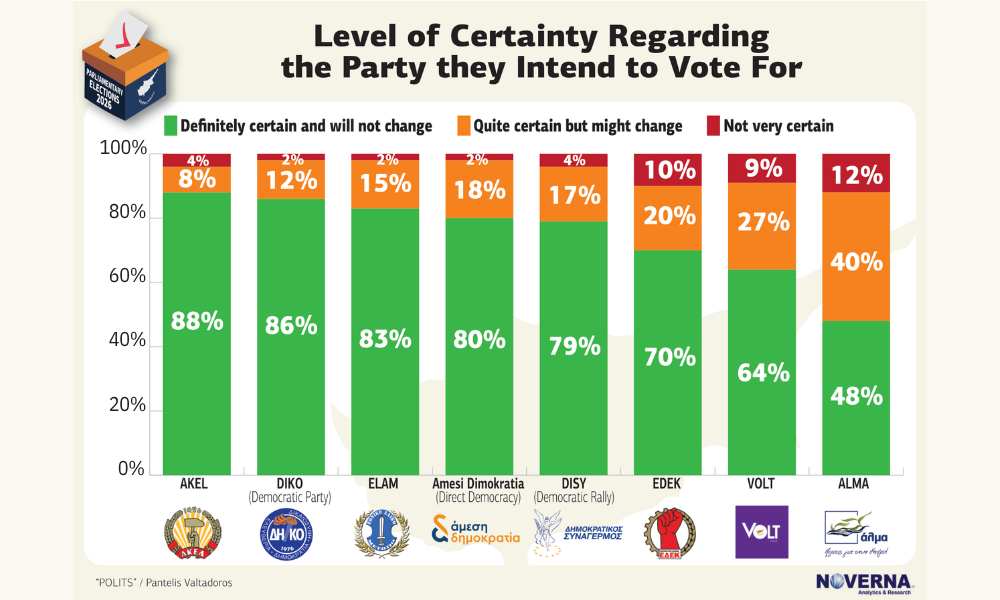
Data consistently points to substantial losses for the traditional political establishment alongside an unprecedented fragmentation of the electoral map. New political formations, most notably the ALMA party led by former Auditor-General Odysseas Michaelides and the Direct Democracy movement spearheaded by Fidias Panayiotou, are fundamentally altering the strategic balance for DISY, AKEL, and DIKO.
Political establishment versus an alienated electorate
The defining characteristic of this campaign period is that the major established parties are not merely competing against each other; they are engaged in a battle for survival against a highly frustrated electorate. Public discourse has shifted away from an exclusive focus on the Cyprus problem or macroeconomic policy to center heavily on institutional corruption, the crisis of governance credibility, and a widespread desire to penalize the traditional political class.
For the leadership of DISY, AKEL, and DIKO, the primary operational challenge stems from the fact that the protest vote is no longer channeled solely toward the right-wing ELAM party. Instead, public dissatisfaction is being captured by two entirely distinct political vectors: the anti-corruption, litigious platform of Odysseas Michaelides and the apolitical, digital communication style of Fidias Panayiotou. Concurrently, the moderate progressive party Volt is drawing support from pro-European, socially liberal voters across the center-right and center-left spectrums.
DISY: The struggle for the top position
For the Democratic Rally (DISY), the central strategic goal is to secure first place with a clear margin over the second-placed AKEL. Party leader and Speaker of the House Annita Demetriou recognizes that a victory, even by a narrow margin, is essential to present a political reset following the party's defeat in the 2023 presidential elections and subsequent internal friction. Any other result will inevitably reignite debates surrounding the current leadership and strategic direction.
DISY faces severe challenges in unifying its highly fragmented traditional base, which spans moderate centrists, urban liberals, traditional conservatives, and hard-line nationalists. The party's adopted stance of "constructive opposition"—balancing selective critique of the administration with legislative cooperation—has frequently blurred its core political messaging. While a segment of traditional supporters is considering abstention or shifting toward ELAM, ALMA, Direct Democracy, or Volt, recent polling indicates a late trend of dissatisfied voters returning to the party core as the election approaches.
In this final phase, DISY will continue to push the classic polarizing dilemma of "DISY or AKEL," framing a vote for the right-wing establishment as a guarantee of economic stability versus a return to past financial crises. The party leadership also responded rapidly to recent signals from the Presidency regarding potential developments in the Cyprus problem, asserting total readiness for a UN-led initiative before the end of the year in an effort to retain traditional pro-settlement conservative voters.
AKEL: Mobilization without expansion
On the left of the spectrum, AKEL displays a higher level of internal mobilization. General Secretary Stefanos Stefanou is capitalising on government wear-and-tear and public anger over inflation, energy costs, property foreclosures, and housing shortages to position the party as the primary opposition force. However, despite remaining outside executive government for 13 years during a period marked by major institutional scandals, AKEL has struggled to expand its electoral reach beyond its traditional core.
While the party easily rallies its base, it faces a structural barrier to growth. Left-wing protest voters rarely cross over to ELAM, but younger, more apolitical demographics are increasingly indifferent to classic ideological rhetoric, turning instead toward alternative platforms like Direct Democracy, Volt, and ALMA. Over the final week of the campaign, AKEL will focus its ground game on targeted socio-economic issues, including standard of living disparities, energy pricing, labor rights, and the taxation of windfall banking profits.
DIKO: Caught in the centrist squeeze
The Democratic Party (DIKO) occupies the most precarious position among the traditional factions. Having historically operated as the kingmaker of Cypriot politics with the ability to forge coalitions across the political spectrum, DIKO is currently facing intense pressure from all sides. It is leaking centrist voters to ALMA, conservative elements to ELAM, and younger voters to Direct Democracy.
Earlier polling placed DIKO's support within single-digit percentages, threatening a significant loss of parliamentary seats and putting senior party figures at risk of failing to secure re-election. Although the party has recorded a slight upward trend in recent days, accompanied by the return of former prominent members such as Angelos Votsis, its vulnerability remains high.
This environment explains the intensified political attacks directed at Odysseas Michaelides. ALMA is viewed by the establishment not merely as a new competitor, but as a direct existential threat to the traditional political center. The former Auditor-General possesses a distinct advantage by framing himself as the sole uncompromising opponent of systemic corruption—a narrative reinforced by his high-profile dismissal from office. His platform appeals simultaneously to disaffected right-wing, centrist, and left-wing voters. DIKO intends to spend the final days of the campaign highlighting positive economic indicators and social welfare measures while escalating its political offensive against its former ally.
Five strategic motives behind the campaign against ALMA
The coordinated counter-offensive launched by DISY, AKEL, and DIKO against ALMA and Michaelides is driven by five distinct political calculation factors:
- Multi-dimensional electoral drain: Unlike ELAM, which traditionally draws votes almost exclusively from the right, ALMA is successfully absorbing support across multiple traditional party spectrums simultaneously, making its electoral impact far more unpredictable.
- Exploitation of moral capital: Michaelides has successfully institutionalised his public image as an independent adversary of political patronage. Traditional parties struggle to counter this anti-establishment reputation using standard partisan polemics.
- Disruption of the post-independence consensus: For decades, the Cypriot political framework relied on predictable shifts within the established party system. ALMA fractures this geometry by offering an alternative that allows voters to abandon traditional parties without aligning with the far right.
- The 2028 presidential factor: Traditional factions fear that a strong legislative performance will position Michaelides as a major independent contender for the 2028 presidential elections, threatening the long-term status of DISY and AKEL as the primary pillars of executive power.
- Preventative delegitimisation: Established parties are attempting to frame the new movement as a populist, volatile force driven by personal grievances rather than structural policy, hoping to check its momentum before it builds a permanent institutional base.
While this strategy has partially slowed ALMA's upward trajectory in recent polling, excessive aggression from the establishment carries a risk of backfiring, potentially reinforcing Michaelides' public image as a reformer targeted by the political status quo.
The digital alternative and the presidential perspective
Operating on an entirely different plane, Fidias Panayiotou's Direct Democracy movement bypasses conventional ideological debates completely. The movement relies on social media culture and unconventional digital communication platforms like TikTok to engage younger demographics who hold no traditional party loyalties. Rather than drawing heavily from the active core of traditional parties, Direct Democracy absorbs unaligned voters and individuals who previously opted for abstention, effectively cutting off the established parties from replenishing their aging electoral bases.
Concurrently, the breakdown of historical voting pathways represents a fundamental development in this cycle. The traditional linear movement of voters between DISY and DIKO, or DIKO and EDEK, has largely collapsed. Voters are actively stepping outside the conventional party boundaries, shifting from traditional conservative or centrist alignments toward completely separate political entities.
The Presidential Palace is monitoring these dynamics closely. While the erosion of the centrist parties that backed the current administration raises long-term concerns regarding legislative stability, a weakened DISY and a highly fragmented opposition offer distinct short-term tactical advantages to President Nikos Christodoulides. The executive branch appears to favor a balanced outcome where no single political force emerges strong enough to dictate terms or establish an early, dominant platform for the 2028 presidential race. For the presidency, a highly fragmented parliament lacking a clear majority remains the most manageable institutional scenario.
Ultimately, the results of the upcoming vote will reveal whether the movement toward new political formations represents a temporary protest phase or a permanent structural break from the traditional party model that has dominated the Republic of Cyprus for decades.
Source: Politis Newspaper