
The Eastern Mediterranean is at a critical juncture, balancing immense economic potential with pressing challenges that threaten its stability and prosperity.
A new report, "6 Facts About the Eastern Mediterranean," produced by Alma Economics, sheds light on the region’s interconnected dynamics, emphasizing the need for cooperation, inclusion, and bold investments in people and systems.
The East Med Report identifies six key areas shaping the region’s future: trade and connectivity, energy security, gender equality, education and human capital, water scarcity, and social inclusion. Each of these areas presents both opportunities and challenges that require urgent attention.
To explore these findings, the Mediterranean Growth Initiative, Friedrich-Ebert-Stiftung Cyprus Office, and PRIO Cyprus Centre are hosting a webinar series, in a bid to foster dialogue and collaboration across the region, addressing the six critical areas and exploring pathways to resilience, stability, and prosperity. The first webinar on water scarcity will take place this Wednesday, February 11, 2026 at 4-5 pm (Nicosia time), offering a platform for experts to discuss sustainable solutions to one of the region’s most pressing challenges (Registration via office.cyprus@fes.de).
Dr. Fadi Comair will discuss the choices that face politicians and policy makers in addressing chronic water scarcity which is fueling conflict risks and migration; and how to turn water resilience into a strategic priority.
Before the discussions begin, the three organisers shared with Politis to the point their perspectives on the report and the region. Together, they underline that the Eastern Mediterranean’s future will not be determined by geography alone but by the choices made today. Their webinars seek to translate data and analysis into actionable dialogue, setting the stage for regional cooperation and sustainable resilience.
Cleopatra Kitti – Mediterranean Growth Initiative (MGI)
Cleopatra Kitti, founder of MGI, emphasised that the region’s future depends on interconnectivity. “For over a decade, we have tracked and benchmarked trade and socio-economic data across the Mediterranean,” she said. “The region, home to 500 million people and accounting for 10% of global GDP, remains strikingly fragmented: just one quarter of its trade is intra-regional, making it the least connected in the world.”
Kitti noted that while the Mediterranean serves as Europe’s frontline to Africa and Africa’s gateway to Europe, much of this strategic potential remains untapped. Sub-regionally, the Eastern Mediterranean is the least interconnected compared with the Central and Western Mediterranean, where industrial and energy networks link countries across borders. For growth to prevail, she argued, conditions for capital investment and cross-border governance must be strengthened.
“Political will is one part of the equation, rigorous, evidence-based analysis and governance frameworks are the other,” Kitti said.
Harry Tzimitras – PRIO Cyprus Centre
Harry Tzimitras, Director of PRIO Cyprus Centre, explained that the Mediterranean is a region where rivalry and opportunity coexist uniquely. “With its vast energy resources, critical trade routes, and abundant human capital, the Mediterranean holds immense potential, provided cooperation can be fostered,” he said.
Tzimitras highlighted that the challenges and opportunities extend beyond narrow geographic boundaries, requiring concerted action across climate, energy, migration, and security.
“Environmental problems do not recognise political boundaries, and energy reserves span multiple countries. Attempting to address these issues in fragmented ways is ineffective,” he added.
For Tzimitras, viewing the Mediterranean as a unified space of shared challenges and opportunities is essential for realistic and holistic solutions.
Dr Hubert Faustmann – FES Office Cyprus
Professor Hubert Faustmann, Director of FES Cyprus, described the foundation’s Regional Peace and Security Project, which aims to support the development of an inclusive regional security architecture.
“The aim is to initiate constructive dialogues in various formats, bringing together policymakers, researchers, and professionals from diverse backgrounds,” Faustmann said.
He stressed that the region lacks institutions that engage all actors inclusively, and that the political reality is marked by rivalries and mistrust. Through the webinar series “Six Facts, One Future: The Eastern Mediterranean”, FES aims to promote dialogue, raise awareness, and include perspectives from the widest possible range of countries, including Cyprus.
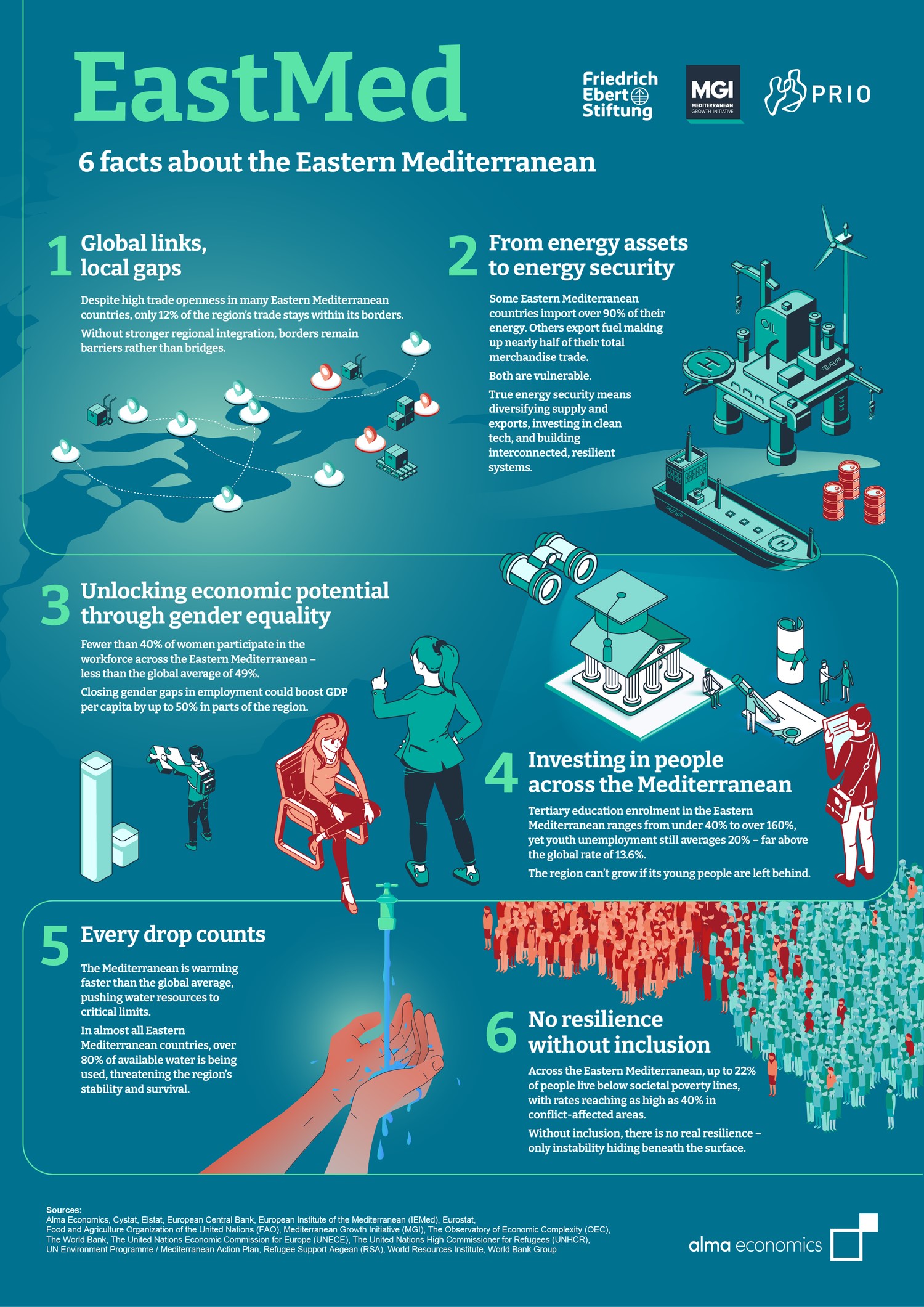
6 Facts About the Eastern Mediterranean
Trade and Connectivity: Borders as Barriers
The Eastern Mediterranean is a region of high trade openness, with countries like Cyprus, Lebanon, and Greece boasting trade-to-GDP ratios of 193%, 115%, and 92%, respectively. However, only 12% of the region’s trade stays within its borders, highlighting limited regional integration.
The report notes that this fragmentation is not due to tariffs but rather logistical, institutional, and political barriers. " Without stronger regional integration, borders remain barriers rather than bridges," the report states.
Investing in smart logistics and regional coordination is essential to unlock the region’s trade potential. Modernized ports like Piraeus in Greece and Ashdod in Israel are steps in the right direction, but broader logistical challenges must be addressed to fully boost regional trade.
Energy Security: A Green Path Forward
The Eastern Mediterranean is a strategic crossroads for global energy flows, serving as both a transit corridor and a potential supplier. However, the region faces a sharp divide between energy exporters and importers, exposing countries to vulnerabilities.
Fuel exports account for a significant share of merchandise trade in Cyprus (49%) and Greece (32%), while energy import dependence remains high in countries like Cyprus (117%) and Lebanon (97%). "True energy security means diversifying supply and exports, investing in clean tech, and building interconnected, resilient systems," the report emphasises.
A study by Alma Economics in Cyprus found that greater energy interconnectivity could reduce electricity bills by €200 per consumer annually, while boosting long-term resilience and sustainability.
Gender Equality: Unlocking Economic Potential
Gender inequality remains a structural economic constraint in the Eastern Mediterranean. Female labor force participation in the region averaged just 37% in 2023, compared to a global average of 49%. Women also face higher unemployment rates (13.5% vs. 7.3% for men) and earn less, with gender pay gaps of 13.6% in Greece and 12.2% in Cyprus.
"Gender equality isn’t a side issue. It’s a core strategy for economic resilience and regional competitiveness," the report states. Closing gender employment gaps in countries like Lebanon could raise GDP per capita by around 50%.
Education and Human Capital: Bridging the Gap
Education is a critical driver of economic resilience, yet the Eastern Mediterranean faces deep structural challenges in its education systems. While tertiary education enrolment averaged 85% in 2022, youth unemployment remains alarmingly high at 20%, far above the global average of 13.6%.
"Education enrolment does not guarantee employability," the report warns, citing mismatched skills, limited vocational pathways, and unequal access to digital tools as key barriers. Public investment in education remains below 5% of GDP across the region, despite evidence that consistent spending improves outcomes.
region’s most pressing challenges.
Water Scarcity: Every Drop Counts
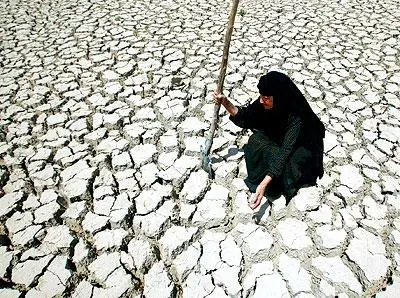
The Mediterranean is warming 20% faster than the global average, with regional temperatures projected to rise 1.5 to 2 degrees Celsius for every 1-degree increase worldwide. This accelerated warming is putting severe pressure on freshwater resources, with countries like Cyprus, Lebanon, Israel, Egypt, Greece, and Syria classified as extremely water-stressed.
"Securing sustainable water access is crucial – it is the foundation of stability, equity, and survival across the 21st-century Mediterranean," the report states.
Desalination offers a lifeline in some areas, but it comes with high energy costs and environmental concerns. The upcoming webinar will explore sustainable solutions to address this critical issue.
Social Inclusion: No Resilience Without Equity
Despite advances in education and infrastructure, deep social divides persist across the Eastern Mediterranean. Poverty headcount ratios range from 10% in Cyprus to 40% in Syria, while income inequality remains high, with Turkey’s Gini coefficient at 44.
Migrants and refugees face even greater challenges, with over 5 million displaced persons hosted in the region. Many lack access to financial assistance, social protections, and employment opportunities. " Without inclusion, there is no real resilience – only instability hiding beneath the surface," the report warns.