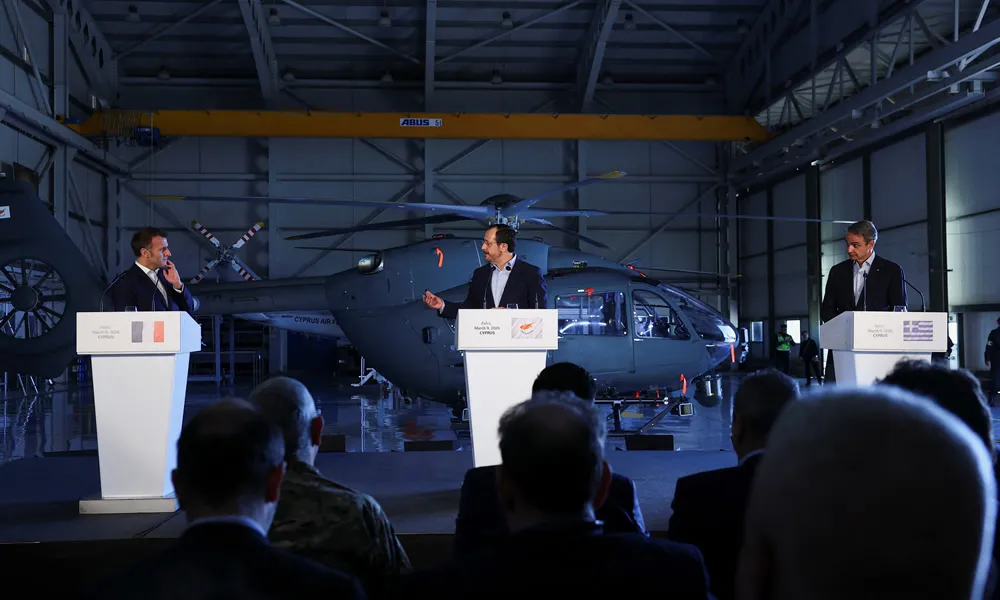
A senior government official has suggested that the ongoing crisis in the region, combined with the solidarity shown to Cyprus following a drone attack on the British bases, could be the springboard on which a discussion is held to establish a clear mechanism for responding to the EU’s mutual defence clause.
The relevant Article 42(7) of the Treaty on European Union (TEU) says:
“If a Member State is the victim of armed aggression on its territory, the other Member States shall have towards it an obligation of aid and assistance by all the means in their power, in accordance with Article 51 of the United Nations Charter. This shall not prejudice the specific character of the security and defence policy of certain Member States.
Commitments and cooperation in this area shall be consistent with commitments under the North Atlantic Treaty Organisation, which, for those States which are members of it, remains the foundation of their collective defence and the forum for its implementation.”
Solidarity in practice
The Cypriot government did not trigger the mutual defence clause, likely because the drone strike was technically an attack on the British bases on the island, and not the Cyprus Republic. However, EU partners responded swiftly to Cyprus’ call for protective measures to be taken against further attacks, particularly given that 11,000 Cypriot citizens live on the British bases. Significant bilateral support was given through the deployment of naval and air defence system assets.
The government source told CNA that the response and speed of action by EU partners were considered very positive, and seen as a tangible act of solidarity.
According to the source, although Article 42(7) was not activated, it would be useful to start discussions and preparatory work to define a mechanism for the mutual defence clause, within which EU partners could have ready-made responses for specific needs of member states.
The same source said the European Commission President Ursula von der Leyen – who played a decisive role in the solidarity shown at the early stages of the crisis – responded very positively to the idea.
EU to help out with FMD in north
Following President Nikos Christodoulides’ meeting with Von der Leyen in Brussels on Wednesday, the source also spoke of steps the Commission will take towards Turkey and the Turkish Cypriot community to implement what has been agreed to tackle foot-and-mouth disease (FMD).
These steps must be implemented to prevent the re-emergence of FMD, said the source, given that the data shows Turkey has the highest rate of increase in cases of the virus.
The measures will not concern state aid, but co-financing from the European Commission, in order to address all stages of the disease – from vaccination to the culling of infected herds, as well as the reactivation of the sector.
Source: CNA