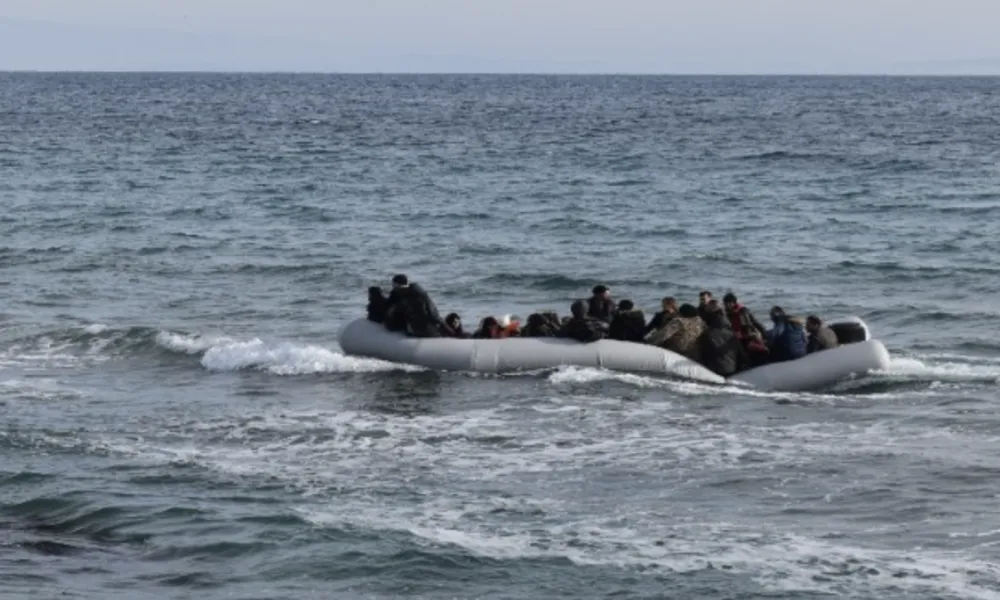


At least 655 migrants died or went missing in the Mediterranean between January and February 2026, more than double the 287 recorded during the same period last year.
The figure marks a record for the first two months of the year since the International Organization for Migration (IOM) began keeping data in 2014.
Central Mediterranean remains deadliest route
Between January 15 and 25 alone, the IOM recorded 104 deaths across three shipwrecks in the central Mediterranean, the world’s most lethal migration route, particularly between Libya and Tunisia.
Frontex attributed the rise in fatalities partly to extreme weather conditions, including Storm Hari, which hit the Mediterranean basin.
Fewer crossings but greater danger
The European Border and Coast Guard Agency (Frontex) noted that irregular border crossings have halved during this period, while condemning criminal smuggling networks that send migrants to sea in unsafe vessels.
However, researchers say the decline in crossings is directly linked to the increase in deaths.
Arnaud Banos, a researcher at France’s National Centre for Scientific Research (CNRS), explained that intensified efforts to prevent departures are creating conditions that favour smugglers.
“The more pressure we apply to stop departures, the more we create ideal conditions for traffickers,” he said, noting that migrants are increasingly forced into dangerous journeys, often in poor winter weather.
Routes shift as controls tighten
Agreements between Italy, Tunisia and Libya aimed at reducing migration flows have led smuggling networks to shift departure points, from Tripoli towards Misrata in Libya or northern Tunisia, often targeting routes towards Sardinia.
These routes are longer and more exposed to strong winds and currents, while also being less visible to rescue teams.
At the same time, the Balkan route, the only land corridor into Europe from the south, is now “almost entirely closed”, leaving the sea as the primary option.
NGOs criticise rescue restrictions
Non-governmental organisations have also criticised increasing obstacles to maritime rescue operations, citing stricter procedures and new disembarkation rules imposed by states.
Sea-Watch spokesperson Giulia Messmer said Italian authorities require NGO vessels to disembark rescued individuals immediately, often at ports located more than 1,000 kilometres away.
“This can force us to ignore other distress calls, which is clearly unlawful,” she said.
The German NGO is calling for a broad European search-and-rescue programme and has criticised the outsourcing of operations to Libyan militias, which it says have fired on vessels in distress.
Limited legal pathways increase risks
NGOs argue that the lack of legal entry routes into Europe is another factor pushing migrants to take dangerous journeys.
Germany, which received around one million refugees in 2015, has since tightened rules on family reunification and citizenship. The United Kingdom has also ended student visa schemes for nationals from countries including Afghanistan, Cameroon, Sudan and Myanmar.
Anthropologist Filippo Furi said smuggling networks operate where demand exists.
“What Frontex does not say is that these networks function because living conditions in countries of origin or transit are dire, and there are no legal ways to reach Europe,” he said.
A cycle of increasing risk
Researchers warn that current policies risk creating a cycle in which attempts to secure borders lead to greater dangers for migrants.
“The more we say we want to secure borders for humanitarian reasons, the more we increase the risk. It becomes a vicious circle,” Banos added.
Source: CNA / AFP