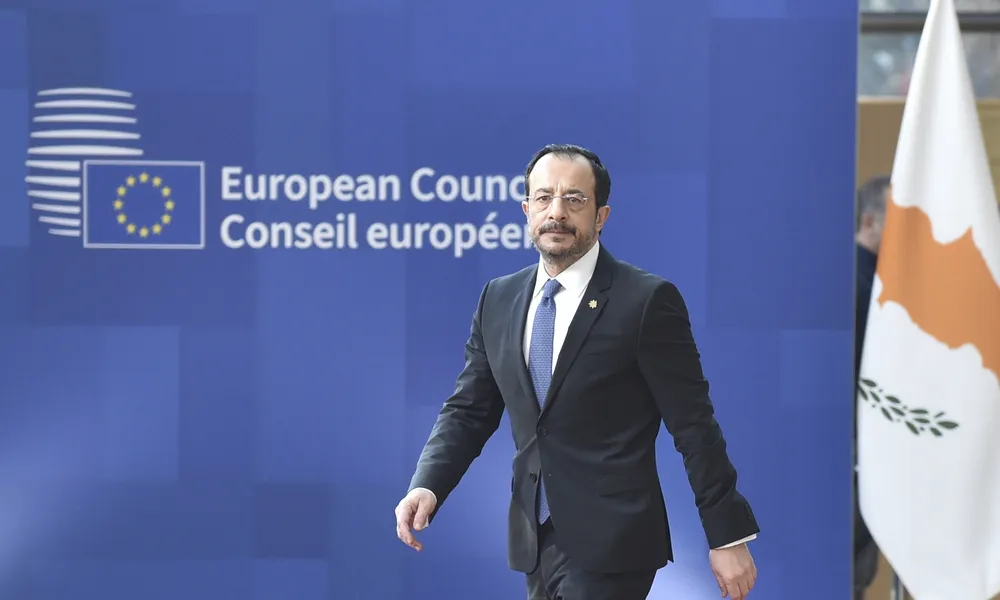

The President of the Republic, Nikos Christodoulides, publicly diverged from EU High Representative Kaja Kallas ahead of the European Council, disputing her position that the war in the Middle East is not Europe’s war. His intervention comes amid heightened regional tensions following a drone attack on the British base in Akrotiri and calls by Cyprus for European support.
Diverging positions on Europe’s role
Speaking after the Foreign Affairs Council on Monday, Kaja Kallas stressed that while the conflict has direct consequences for Europe, it should not be framed as a European war.
“This is not Europe’s war, but Europe’s interests are directly at stake,” she said, underlining that the EU’s priority remains de-escalation and the protection of its citizens.
Kallas pointed to the broader impact of the conflict, including disruptions to global energy markets and security risks linked to the Strait of Hormuz, while confirming that more than 30,000 people have been evacuated from the region with EU support.
Christodoulides rejects interpretation
Arriving at the European Council, President Christodoulides took a different position, emphasising that developments in the Middle East directly affect the European Union and cannot be viewed as external.
“It is important through the discussion to send two very clear messages. First, that the EU is genuinely concerned about the situation in the Middle East. I disagree with references that it is not something that concerns the EU,” he said.
He linked the conflict directly to European economic stability, noting that rising energy costs driven by regional instability are already impacting EU competitiveness.
Security and energy concerns linked
Christodoulides identified competitiveness and the Middle East as two of the central issues on the European Council agenda, alongside Ukraine.
“The situation in the Middle East, and its impact on rising energy costs, also affects the competitiveness of the European Union,” he stated.
He added that discussions on competitiveness are expected to include concrete timelines and deliverables from the European Commission, building on recent EU actions in defence and security.
Broader EU discussions ongoing
At the Foreign Affairs Council, ministers also addressed Ukraine, sanctions on Russia, and the broader geopolitical impact of the Middle East conflict. Kallas reiterated that while the EU seeks to avoid escalation, its strategic, economic and security interests are increasingly affected.
The contrast in messaging highlights an emerging debate within the EU on how to define its role amid overlapping crises, particularly as regional conflicts carry direct implications for European security and economic stability.