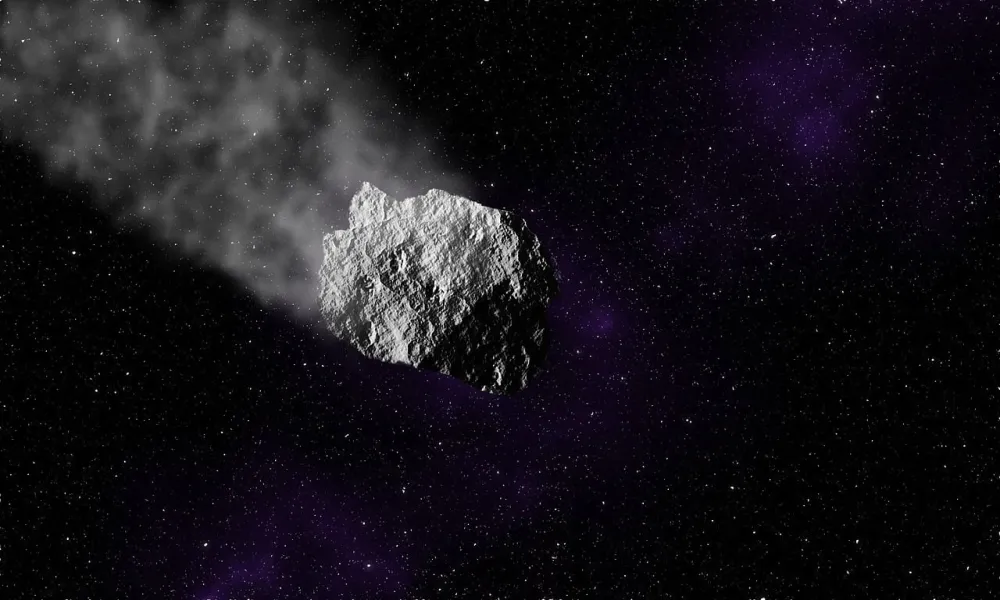

A large asteroid is on course for a rare and exceptionally close flyby of Earth in 2029, in what scientists describe as a once-in-a-generation event.
The asteroid, known as Apophis, has been classified by NASA as a “potentially hazardous asteroid” due to its size and proximity to Earth’s orbit. However, experts stress there is no risk of collision with the planet for at least the next 100 years.
A rare close approach
Apophis is expected to pass Earth on 13 April 2029 at a distance of around 32,000 kilometres from the planet’s surface. This will bring it closer than many orbiting satellites and make it visible to the naked eye from parts of the Eastern Hemisphere.
According to NASA, such a close approach by an asteroid of this size is extremely rare. Measuring at least 450 metres in length, Apophis is comparable in height to the Eiffel Tower.
Scientists say this will be the closest known flyby of an object of this scale that has been predicted in advance.
International observation effort
The European Space Agency plans to send a spacecraft to observe the asteroid during its passage, while NASA has redirected its OSIRIS-APEX mission to track Apophis more closely.
Researchers expect the encounter to provide valuable data on asteroid composition, structure and orbital behaviour.
A relic from the early solar system
Apophis is believed to be a remnant from the formation of the solar system around 4.6 billion years ago. It likely originated in the asteroid belt between Mars and Jupiter before its orbit gradually shifted.
Over millions of years, gravitational interactions, particularly with Jupiter, altered its trajectory, bringing it into a path that now crosses closer to Earth.
NASA says the 2029 flyby will offer a unique opportunity for humanity to observe such an event with modern technology, something that may never have occurred before in recorded history.
Source: protothema.gr