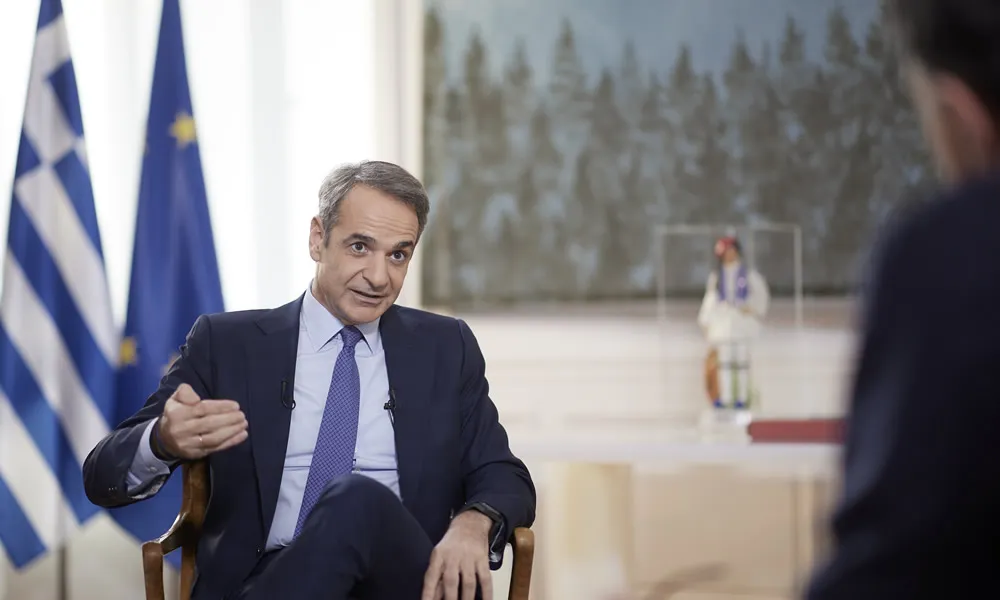

Following the announcement of restrictions on social media use for children under 15, Greek Prime Minister Kyriakos Mitsotakis sent a letter on Wednesday to European Commission President Ursula von der Leyen, calling for a unified European framework by the end of 2026 to complement national measures aimed at protecting minors from digital addiction.
Greece is among the first countries to take such an initiative, Mitsotakis noted earlier on Wednesday, adding that the goal is also to encourage the European Union to move in the same direction.
In his letter to the Commission president, the prime minister outlines specific proposals, including expanding the European pilot programme for age verification and making the standardised mechanism mandatory for all platforms serving users under the age of 15. He also proposes the establishment of a European “digital age of adulthood” at 15, the obligation for platforms to repeat age verification every six months, and the creation of a simplified coordination and enforcement mechanism at EU level.
“These indicative initiatives are only part of a broader European strategy, as we address this issue not simply as a matter of policy but as a moral responsibility towards the next generation,” Mitsotakis writes in the letter, which reads in full:
“Dear Ursula,
I am writing to you regarding an issue of intergenerational responsibility that requires collective action at the European level; an issue that I know resonates deeply with you not only in your capacity as President of the European Commission, but also as a mother: the protection of minors from digital addiction.
Today Greece announced its intention to introduce national legislation establishing a minimum age for access to social media, with entry into force on 1 January 2027.
However, national action alone is not enough. A unified European framework is required by the end of 2026, which will complement and strengthen the necessary national initiatives for the protection of minors.
We agree that Europe must choose its regulatory battles carefully. I am convinced that this is one of them. What is required now is a coordinated and rapid response.
Under your leadership, we have advanced the European Strategy for a Better Internet for Children (BIK+), with a focus on safer digital experiences and user empowerment, while the Digital Services Act (DSA) — our flagship legislation — has introduced stronger accountability and transparency requirements for Very Large Online Platforms.
Although these initiatives represent a global benchmark, further action is necessary.
Given that national action alone is not sufficient, I would like to propose:
• The expansion of the European age-verification pilot into a fully harmonised, pan-European framework, ensuring uniform implementation across all member states by the end of the year.
• The mandatory use of this standardised age-verification mechanism for all platforms serving users under the age of 15, eliminating regulatory fragmentation.
• The establishment of a European “digital age of adulthood” at 15, introducing a pan-European ban on social media access for users below that threshold.
• The obligation for platforms to conduct repeated age verification every six months, ensuring continuous compliance and preventing the circumvention of restrictions.
• The creation of a simplified coordination and enforcement mechanism at EU level, enabling member states and the European Commission to jointly assess incidents and accelerate the imposition of sanctions on companies that fail to comply.
Our national initiative can serve as a model for this broader European solution.
“KidsWallet” is an innovative state-issued application that allows parents to set clear limits on the use of apps, while establishing a secure and reliable age-verification process, ensuring that children are exposed only to content appropriate for their age.
It is already interoperable with the European age-verification mechanism.
These indicative initiatives form only part of a wider European strategy, as we treat this issue not merely as a matter of policy but as a moral responsibility towards the next generation.
I hope you find value in the above proposals and remain at your disposal for a more detailed exchange of views.
Yours sincerely,
Kyriakos Mitsotakis”
Mitsotakis announces social media ban for children under 15
In a video posted on social media, Prime Minister Kyriakos Mitsotakis officially announced a ban on access to social media for children under the age of 15.
According to the prime minister, the regulation will be submitted to parliament during the summer of 2026 and will come into force on 1 January 2027.
“Greece will be among the first countries to take such an initiative,” Mitsotakis said, adding that the aim is to encourage the European Union to move in the same direction.
The video begins with the well-known viral meme phrase “Six-seven”.
“Six-seven… Now that I have your attention, hello kids. This video will not be #top or #viral, but there is a serious reason why I want to tell you something from here,” the prime minister says in the introduction.
He continues by explaining the need for restrictions on social media use for minors under 15.
“I want to speak to you honestly. In recent years I have spoken with many parents and they all tell me roughly the same thing: that their child does not sleep well, becomes anxious easily, and is constantly on their phone.
“But I also speak with many of you. Many children tell me they feel tired from comparisons, from comments, from the pressure to always be there.
“The science is clear: when a child spends hours in front of a screen, the brain does not rest.
“That is why we decided to move forward with something difficult but necessary: to ban access to social media for children under 15.
“The regulation will come this summer and will take effect on 1 January 2027.
“Greece will be among the first countries to take such an initiative. And I am sure it will not be the last.
“Our goal is to encourage the EU to move in the same direction.”
The prime minister acknowledged that younger audiences might react negatively.
“Now I am sure that many younger people will be angry with me. If I were your age, I might feel the same,” he said.
“But our role, including my own, is not always to be pleasant. Even if you disagree today, I simply ask you to think about it and discuss it with your friends.
“If something makes us feel more anxious, worse, or less good than we really are, then perhaps it is worth putting a brake on it.”
He stressed that the objective is not to distance children from technology.
“Our goal is not to remove you from technology, which can be a source of inspiration, knowledge and creativity.
“But the addictive design of some applications, and the profit model based on your attention and the amount of time you spend in front of your phone screen — which also takes away your innocence and freedom — must stop somewhere.”
The video concludes with Mitsotakis addressing parents.
“And I want to say something to parents: no law can replace your presence. This policy is simply a tool to help you.
“I sincerely believe that in a few years we will all see this as something positive and self-evident.”
A joint press conference presenting the details of the new framework was held shortly after 13:00 on Wednesday at the Ministry of Digital Governance by Health Minister Adonis Georgiadis, Digital Governance and Artificial Intelligence Minister Dimitris Papastergiou, and Minister of State Akis Skertsos.
Earlier, during the presentation of the National Strategy for the Protection of Minors from Internet Addiction, the prime minister noted that a universal ban on social media for children cannot be the only solution.
“The problem is clear and has to do with the excessive dependence, the addiction of children and teenagers to the internet, to specific applications, which children usually use on their phones,” he said.
“It is the image of children glued to a mobile phone, almost like zombies, losing contact with the world.
“We discover along the way that many children and teenagers develop serious psychological problems — different for girls and different for boys.
“Depression, isolation, attention deficit — this is the most common experience teachers report to us.”
“We understand that something problematic is happening here, linked to the dark side of technology,” he added before referring to possible interventions.
“So what interventions are possible? A universal ban on social media may be one solution, but I doubt it would be effective.
“That is why the strategy we are developing is much more adapted to the real way children and teenagers use social media.”
Source: Protagon.gr