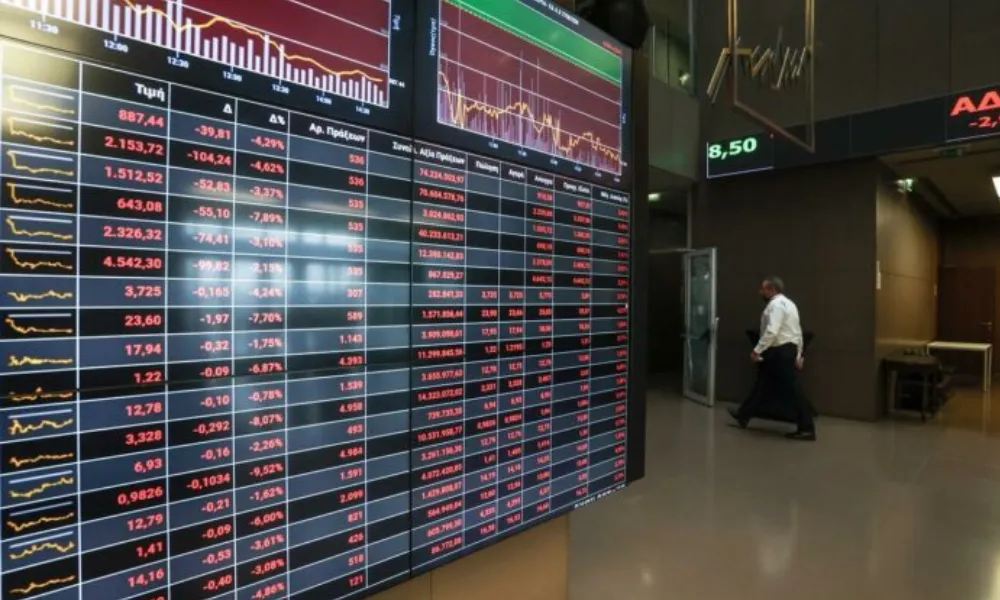
Global stock markets fell sharply on Monday as oil and natural gas prices surged, driven by concerns over energy supply from the Middle East as the war between the United States and Israel against Iran entered its second week with no sign of de-escalation.
Investors, already uneasy about high technology sector valuations and heavy spending on artificial intelligence, moved away from riskier assets as crude oil climbed to its highest level since Russia’s invasion of Ukraine in 2022.
European markets fall
European stock markets declined as the latest surge in energy prices intensified fears that supply disruptions caused by the conflict in the Middle East could fuel inflation.
In early trading, the Frankfurt and Paris stock exchanges fell by more than 2.5 percent, while London dropped 1.8 percent.
At the same time, global oil prices jumped around 15 percent, while European natural gas prices surged by up to 30 percent.
Oil prices approach 120 dollars
Both major oil benchmarks rose sharply after Iran carried out retaliatory actions against Gulf countries producing crude oil.
The West Texas Intermediate (WTI) and Brent benchmarks climbed close to 120 dollars per barrel, marking gains of roughly 30 percent during the latest market surge.
Since the start of the war, WTI has risen by more than 75 percent and Brent by over 60 percent, although prices eased slightly following reports that the Group of Seven (G7) finance ministers may consider using emergency reserves to stabilise supply.
French officials confirmed reports in the Financial Times that the issue would be discussed among G7 members.
Energy infrastructure under pressure
Reports of attacks on oil fields in southern Iraq and the autonomous Kurdish region of northern Iraq forced a US-operated oil field to halt production.
At the same time, the United Arab Emirates and Kuwait have begun reducing production, further tightening supply.
The situation has been worsened by disruptions to shipping through the Strait of Hormuz, a vital maritime route through which around one fifth of the world’s crude oil passes.
Inflation fears return
The prospect of persistently high energy prices has raised fears of a renewed surge in global inflation, potentially limiting the ability of central banks to lower interest rates to support economic growth.
Global stock markets extended losses recorded last week, though some indices later recovered part of their earlier declines.
Markets fall across Asia and beyond
Asian markets were particularly hard hit.
Seoul, which had been among the best-performing markets this year due to a technology rally, fell by more than 8 percent during trading before closing down 6 percent.
Tokyo dropped more than 5 percent, while Taipei fell by over 4 percent.
Sharp declines were also recorded in Hong Kong, Shanghai, Sydney, Singapore, Manila, Bangkok, Mumbai, Jakarta and Wellington.
Futures for the three major Wall Street indices fell by more than 1 percent, while the US dollar strengthened as investors sought safe-haven assets.
Gold declines despite market turmoil
Despite the heightened uncertainty, gold prices fell by more than 1 percent to around 5,100 dollars per ounce, as expectations grew that interest rates could remain high or even rise to counter inflation.
Stephen Innes of SPI Asset Management warned that the impact of the crisis is spreading through global supply chains.
“The deeper shock is spreading through the production chain,” he said.
“Gulf producers are reducing output because storage hubs are filling up and export flows are collapsing. Qatar has halted liquefaction at key gas facilities, a move that could take weeks to reverse even if the conflict ended tomorrow.”
“Oil above 100 dollars is no longer just a commodity rally. It becomes a tax on the global economy,” he added.
Trump says price spike will be temporary
US President Donald Trump sought to reassure markets that the surge in oil prices would not last.
“Short-term oil prices, which will drop rapidly once the destruction of Iran’s nuclear threat is complete, are a very small price to pay for security and peace,” Trump wrote on social media late Sunday.
However, Michael O’Rourke of JonesTrading warned that investors could face prolonged volatility.
“The worst may not yet be over for the stock market reaction,” he said. “I would expect risk-off sentiment until we see some tangible positive news.”
Meanwhile, negative sentiment was reinforced by US economic data released on Friday showing unexpected job losses in February and a sharp rise in unemployment, along with a separate report indicating declining retail sales.
Source: CNA