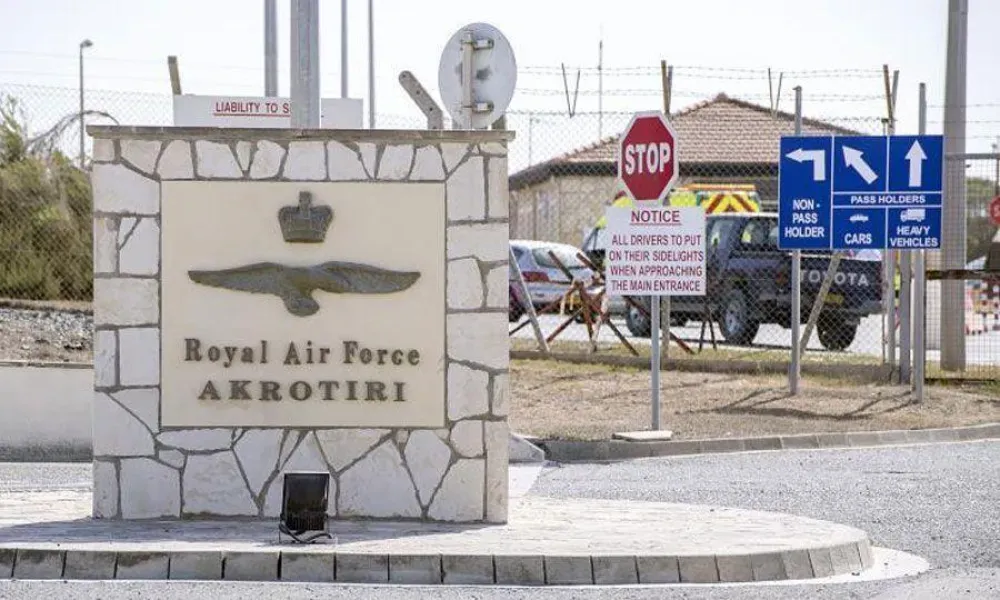
The recent remarks by the High Commissioner of the Republic of Cyprus to the United Kingdom, Kyriacos Kouros, on Sky News, although made within the diplomatic boundaries required by his position, were among the clearest and most well-documented statements heard in recent years on the issue of the British Bases in Cyprus. At a time when the Eastern Mediterranean is once again at the centre of geopolitical developments and the bases at Akrotiri and Dhekelia are acquiring increased strategic importance, the Cypriot diplomat highlighted a reality that is often overlooked: the Bases may be considered “sovereign”, but that sovereignty is neither absolute nor independent of the Republic of Cyprus. Let us look at the issue more closely.
Sovereignty with operational limits
The status of the British Bases was defined by the 1960 Treaty of Establishment, which accompanied Cyprus’ independence. Under that agreement, the United Kingdom retained two areas on the island, Akrotiri and Dhekelia, which were designated as Sovereign Base Areas. The British position is that these areas constitute sovereign British territory, under the full jurisdiction of London. However, the reality is more complex.
In practice, the sovereignty of the Bases is functional, but not absolute. This is reflected both in the 1960 agreements and in the practice followed ever since. The Bases were created exclusively for military purposes and not as colonial territories or as a normal administrative extension of the United Kingdom. Britain itself undertook not to use these areas for economic or political exploitation.
One of the main elements demonstrating the limits of the Bases’ “sovereignty” is their geographical and functional dependence on the Republic of Cyprus. The areas of Akrotiri and Dhekelia are not isolated territories, but lie within Cypriot territory and are surrounded by it. For their operation, the British authorities rely daily on the road network, infrastructure, including ports and airports, and services of the Republic of Cyprus.
Communication between the two Bases, as well as their connection with the outside world, inevitably passes through Cypriot territory. Without the ability to move personnel, equipment and materials through Cypriot territory, for example to and from the Troodos radar installations or to firing ranges, the operation of the Bases would in practice be impossible.
The Cypriot residents of the Bases
A second factor that limits the notion of absolute sovereignty is the fact that around 11,000 Cypriot citizens live within the Bases. These people are not British nationals, but citizens of the Republic of Cyprus residing in 12 communities within the Base Areas. At the same time, between 30,000 and 40,000 British nationals live permanently in Cyprus. If military personnel and their families are included, that number may reach 60,000.
Although responsibility for security in these areas lies with the British authorities, the residents retain their rights and their status as citizens of the Republic of Cyprus. This means that the Bases do not function as purely military territory without social life, but as areas where military installations and Cypriot communities coexist.
The 2014 agreement and European law
Also of particular significance is the agreement reached in 2014 between Nicosia and London regarding land development within the Base Areas. The drafting of the Sovereign Base Areas Policy Statement for Akrotiri and Dhekelia, which was promoted on the basis of the relevant arrangement signed between the authorities of the Republic of Cyprus and the United Kingdom in January 2014, aimed to secure a rational approach to urban planning and spatial development in the Base Areas, which cover some 25,000 hectares, through the designation of planning zones and location policies.
In essence, that agreement allowed the use of a large part of the land for residential and economic development, subject to one crucial condition: that such development would be governed by the European acquis and European Union legislation.
This provision shows that the Bases do not operate as a completely independent legal system, but are subject to rules deriving from European law.
An issue that remains open
The discussion over how “sovereign” the Bases really are often returns to public debate, particularly during periods of international crisis, when the facilities at Akrotiri take on an increased operational role.
Reality shows that their status is the product of a historical and legal balance shaped in 1960 and adjusted ever since in response to geopolitical developments.
Kyriacos Kouros’ intervention on Sky News highlighted precisely this: that the sovereignty of the Bases cannot be interpreted in a way that ignores the Republic of Cyprus. Their presence on the island is not a unilateral reality, but the result of international agreements that presuppose cooperation, coordination and mutual respect, something which Great Britain fully understands, judging from the reactions of British Prime Minister Keir Starmer, as well as the outcome of the visit to Cyprus by British Defence Secretary John Healey.
The key question, therefore, is not whether the Bases are sovereign. It is how far that sovereignty can be exercised without the cooperation of the Republic of Cyprus, and what form the island’s security system might take in the future within a changing international environment.
The Hague precedent and the Mauritius case
The discussion over the status of the Bases has taken on a new dimension following the 2019 advisory opinion of the International Court of Justice in The Hague in the case of Mauritius and the Chagos Archipelago.
The court ruled that the separation of the Chagos Islands from Mauritius prior to its independence was unlawful within the framework of decolonisation. On the basis of that opinion, the United Kingdom was called upon to end its administration of the archipelago.
Although the case concerns a different geographical area, it created an important legal precedent. It strengthened the argument that the decolonisation process should lead to the full territorial integrity of new states. For some international law experts, this reasoning could in future affect the way other cases are assessed, particularly territories that remained under colonial control after independence. Such a process, of course, could only take place in the event of a Cyprus settlement and through a joint démarche by Greek Cypriots and Turkish Cypriots, who co-signed the London agreements that led to the creation of the Republic of Cyprus in 1960.
The prospect of Cyprus joining NATO
A further dimension is now being added to the debate on the future of Cyprus’ security status: the position of President of the Republic Nikos Christodoulides in favour of the prospect of Cyprus joining NATO.
This position is directly linked to the 1960 system of guarantees, under which the security of the Republic of Cyprus is guaranteed by Britain, Greece and Turkey. Indirectly but clearly, it could also raise the issue of ending the presence of the British Bases in Cyprus. This system has been the subject of strong criticism since the events of 1974, when the Treaty of Guarantee was used by Turkey as a legal argument for its military intervention on the island.
In the event of a settlement of the Cyprus problem, Cyprus’ accession to NATO could create an entirely different security architecture. A member state of the Alliance does not require a separate system of guarantees, since its security is covered by Article 5 of the NATO Treaty, which provides for collective defence.
Based on this logic, such a development could lead to:
-
the abolition of the 1960 system of guarantees
-
a new security agreement for Cyprus
-
a redefinition of the role of military installations on the island
Within this framework, some analysts believe that the prospect of Cyprus joining NATO could open up, alongside negotiations for a Cyprus settlement, a broader discussion on the future of the British Bases. One alternative that has occasionally been mentioned is the creation of a NATO base in Cyprus, which would replace or reshape the existing status of the British installations.