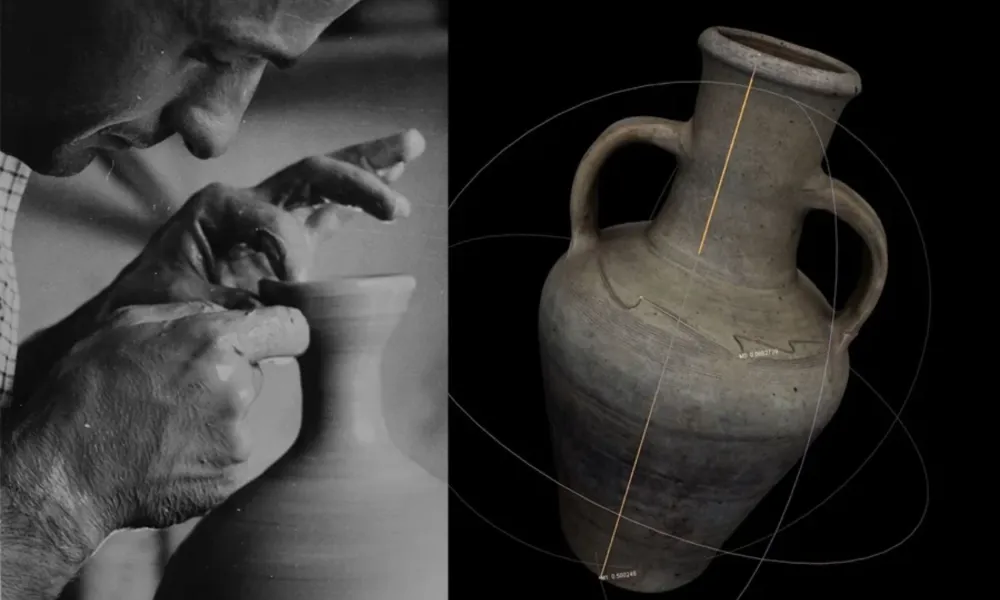

The archive of Valentinos Charalambous, regarded as one of the most important figures in modern Cypriot ceramics, is being digitised in an interdisciplinary project that seeks to preserve not only his works but also his workshop, memories and expertise. The project will be presented on Friday 13 November 2026 at 19:00 at the Rialto Theatre in Limassol.
The event is titled “Traces in Clay: Valentinos Charalambous and the Digitization of a Living Archive”.
A digital archive of a lifetime’s work
The project focuses on documenting, studying, visualising and preserving the artist’s archive, which has been donated to the Cyprus Institute.
The aim is to create an innovative digital archive that will bring together and make accessible not only material related to his work, but also the environment of his workshop, documents, photographs, personal memories and the technical knowledge he developed over his long artistic career.
During the event, Marina Schiza, Andriana Nikolaidou and Nikolas Bakirtzis will give short presentations on the significance of Charalambous’s work, the donation of his archive to the Cyprus Institute and the progress of the digitisation process.
Training in London and St Ives
Valentinos Charalambous was born in Famagusta in 1929 into a family of traditional potters.
He studied at the Central School of Arts and Crafts in London under Dora Billington and Gilbert Harding-Green, becoming the first Cypriot ceramicist with academic training in the field. He then spent a year as an apprentice at the historic Leach Pottery in St Ives, England, before returning to Cyprus in 1952 to work alongside his father.
Three decades of teaching in Iraq
In 1957, he was invited by Iraq’s Ministry of Education to establish the Ceramics Department at the Institute of Fine Arts in Baghdad. In 1960, he set up a similar department at Tahrir Female College. From 1967 until his retirement in 1983, he served as head of the Ceramics Department at the Academy of Fine Arts in Baghdad.
His contribution to the development of Iraqi art and culture was recognised in 1987, when he was honoured for his work as an artist and educator.
After returning to Cyprus, he worked in 1988 with the Cultural Services of the Ministry of Education and Culture to strengthen cultural ties between Cyprus and the Arab world.
A dialogue between East and West
Charalambous’s work is defined by the meeting of Western and Eastern artistic traditions, shaped by his apprenticeship in England and his many years in Iraq.
His output includes murals, sculptures and large ceramic vessels decorated with geometric patterns and historical references. Experimenting with local materials such as clay and celadonite, he developed his own pigments, while also exploring firing techniques and the handling of texture and colour.
Poetry in clay
Poetry also holds a special place in his work. In several pieces, Arabic calligraphy meets ancient Greek script, carrying verses by Constantine Cavafy onto clay.
The digitisation of his archive seeks to preserve this multifaceted artistic journey, while highlighting the importance of safeguarding the knowledge, techniques and personal stories behind an artistic body of work.
Event information
- Title: Traces in Clay: Valentinos Charalambous and the Digitization of a Living Archive
- Date: Friday 13 November 2026
- Time: 19:00 to 20:10
- Venue: Rialto Theatre, Limassol
- Admission: Free, booking essential
- Bookings: rialto.interticket.com
- Language: Greek and English
A reception will follow the presentation.
Source: Parathyro