First published in Parathyro, the cultural section of Politis newspaper
25 March 2026 and 1 April. Two national holidays, and the schools are closed. A walk through the neighbourhoods of Nicosia is enough to notice something that quietly upends the story we have told ourselves about the generation growing up in 2026.
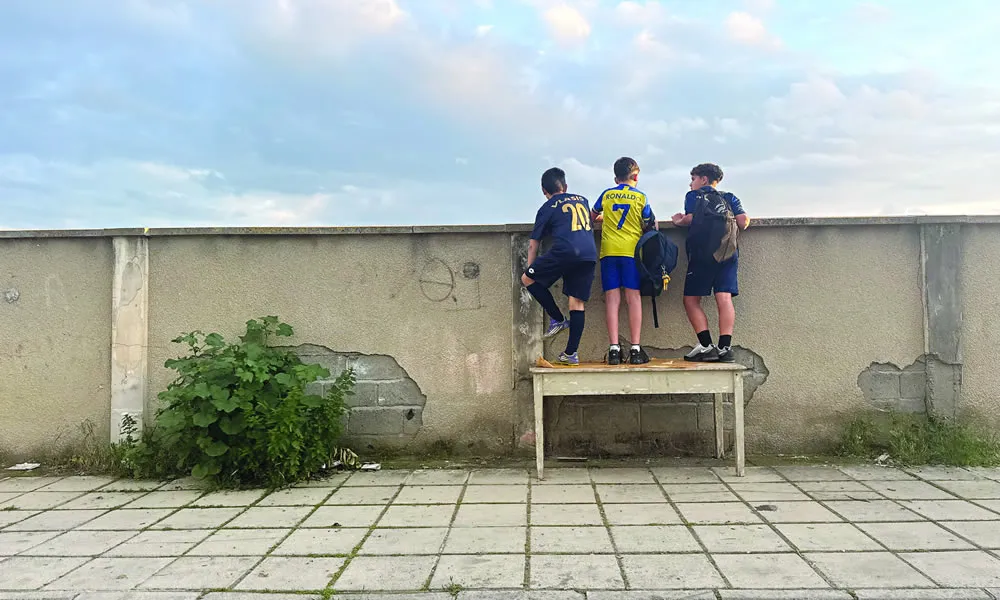
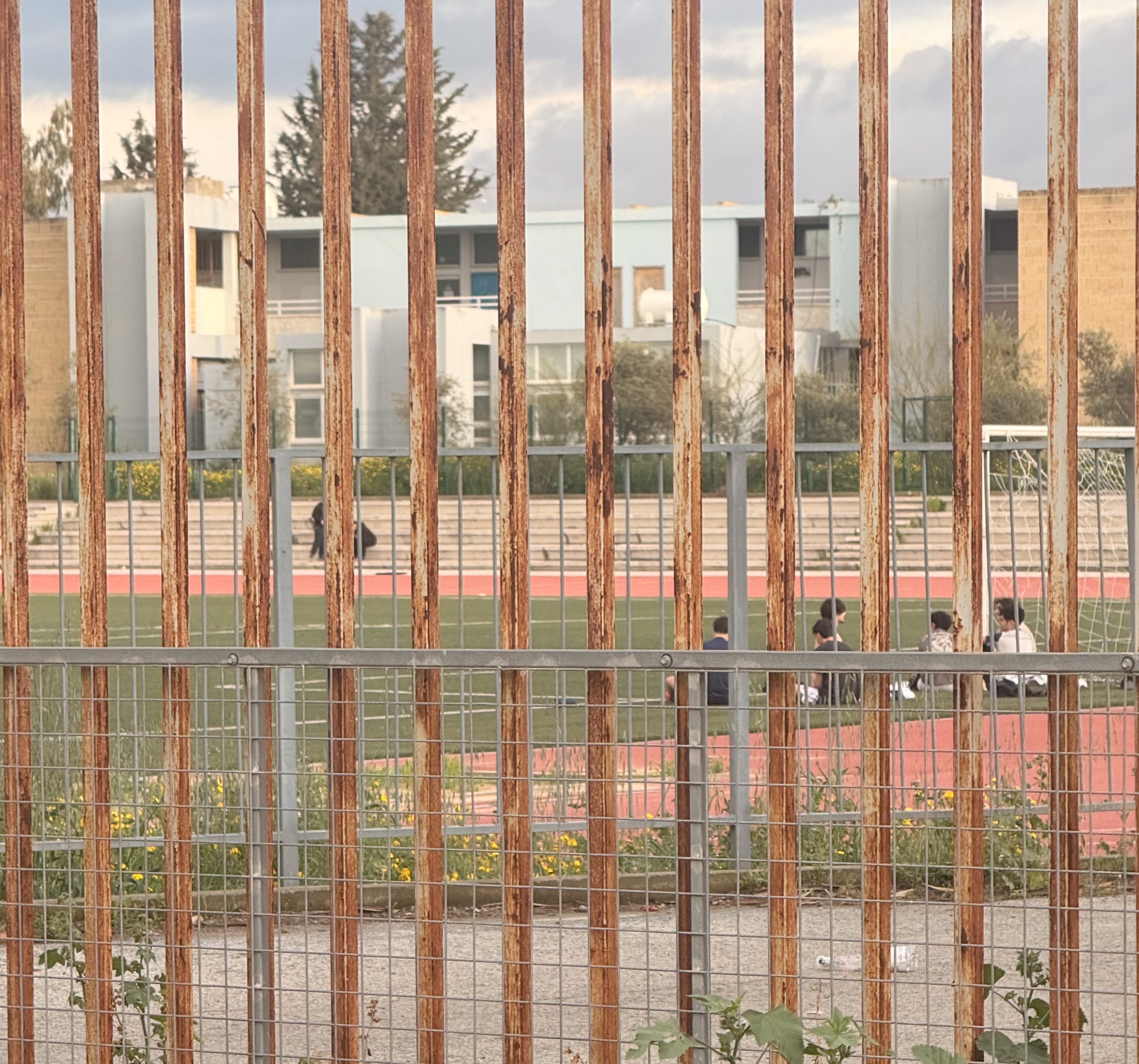
The silence of empty streets is broken by noise coming from behind school railings. More than 20 children are climbing rusty fences and walls to play football in their school's courtyard. Three of them are standing on an old school desk. It is an image that is at once absurd and infuriating. Absurd, because what we tend to write off as relics of another era, neighbourhood play, carefree childhood, turn out to be stubbornly alive. Infuriating, because children should not have to scale a fence to reach them.
Behind the tall railings sit basketball and football courts, athletics tracks, event spaces, car parks and stretches of green. Spaces built with public money, belonging to the community. And yet they remain locked. Almost every neighbourhood in Cyprus contains one of these multi-use spaces, which we call a school, and which we lock up shortly after lessons end, once its institutional function is discharged.
The numbers are clear
The figures leave no room for doubt. According to the World Health Organization's European Childhood Obesity Surveillance Initiative, Cyprus has the highest rate of childhood excess weight in Europe: 42% of children aged 7–9 are overweight and 20% are obese. Only 16.1% of adolescents aged 11–15 meet the WHO recommendation of 60 minutes of daily physical activity. The problem does not stop with children. 52% of adults in Cyprus engage in no physical activity whatsoever, the third-worst rate in the EU, while only 22% meet the minimum of 150 minutes of weekly exercise.
Cyprus is also grappling with one of the most serious loneliness crises in the European Union. Research by the Joint Research Centre of the European Commission finds that more than 17% of Cypriots report feeling lonely often or always, placing the country fourth-highest in the EU. A study published in the journal Aging and Mental Health ranks Cyprus as the loneliest country in the world for people aged 50–90. What we are looking at is a mounting public health emergency, physical and psychological, with direct consequences for cardiovascular disease, diabetes, depression and productivity. A crisis the health system will soon struggle to absorb, already visible in a public sphere populated by isolated and alienated citizens. In a society that is unwell in body and in mind, stripped of outlets and spaces for shared life, it is perhaps less surprising than it should be that the demagogues keep finding their way to power.
Schools as community hubs
The idea of the school as a community hub is not abstract. Take a concrete example from when I lived in London: the primary school in my neighbourhood. The school's court served as the neighbourhood futsal pitch. At set hours it was open and unsupervised, and children could simply show up and play, the way we once played in vacant lots. A familiar space, available for free, unstructured play, which remains the one thing children most consistently say they want. The school was, in essence, a place where they could socialise and form bonds without an agenda.
In other cases, the school was made available to private academies which, as part of their usage agreement, charged no fees to children from low-income families in the community. But the building was not reserved for children alone. It functioned as a community space, bookable at subsidised rates. Empty classrooms hosted adult learning programmes, co-working sessions, volunteer-run robotics clubs. You could reserve a room for a quiz night or a poetry reading for a nominal fee. Film screenings were organised for local children, who had the luxury of staying in their own neighbourhood: no car, no parking, just a short walk there and back.
The school gym was open to the community too and, without a single piece of expensive fitness equipment, was invariably full. Once a week the same space became a gathering point for elderly people living alone, an open meeting that addressed loneliness in practice, perhaps more effectively than any formal mental health intervention ever could. The space, in short, adapted to whatever the community needed. And the most important part? It was genuinely affordable and accessible. Most programmes were run by volunteers and NGOs who had simply been given the keys to infrastructure the community already owned.
The Cypriot reality
In Cyprus, and particularly in urban centres, the clubs that should theoretically function as community centres have largely become restaurants and gambling establishments. The Athlitismos gia Olous (Sport for All) programme, useful as it is, cannot begin to meet actual demand: it serves just 16,000 members, fewer than 2% of the population.
Meanwhile, our schools go dark from 2pm onwards. A typical school operates for around 180 days a year, six to eight hours a day. That amounts to a utilisation rate of just 16%. For more than 80% of the time, facilities built and maintained with public funds sit empty: afternoons, evenings, weekends, and, where no summer programme exists, the entire summer.
The fiscal logic
The school-as-community-hub model is not experimental. It has been running successfully for decades in Japan, Denmark, Finland, the Netherlands and the United Kingdom. The standard objections concern security and cost. But studies consistently show that in areas where similar programmes were introduced, vandalism and repair bills fell. In Southampton, vandalism damage dropped by 90% and repair costs by 75%. The reason is straightforward, even if it seems to elude those making decisions: the most effective security is the presence of people. A living space, used by families, volunteers and athletes into the evening, ceases to be a target. It is abandonment that invites damage, not use. When a community feels a space belongs to it, the community protects it.
On the financial side, there is nothing to build. The facilities already exist. Opening them simply means extracting a better return on an investment already made. What should be factored in is the long-term reduction in pressure on the General Healthcare System, GeSY: fewer cases of obesity, diabetes and depression finding their way into waiting rooms.
This policy does not only cost nothing; it pays back. A study of community school programmes in Massachusetts found that every dollar invested returned $2.20 in reduced healthcare costs and increased productivity. A corresponding assessment across four school districts in Ohio recorded a net social benefit of $1.35 million over three years. In Japan, the number of adults who exercise regularly more than doubled.
Time to act
No new legislation is needed, no millions in funding, no reinvention of the wheel. Dozens of countries have been running this model for decades, with measurable results across health, social cohesion, security and public finances. What is needed is a pilot: four or five schools in different neighbourhoods, working with municipalities, voluntary organisations and local bodies. Governance frameworks already exist and are ready to be adapted. The only missing ingredient is political will. Picture schools as living spaces: afternoons as open courts for children and adults, evenings offering fitness classes, yoga or dance, weekends hosting local tournaments and cultural events. All of it within walking distance. None of it requiring a car, a babysitter or a prohibitive fee.
Open the spaces we paid for. They belong to the community.
Sources
-
Childhood obesity in Cyprus: 42% of children aged 7–9 are overweight and 20% obese (1st among 37 countries). WHO European Childhood Obesity Surveillance Initiative (COSI), Round 6 Report (2022–2024). https://www.who.int/europe/publications/i/item/WHO-EURO-2025-11788-51560-78769 Published: November 2025.
-
Adolescent physical activity: only 16.1% of adolescents aged 11–15 meet the recommendation for 60 minutes of daily activity. WHO, Cyprus Country Physical Activity Factsheet 2024 (based on HBSC 2022 data). https://cdn.who.int/media/docs/librariesprovider2/country-profiles/physical-activity/2024-country-profiles/physical-activity-2024-cyp.pdf Published: 2024.
-
Adult physical activity: 52% of adults with no activity (3rd worst in the EU). Special Eurobarometer 525: Sport and Physical Activity. https://europa.eu/eurobarometer/surveys/detail/2668 Published: September 2022.
-
Loneliness: more than 17% of Cypriots report loneliness often or always (4th highest in the EU). European Commission Joint Research Centre, Loneliness prevalence in the EU. https://joint-research-centre.ec.europa.eu/projects-and-activities/survey-methods-and-analysis-centre/loneliness/loneliness-prevalence-eu_en Published: 2023.
-
Loneliness among older adults: Cyprus ranked loneliest country for people aged 50–90. Richardson RA et al., Aging & Mental Health. https://doi.org/10.1080/13607863.2025.2473634 Published: April 2025.
-
Sport for All programme: https://ago.org.cy/archiki-selida/ago/