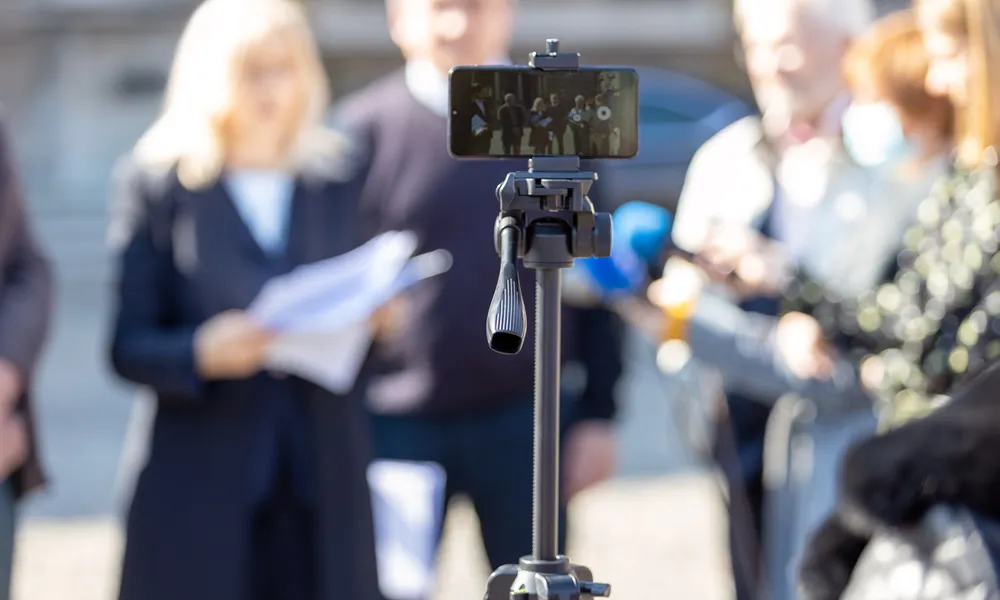
Somewhere on this island, a prospective member of parliament is filming themselves in a parked car, in 420p, with wind noise, and they think it is going well.
I say this with confidence because I spent the past several weeks on the receiving end of what I can only describe as a masterclass in how not to run a political digital campaign. Candidates, their teams, and in some cases the candidates themselves, contacted me one after another. They wanted help. I turned every single one of them down. But not before those conversations taught me something genuinely useful about the state of political communication in Cyprus, which I am going to share here, because it concerns all of us.
What I actually witnessed
Let me be specific, because the details matter more than the generalisation.
I spoke with members of parliament in their late sixties who wanted to measure the success of their entire campaign by views. Not reach, not engagement, not conversion to actual votes. Views. The same metric a teenager uses to decide whether their dance video performed well. These are people asking to help govern a country with a GDP of over thirty billion euros.
I received requests for pro bono work. Not from independent candidates running on goodwill and no resources, but from established political figures, affiliated with parties, with access to party infrastructure, asking a professional to run their digital campaign for free. The implied logic was that the exposure on their page would be sufficient compensation. It was not a serious conversation.
And then there was the Canva confession. A sitting member of parliament, not a newcomer finding their feet, told me with complete sincerity that they were handling their own creative content. On Canva. I did not ask which subscription tier.
I turned all of them down. Not out of political preference, but because no serious campaign can be built on a foundation this shaky.
The two failure modes nobody is talking about
What makes this cycle particularly striking is that Cypriot political social media has managed to split itself into two equally ineffective extremes, and almost nobody is operating in the space between them.
On one end, you have the candidates who clearly received the memo that production values matter. So they hired expensive camera crews, built clean backdrops, pressed their suits, and sat down to deliver their message straight to camera. The problem is that they are delivering it like a politician doing their very best impression of Emily in Paris: technically polished, completely unaware of how they actually come across, and somehow managing to make a beautiful setting feel deeply unconvincing. Voters can sense performance at a distance. They are extraordinarily good at it. Looking expensive and feeling authentic are not the same thing, and in front of a camera, the gap between them is obvious within the first three seconds.
Then there is a special category all of its own: the older candidate trying desperately to appear hip. The word "hip" itself is, of course, the first sign that something has gone wrong. Dropping slang into a scripted video, referencing a meme that was relevant four months ago, or opening with "hey guys" in a tone that suggests it was workshopped in a committee meeting does not close the generational gap. It announces it. Loudly. Wanting to be hip and being hip are not the same exercise, and no amount of coaching can manufacture the kind of ease that either exists or does not.
On the other end, you have the screamers. Candidates who have decided that passion is the answer, and that passion, apparently, means volume. They are not speaking to you. They are shouting at you, directly into the lens, hoping the intensity of the delivery will be mistaken for conviction. It will not be. Rage without strategy is noise, and social media algorithms actively suppress content that drives users away rather than drawing them in.
In the middle, where actual political communication lives, there is almost nobody.
Why this matters more than most candidates realise
Political social media is not a bulletin board. It is not a place to post your photograph, your slogan, and your itinerary of village visits. It is a dynamic communication environment where perception is built or destroyed in seconds, where the algorithm does not care about your party affiliation or how many elections you have previously won, and where voters, particularly younger ones, are forming judgements about your credibility before they have processed a single word of your message.
This is especially consequential in a preferential voting system where candidates from the same party are competing against each other for personal votes within the same constituency. Every day a candidate spends communicating poorly is a day their party colleague communicates better. The race is not only against the opposition. It is against the person standing next to you on the ballot.
There is also a legal dimension that most campaigns appear to be ignoring entirely. The EU Regulation on the transparency and targeting of political advertising has been in force since October 2025. It requires clear disclosure, accountability, and responsible handling of personal data in all political campaigns. Every boosted post, every targeted advertisement, every sponsored piece of content now operates within this framework. It is not optional, and the sanctions for violations are designed to be, in the regulation's own language, effective and dissuasive.
What professional political communication actually looks like
Effective political social media rests on three things that most Cypriot campaigns are currently skipping.
The first is positioning. Before a single post goes live, a candidate needs a clearly defined message architecture. Who are you speaking to specifically? What is the single idea you want voters to associate with your name? What problem do you solve that the others do not? Without honest answers to these questions, you do not have a campaign. You have a posting schedule.
The second is production discipline. This does not require a television budget. It requires a smartphone, decent light, a lapel microphone that costs thirty euros, and someone who understands basic framing and eye contact. The difference between a candidate who looks like they belong on screen and one who looks like they accidentally pressed record is not money. It is preparation. Voters forgive a great deal. They do not forgive the impression that you could not be bothered.
The third is paid strategy. Organic reach on Facebook and Instagram is functionally dead for anyone without a large pre-existing following. A targeted paid campaign, even a modest one, built around clearly defined voter segments within a specific constituency, will outperform three months of daily organic posting. This is not a new observation. It is how digital advertising has worked for the better part of a decade, and political campaigns in markets far smaller than Cyprus have already internalised it.
The Fidias problem
Every cycle now, a Cypriot candidate or their team watches Fidias Panayiotou's trajectory and decides they want that. The viral moment, the unfiltered authenticity, the sense of speaking directly to people without the machinery of traditional politics mediating everything.
What they consistently miss is that Fidias was not accidental. The rawness was a deliberate production choice. The consistency was a strategy, executed over years before it was ever applied to a political context. Copying the aesthetic without the underlying architecture is not authenticity. It is costume. And voters, particularly the younger voters these candidates are trying to reach, identify costume immediately.
The answer is not to become Fidias. The answer is to understand why he worked and apply those same principles, genuine voice, genuine consistency, genuine connection, to your own story and your own clearly defined reason for being on the ballot.
The honest conclusion
Cyprus is not short of intelligent people. It is not short of candidates with genuine things to say. What it is short of, in this cycle as in the ones before it, is the discipline to say those things in a way that the modern voter will actually stop to receive.
The candidates who approach this with discipline will find that digital communication, done properly, is the single most cost-effective tool available to them. The ones who do not will count their views, post their Canva graphics, shout into their cameras, and workshop their slang. Then they will wonder why the numbers did not move.
That gap, more than any policy platform, may decide who gets in.