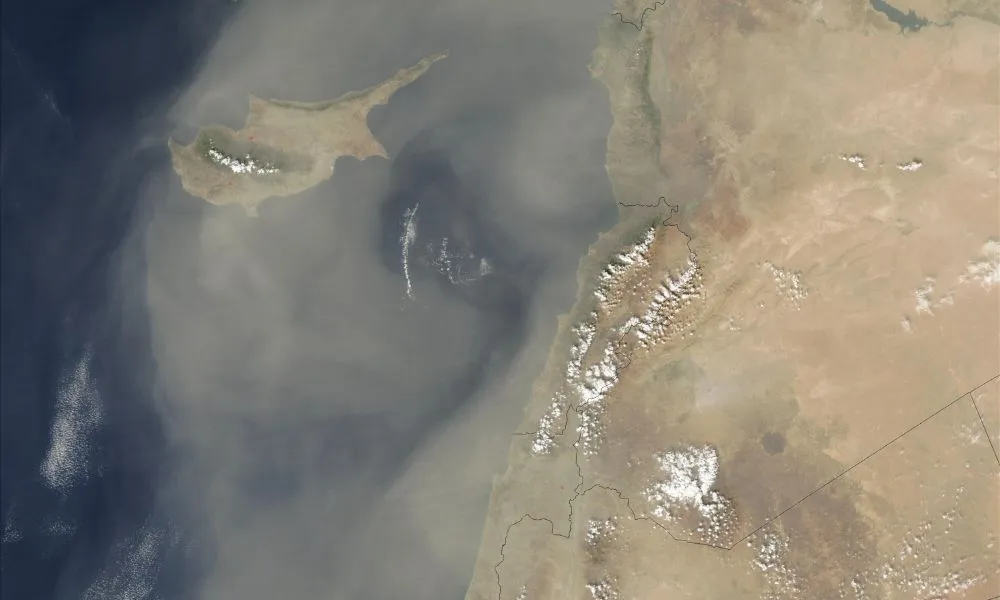
Plants growing in nutrient-poor environments may rely on dust in the air as an additional source of nourishment. A new study suggests that minerals carried in atmospheric dust can be absorbed directly through leaves, rather than exclusively through roots.
The findings challenge the long-standing view that soil is the main pathway for plant nutrition and indicate that airborne particles may play a significant role in sustaining vegetation in dry landscapes.
Dust as a direct nutrient source
Researchers studying Mediterranean shrubland in Israel’s Judean Hills found that plants exposed to dust accumulated significantly higher levels of iron and other micronutrients in their leaves.
The team, led by Anton Lokshin of Ben-Gurion University of the Negev, observed that the increase remained concentrated in shoots, while root nutrient levels changed little. This pattern suggested that the minerals entered the plants through the foliage rather than through the soil.
Dust particles settling on leaves appeared to dissolve in a thin layer of moisture on the leaf surface. This process allowed nutrients to be released and absorbed directly by plant tissues.
Chemical fingerprints confirm leaf uptake
To confirm that the nutrients had entered the plants rather than simply sticking to leaf surfaces, the researchers analysed rare earth elements. These trace metals retain distinctive chemical signatures that can identify their source.
The chemical patterns in treated plants shifted away from the composition of local soil and towards the signature of the applied dust. Leaves showed clear traces of the dust’s chemical fingerprint, while plants that received dust only through their roots displayed little change.
These results strengthened the conclusion that minerals from the dust crossed the leaf surface and were absorbed into plant tissue.
Leaf chemistry plays a key role
The study found that the chemistry of the leaf surface helped turn dust into a usable nutrient source. The shrub species examined maintained mildly acidic leaf surfaces and secreted organic acids that helped dissolve minerals.
In laboratory simulations, this acidic film released iron, manganese, zinc, magnesium, nickel and copper from dust particles far more quickly than water alone.
The surrounding soil in the study area was alkaline, meaning many of these nutrients were less easily released underground. Leaves therefore provided a more efficient entry point for certain minerals.
Roots absorb far less dust-derived nutrients
When researchers placed the same dust near plant roots, the uptake of nutrients was significantly lower. Soil processes diluted the particles, bound nutrients to minerals and exposed them to microbes before plants could absorb them.
Leaves bypassed this bottleneck because dust grains came into direct contact with plant tissue and dissolved rapidly on the leaf surface.
Where airborne nutrients matter most
The findings suggest that airborne minerals could contribute meaningfully to plant nutrition in regions where soils hold nutrients tightly.
The researchers estimated that dust-borne iron may supply up to 17 percent of the iron plants receive from soil in parts of the western United States. In the eastern Amazon, Saharan dust transported across the Atlantic may provide up to 12 percent of soil-derived phosphorus.
Short bursts of dust events may therefore deliver nutrient inputs that temporarily rival or exceed daily soil supplies.
Implications for ecosystems and climate models
Despite the increased nutrient levels, the three-month field study did not show strong short-term growth in the plants. Differences in starting plant size, weather conditions and internal nutrient movement may have masked growth responses.
Nevertheless, the research highlights an overlooked pathway in plant nutrition. Current vegetation models typically assume that airborne nutrients reach plants only through soil deposition.
Including direct leaf uptake in future models could improve predictions about plant growth, nutrient stress and carbon storage in regions frequently exposed to dust.
The study concludes that leaves act as active surfaces that capture dust, dissolve minerals and integrate part of them into plant nutrition.
Source: Study published in the journal New Phytologist