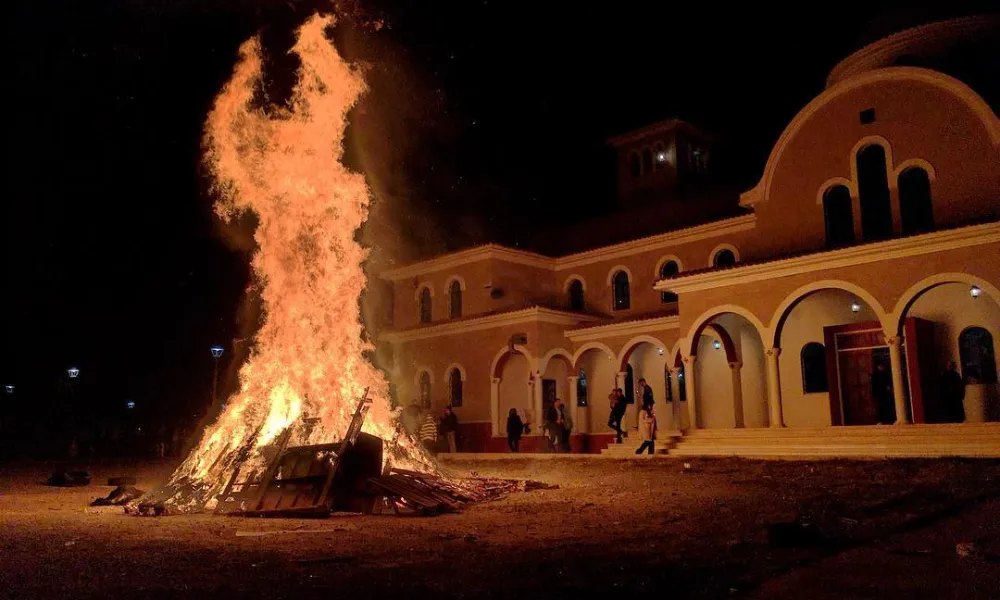

On Holy Saturday last April, young people placed an LGBTQ+ pride flag on top of a bonfire in Palodia. At another bonfire in Lakatamia, a photograph of Akel MEP Giorgos Georgiou was thrown into the flames alongside a banner reading "How long will traitor-leaders nest in the bosom of Greece?", next to a photograph of Greek Prime Minister Kyriakos Mitsotakis. In Limassol, in the Agios Georgios Chavouzas area, a sign bearing the initials "LGBT" was burned. The images spread across social media. Despite the public outcry that followed, nobody was charged.
What has happened in the year since to prevent a repeat? Justice Minister Costas Fytiris convened a meeting with police, the Fire Service and the Union of Municipalities and Communities to discuss the management of the Holy Saturday bonfire tradition, announcing intensive checks, "arrests of offenders and the imposition of responsibility on the parents of minors." The goal, he said, is for "the traditional custom of the bonfire to remain a celebration." Whether it will is the question Cyprus is asking again tonight.
These incidents do not surprise those who have been watching the far right in Cyprus. Elam, which was established from an organisation that operated under the name "Golden Dawn: Cypriot Kernel" before being renamed, took 11.2% in the 2024 European elections. The young people who placed flags and photographs on bonfires did not emerge from a political vacuum. They grew up in a society where the far right found space, built a presence and was gradually normalised, inside and outside the ballot box.
Elam's ascent has been slow but unbroken. From 0.88% in 2013, the party recorded 6% in the 2023 presidential elections and in the June 2024 European elections managed to elect an MEP for the first time. It now sits in the European Conservatives and Reformists group alongside Fratelli d'Italia and Vox, and was the only Cypriot party represented at Donald Trump's inauguration.
Academic research maps the broader pattern. In a 2024 study in the journal Ethnicities, researcher Anna Triandafyllidou analyses the rise of religious nationalism in south-eastern Europe and concludes that far-right parties in the region use religion to construct an opposition between a "moral people" and a "corrupt elite," with faith functioning as a language of exclusion and a form of identity that sustains it. A January 2025 Pew Research Center survey covering 36 countries found that in south-eastern European countries the proportion of people who consider religion inseparable from national identity remains among the highest in the EU, and is directly linked to acceptance of populist and authoritarian narratives. Closer to home, the symbol "Jesus Christ Conquers" has been appearing spray-painted on neighbourhood walls across Cyprus, alongside the tags of self-described local "terrorist" organisations run by groups of young men operating outside any formal political structure.
Up close
"The wrong strategy has been applied for some time at institutional level," says Stefanos Evangelou, secretary of Accept LGBTQ+ Cyprus. "It did not address the general insecurity of our times, or society's concerns, with real solutions. And so we arrived at a generalised anxiety, and minority individuals ended up becoming scapegoats." The context of that insecurity is specific: a housing crisis, migration pressures, class divisions, economic strain and, surrounding everything, the persistence of war in the region. "Space was given to various political groups to use and promote a far-right narrative," Evangelou says. "Like Meloni and Le Pen, they always stand on the most familiar ground, the ground that offers relief in the face of insecurity."
A 2024 analysis of the rise of the Christian right in Europe by Lo Mascolo and Stoeckl describes how these movements exploit existing religious identity to bring far-right ideas to sections of society that would not otherwise embrace them. Evangelou notes with concern a recent statement by Elam leader Christos Christou claiming that his party defends and protects LGBTQ+ people. "The far right in Cyprus found space to flourish and created narratives that served it. While it is the extreme right, it became the voice of conservative popular right-wing opinion, and this is visible clearly in the Trump phenomenon too," he says.
The incidents are not abstract. In February 2023, masked individuals attacked an Accept event at the Cyprus University of Technology. More recently, a 17-year-old in Lakatamia was attacked solely because of his appearance. "There are people in Cyprus living double lives, who have not come out to their families, who are afraid to go to the police when they are victims of hate crimes," Evangelou says. "They do not trust. They hide." He adds that bullying in schools is worsening: "The school today is sick, sending the wrong messages of pseudo-conservatism and intolerance."
Impunity
Hate speech based on sexual orientation was criminalised in Cyprus in 2015. In October 2024, the penalties were raised to up to five years in prison and a €10,000 fine. According to ILGA-Europe data, not a single conviction has been secured to date. The Ministry of Justice submitted a bill in February 2026 regulating the bonfire tradition, focused on fireworks, timber and permits, with no reference whatsoever to the hate incidents of 2025.
Evangelou acknowledges some movement. "There has been police mobilisation around investigations into hate crime complaints. The number of reports is increasing, as is the response." But what happens to cases once they are reported is another matter entirely. Many end without formal proceedings, partly because the slow pace of the judicial system discourages victims from pursuing a case and partly because many choose never to report at all. "The police," he says, "have set targets for the bonfires that are impossible to meet." Political inertia compounds the problem. After the Holy Saturday incidents of 2025, only Akel and Volt publicly condemned what had happened. "We observe parties not denouncing these narratives and in many cases adopting them," Evangelou says. He notes that the president of the House of Representatives was heard to say "society is not ready" as a justification for inaction. "Parties shape policy and influence society," he responds. "Who exactly is going to prepare society?"
The left in the crosshairs
Giorgos Koukoumas, Akel spokesman and MP for Famagusta, identifies another dimension to the problem. "It is neither coincidental nor unknown that the far right has the left permanently in its sights, its ideas and its organisations," he says. "That is why we have seen in recent years an escalation in incidents such as vandalism of premises belonging to people's organisations and the daubing of fascist slogans on walls." On last year's bonfire incidents, he is direct: "We saw no conclusion to the investigation and no one held to account. Impunity for such behaviour encourages far-right action, and for that the state bears responsibility." He acknowledges that some, when they witness such actions, may tolerate them, or dismiss them as youthful recklessness, or even take quiet satisfaction in seeing them directed at the left. "But everyone should know that the far right, sooner or later, turns against the whole of society. As we have pointed out many times, the forces of the far right sometimes turn against those who gave them ideological sustenance and against those who associate with them. But by then, it is usually too late," Koukoumas says.
This Holy Saturday
Police are already on operational footing for tonight. In 2025, 20,500 fireworks items were confiscated. The operational plan for Easter 2026 was drawn up from February. The state appears determined that the custom should remain, in Fytiris's words, "a celebration and not a danger." The question that stays open is a different one: if this Holy Saturday flags or photographs of political figures and social groups appear again in the flames, which parties, in the middle of an election campaign, will have the courage to say so clearly?