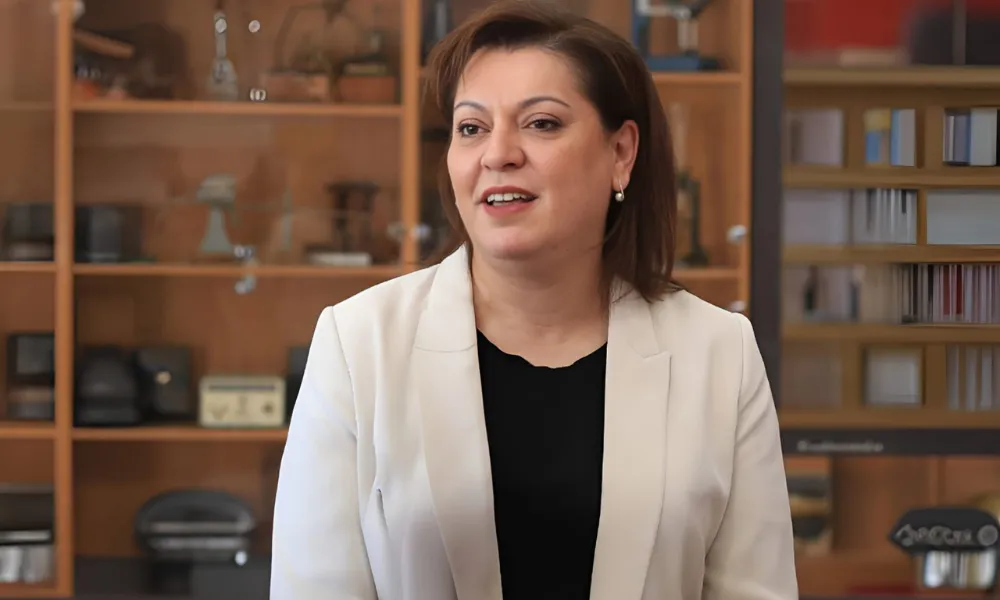

Education is no longer just about acquiring knowledge. It must prepare children and teenagers for a world changing at speed, from artificial intelligence to digital exposure and money management. Against the backdrop of a new European debate opened by Greek Prime Minister Kyriakos Mitsotakis's proposal to European Commission President Ursula von der Leyen for restrictions on social media use by minors, the question of what schools should actually be teaching has become more pressing than ever. In an interview with Politis, Minister of Education, Sport and Youth Athena Michaelidou insists the goal should not be uncritical adaptation to every new technology, but the development of knowledge, judgement and responsibility.
AI as part of digital policy
Michaelidou makes clear that the Ministry of Education, Sport and Youth has already incorporated artificial intelligence into its broader digital policy framework. Under the ministry's AI Roadmap, she says, it has made the definition of policy and guidelines for the ethical and responsible use of AI in primary and secondary education a priority. A policy document announced in October 2025 sets out the core principles underpinning the ministry's approach, along with guidelines for teachers, students, parents, guardians and carers. This approach, she adds, is aligned with both Cyprus's national AI strategy and the European regulatory framework, including the GDPR, the Digital Services Act and the EU AI Act.
For Michaelidou, artificial intelligence is not treated as an isolated technology issue but as part of the broader set of digital competencies that schools must cultivate, covering both students and teachers, and consistent with European and international digital skills frameworks.
Understanding first, tools second
Asked whether the updating of curricula includes AI management skills, the minister gives an answer that captures the ministry's underlying philosophy. The priority, she explains, is not to rush tools into the classroom but to build knowledge, attitudes and skills. "Our main priority is AI literacy for teachers and students, with the primary goals of developing understanding of what AI is, what its different types are and how it is affecting the world today," she says, shifting the emphasis from use to comprehension.
This approach is being pursued through two channels. The first is teacher training, which is already under way in multiple forms. The second is the inclusion of relevant topics in curricula, so far within the Computer Science subject in secondary general education.
On the question of children using AI tools as a learning aid, Michaelidou is more cautious. "There is not yet documented scientific research on its added value for learning," she says, noting that the use of AI tools by children is being examined in light of international research and the practices of other education systems, alongside challenges related to age restrictions and child protection. Her position is unambiguous: for now, AI has not been incorporated into curricula as a tool for student use in learning. It has, however, been incorporated as a subject of knowledge.
No standalone subject
Asked whether AI would become a standalone school subject, Michaelidou says the ministry is monitoring international practice closely, but the preferred direction is different. "Digital competencies and AI competencies must be integrated progressively and horizontally across the curricula of all subjects at all levels," she says. The aim is to embed relevant skills within a broader educational environment that gives space to understanding, ethics and critical evaluation of the digital world. "The ministry places particular emphasis on basic knowledge of what AI is, but above all on empowering children on the ethical questions that AI raises," she says. "The development of critical thinking and evaluation of the digital world, which now includes AI, is at the centre of our policies."
Training the teachers
Implementing this policy, Michaelidou says, necessarily runs through teacher training. The ministry has been designing and developing AI training programmes since 2019, with more intensive work over the past three years. These programmes are delivered primarily through the Cyprus Pedagogical Institute, in cooperation with universities and other bodies. A training plan for AI literacy has already been developed and is expected to be implemented "to a large extent from September 2026," covering different needs and levels of readiness through multiple formats including distance learning and a series of online training sessions making use of digital environments already available in schools.
International partnerships
A significant part of the preparation involves partnerships with academic, research and educational institutions. Michaelidou says the ministry works on an ongoing basis at both national and international level with universities, research institutions and the Deputy Ministry of Research, Innovation and Digital Policy. The goals are the exchange of good practice and the development of training programmes and support materials adapted to the country's policy and regulatory context. Training initiatives organised by local and international bodies are also promoted to teachers, including a Google experience run in cooperation with the Computer Technology Institute and Press "Diophantus", the European School Education Platform and the European Schoolnet Academy.
Social media and the protection of minors
The debate around safe social media use by minors has gained new weight at European level, and Cyprus is following the process closely. Michaelidou clarifies, however, that the technical and operational questions around age verification fall outside her ministry's remit. Implementation of age verification is a matter for the Deputy Ministry of Research, Innovation and Digital Policy, which has taken on the pilot participation in the relevant system. She notes that the ministry does participate in a working group that is currently developing a concept paper alongside an action plan.
On the EU's Age Verification Blueprint, which underpins this process, the system has been designed to be secure, functional and privacy-compatible. It allows a user to prove they are above a certain age threshold without revealing their exact identity or any personal data beyond what is strictly necessary. The model is built on the same technical specifications as the forthcoming European Digital Identity Wallet, expected by the end of 2026, and can be adapted to different age thresholds depending on national or legal requirements, whether 13+, 16+ or 18+. In practice, a user would download an age verification application or use an equivalent function built into another system. The application would issue an age certificate based on reliable national credentials such as a national electronic ID, passport or identity card, which the user could then present to a service to confirm they are above the required age threshold without disclosing any other personal details. Each certificate is designed to be used only once, to prevent cross-service tracking.
On data protection, Michaelidou reiterates that the detailed response must come from the deputy ministry, but underlines one clear principle: "Personal data protection must certainly be guaranteed in accordance with national legislation."
The purpose of the measure
For Michaelidou, the goal of age verification is twofold, with a clear priority on protecting minors. On one side, it concerns restricting access to content or services subject to age limits, such as adult content or online gambling. "Age verification ensures that only users above the legal threshold can gain access," she says. On the other, it is connected to reinforcing digital responsibility, encouraging accountability from users, content providers and platforms alike. As for effectiveness, she says any assessment will require systematic monitoring and data collection from multiple sources, including statistics from helplines such as the Cyprus CyberSafety Helpline, reports and complaints about online bullying, questionnaires to children and parents, risk indicators related to minors' access to high-risk platforms, and technical audits of the age verification mechanism.
The role of schools
Although the technical side of age verification falls outside her ministry, Michaelidou gives schools a central role in the parallel education of both children and parents around social media use. "The role of the school in the parallel education of parents and students on the use of social media is crucial," she says. For students, schools should teach basic concepts of safe internet and social media use, including personal data protection, privacy, cyberbullying and disinformation, while helping children learn to recognise misleading or dangerous behaviour and to interact safely, responsibly and respectfully online. For parents and guardians, the school should provide ongoing information about core threats in the digital environment, including online bullying, grooming and the distribution of illegal material involving minors. "Parents are encouraged to participate in seminars or meetings aimed at keeping them continuously informed," she says. The central idea is to guide children safely without excessive control or violation of their privacy. Michaelidou adds that continuous professional development for teachers is equally critical, so they can respond to the evolving challenges of the digital environment.
Financial literacy
In the second major area covered by the interview, Michaelidou turns to financial literacy, which she treats as a core life skill. She says the report of the ad hoc committee tasked with developing a National Strategy for the promotion of financial literacy and education in Cyprus recommends the introduction of a compulsory standalone subject in public secondary education. This has not yet been legislated. In its place, an island-wide financial literacy and education intervention programme has been running in secondary schools since the 2024-2025 school year, aimed at familiarising students with basic economic concepts and laying the groundwork for a more comprehensive future subject.
From budgeting to fraud
Michaelidou emphasises the practical character of financial education. The current programme focuses on personal budgeting, saving and borrowing. The fuller version planned for the future will cover taxation, investment, the relationship between risk and return, retirement, insurance, digital financial skills and the recognition of financial fraud. "The aim is for students to acquire real life skills that will help them manage their finances responsibly and make the right decisions for their future," she says, linking the need directly to Cyprus's social context, pointing to persistent financial illiteracy alongside visible problems such as over-indebtedness and gambling among young people.
The rollout
During the 2024-2025 school year, the financial education programme was introduced in the third year of public secondary school. In the current 2025-2026 school year it continues in the third year and has been extended to the first and second years of secondary school, with specific teaching periods per term. From this school year, financial education is also being introduced in the sixth year of primary school, through the Health Education subject, using teaching material developed around a children's story accompanied by activities covering income, expenditure, budgeting, saving, borrowing, debt repayment, social inequalities and online fraud.
For both the intervention programme and the future standalone subject, the ministry is working with academic advisers from the University of Cyprus and the Cyprus University of Technology, as well as the Cyprus Committee for Financial Literacy and Education and its scientific committee. "The aim is for the subject not to be limited to theory, but to help students develop practical money management skills that will be useful throughout their lives," Michaelidou says.