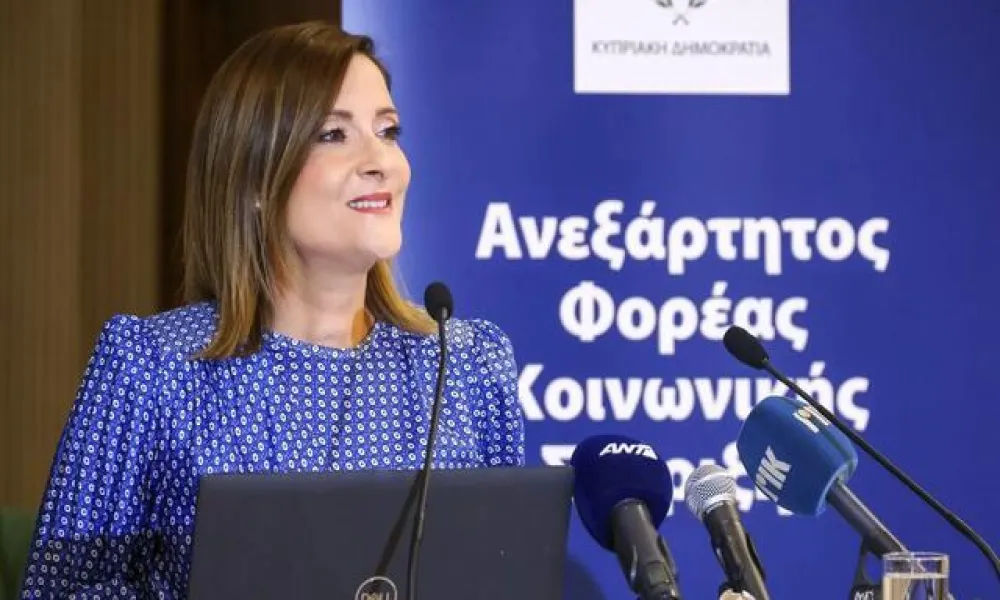



A legal opinion issued by the Legal Service of the Republic of Cyprus has effectively halted the parliamentary scrutiny that the House Institutions Committee was preparing into the Social Support Fund linked to the First Lady.
As a result, the names of private donors who contributed a total of €6.4 million during the tenure of First Lady Philippa Karsera as head of the fund’s management committee will remain undisclosed for the foreseeable future.
The opinion advised the House of Representatives of Cyprus and the Office of the Auditor General that submitting a nominal list of donors for parliamentary control would lack legal basis and could expose the fund to administrative sanctions under GDPR rules.
Legal service blocks disclosure
According to the Legal Service, disclosure of donor identities would contravene European data protection legislation, relevant case law of the Court of Justice of the EU, and rulings of the Supreme Constitutional Court. It concluded that there is no lawful basis for sharing the requested information with parliament.
While the opinion leaves open a narrow alternative, resubmission of a better-justified request by parliament, even then, donor names would be reduced to initials and classified as confidential. Corporate donors’ identities would also need to be anonymised to avoid identifying the individuals behind them.
In practical terms, this would prevent MPs from investigating potential conflicts of interest or determining whether any donors received favourable treatment from the presidency, concerns raised following a recent report by the Audit Office.
What parliament sought to examine
The chairman of the House Institutions Committee, DISY MP Demetris Demetriou, formally requested from the Auditor General on 15 January 2026:
-
A full list of natural and legal persons who donated to the Social Support Fund between 1 January 2020 and 31 December 2025, broken down by year
-
The number of anonymous donors per year, distinguishing between individuals and companies
MPs wanted to assess whether donations were linked to political favours, particularly after allegations that the fund was used for vote-seeking purposes. These suspicions were amplified by the so-called “videogate” footage, which implied that major investors might be expected to contribute to the fund in exchange for smoother bureaucratic treatment or presidential access.
Audit Office findings and red flags
In a special report published on 4 November 2025, the Audit Office referred to an “idiosyncratic relationship”, noting that the fund was chaired by the First Lady while key decisions affecting donors’ business interests were taken by her husband, Nikos Christodoulides, as President of the Republic.
The Audit Office identified a series of suspicious donations, including:
-
An individual donor who contributed €600,000 across 2023–2024 without adequate identifying details
-
A company negotiating a major state contract that donated €695,750
-
Shipping companies that made large first-time donations shortly before or during periods of favourable regulatory or fiscal decisions, including a tonnage tax decree
-
Financial services firms under regulatory scrutiny that donated between €10,000 and €50,000
-
A company whose owner received a commercial construction permit and donated €400,000 over two years
Parliament sought donor identities precisely to determine whether such contributions masked ulterior motives.
Political reactions and calls for abolition
AKEL general secretary Stefanos Stefanou called for the fund’s abolition, arguing that its operation within the presidential sphere and its financing by companies seeking or holding state contracts created systemic conditions for entanglement.
Similar positions have been taken by DISY MP Kyriakos Hadjiyiannis and Volt MP Alexandra Attalidou, who have co-signed a legislative proposal with AKEL. DIKO and EDEK are also expected to support the proposal.
Oversight left in the dark
With donor identities shielded by legal opinion, MPs concede they are effectively unable to determine whether conflicts of interest existed or whether any form of quid pro quo took place.
As matters stand, the Social Support Fund appears headed toward abolition, but without ever undergoing the full transparency review parliament had sought, leaving lingering questions over institutional accountability unanswered.
This article was first published on Politis' paper