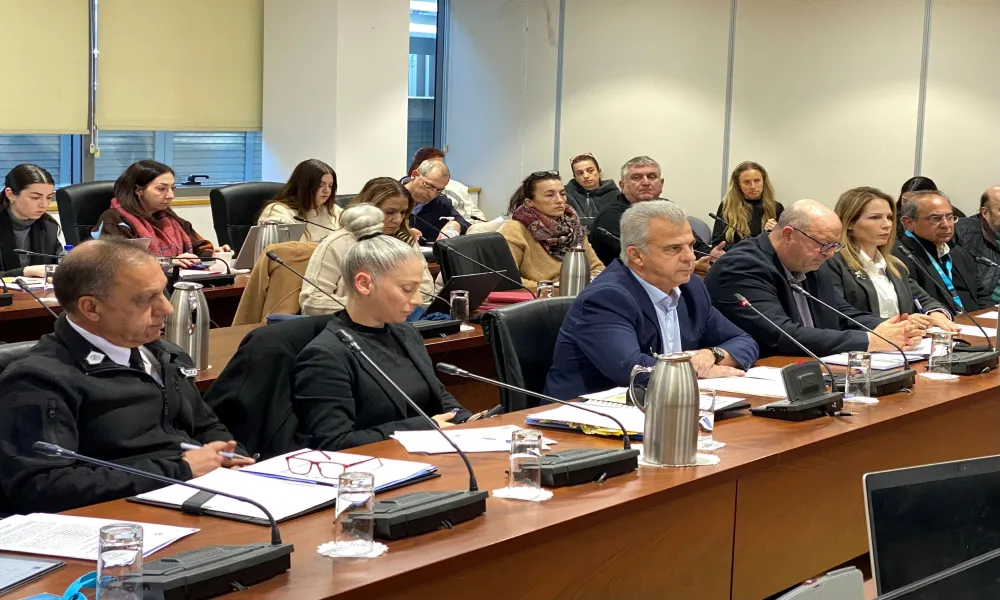
The Minister of Justice and Public Order, Kostas Fytiris, said measures to address longstanding problems at Cyprus’s Central Prisons will be announced by the end of March, speaking on Monday before the Parliamentary Committee on Human Rights.
The committee revisited the situation at the Central Prisons in light of findings by the European Committee for the Prevention of Torture and Inhuman or Degrading Treatment or Punishment (CPT), which has raised concerns about conditions and management at the facility.
Building a new prison
Among the measures expected to be announced is the activation of a mobile phone signal blocking system, aimed at tackling organised crime operating from within the prison. Support measures for prison officers are also planned. The minister said he has recommended halting plans to expand the existing prison building and instead beginning the design of a new, modern correctional facility outside the urban area, built to contemporary standards.
Committee chair and AKEL MP Irene Charalambidou welcomed the approach outlined by the minister and said a further meeting on the issue would be held on 23 March, calling on the minister to report on progress made by then.
Organised crime
Serious concern was expressed over the working conditions and safety of prison officers. DISY MP Rita Superman and independent MP Alexandra Attalidou raised alarm over the influence of organised crime within the prison system, while Superman also referred to accountability for the worsening situation, noting the resignations of several prison directors over the past three years.
Fytiris said he has already visited the Central Prisons four times and plans to return shortly to assess conditions on the ground and meet all stakeholders. He identified overcrowding as one of the most serious challenges, along with the cohabitation of prisoners serving minor and serious sentences.
Overcrowding
Efforts are under way to ease overcrowding, including procedures for deporting individuals convicted of illegal employment offences. Deportations will not apply to those convicted of serious crimes such as murder or sexual offences, while asylum seekers may only be subject to voluntary return. The minister said deportations alone would not significantly reduce overcrowding, adding that electronic monitoring is already in use and the period for granting presidential pardons has been extended.
Deputy Director of the Prisons Department Maria Siali told the committee that the prison population currently exceeds 1,140 inmates. Of these, 20 are under electronic monitoring with ankle bracelets, 35 are serving sentences under supervision outside prison, 27 are in open prison conditions and 20 are housed at the Centre for External Employment.
She said 608 inmates, or 53 per cent of the total prison population, are foreign nationals, including 350 convicted prisoners and the remainder remand prisoners. Twenty women are currently detained at the Central Prisons, out of a total female prison population of 80.
Prisons in state of emergency
On infrastructure, Fytiris said he has recommended suspending the expansion of the existing prison, citing unsuitable facilities and a projected cost of €40–50 million. The aim is to complete planning for a new correctional institution within the year, although construction would take an estimated four to five years if initiated immediately.
President of the Association of Prisoners and Former Prisoners Alexandros Clerides described the Central Prisons as being in a state of emergency, saying they function “as a warehouse for people” rather than a correctional institution focused on rehabilitation and reintegration. He called for immediate measures such as wider use of electronic monitoring, deportation of foreign nationals following conviction and broader application of sentence reductions through presidential pardons.
Fytiris also confirmed that a mobile phone signal detection system has been operational for three months, during which 90 devices were seized. He said a full signal blocking system would be implemented in the coming months as part of efforts to curb organised crime inside prisons.
Staffing, training and protection of prison officers
The filling of the post of Director of the Prisons Department and support for prison officers were discussed extensively. Fytiris said he would ideally like to see changes to the job description of the director and the designation of prison officers as a security force, though constitutional provisions may pose obstacles.
He announced that a recruitment notice for 90 new prison officers will be published before the end of January. Both new recruits and existing staff will undergo training, with the training framework to be finalised by the end of March and to include input from psychologists and sociologists.
A daily staff scoring system, reflecting the difficulty of duties performed, will also be presented in March. Fytiris said steps would be taken to insure staff against injury, noting that coverage currently applies only in cases of death.
Threats
Prison officer representative Andreas Nearchou warned that staff frequently receive threats and said the state must ensure their protection. Fytiris said staff rotation between posts would be increased to reduce vulnerability and announced plans for the creation of an internal intervention unit within the prison.
Union representative Giorgos Maltezos said that of 452 prison officers, only 190 are deployed on the frontline, calling for changes to the organisational structure. He expressed satisfaction that the minister had identified the root causes of the problem.
Loss of control
Following the meeting, Charalambidou said prison officers must feel safe in order to carry out their duties effectively, adding that concerns had been raised about the absence of secure procedures to support staff when threats are made against them. She also suggested that constitutional amendments may be required to enable meaningful reform, particularly regarding the appointment of a prison director.
Superman said repeated criminal incidents inside prisons indicated a loss of control, adding that changing directors without altering policy had failed to address the problem. She warned that if mobile phone signal blocking is deemed essential to combat organised crime, it raises serious concerns for the rule of law, arguing that inaction by the state amounts to complicity.
DIKO MP Christos Senekis said the minister had candidly acknowledged chronic weaknesses requiring radical intervention. He said measures such as suspending prison expansion plans, building new facilities outside urban areas, upgrading the director’s role, recruiting and training new prison officers and expanding electronic monitoring would contribute to the creation of a modern correctional system.
Independent MP Alexandra Attalidou said the issue goes beyond detention conditions and touches the core of the rule of law. She stressed that prisons must not remain under the control of organised crime and called for population reduction through electronic monitoring and community work, as well as the prompt appointment of a prison director, describing the role as a key institutional guarantor of human rights under European Court of Human Rights case law.