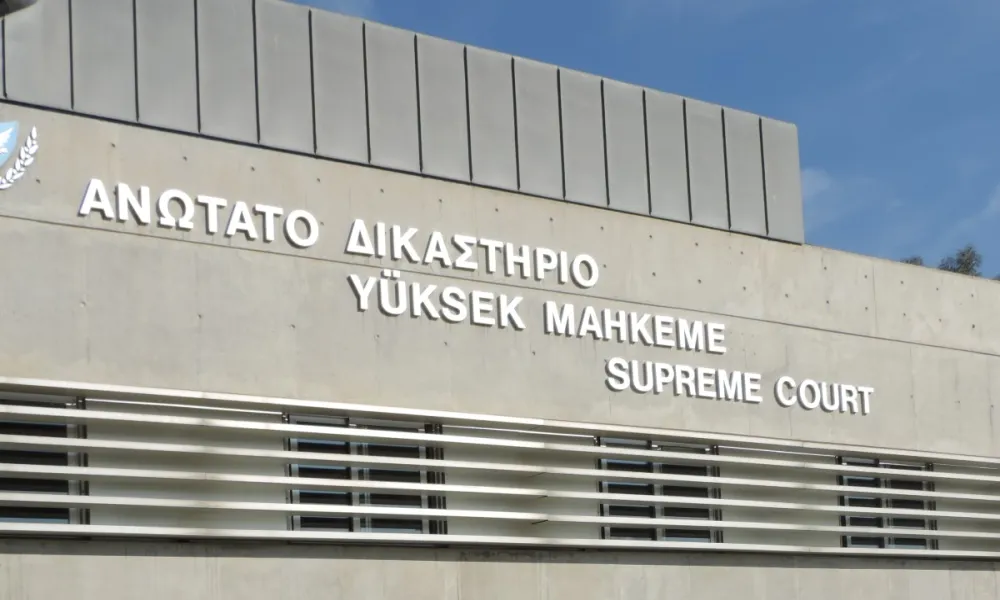

The Supreme Court has rejected an application by a former priest turned lawyer, who was previously convicted of serious criminal offences, seeking to annul a decision by the Cyprus Bar Association to strike him off the Register of Advocates.
In a ruling dated April 21, 2026, the court refused to grant leave to file applications for the prerogative writs of certiorari and prohibition, finding that it lacks jurisdiction to examine the case.
The applicant had challenged a decision taken on February 9, 2026, by the Council of the Cyprus Bar Association to remove him from the Register of Advocates. He argued, among other things, that his right to a fair trial had been violated, that the decision lacked adequate reasoning and that the Council had acted in excess of its powers.
Background
According to the facts set out in the ruling, the applicant is a Greek national who arrived in Cyprus in 2002 as a priest and served in parishes under the Holy Archbishopric of Cyprus.
In 2012, upon his arrival at Larnaca airport from Athens, baggage checks uncovered 2,980 grams of cannabis in his possession. Authorities arrested and charged him with conspiracy to commit a felony, importation and possession of drugs with intent to supply others.
Following his guilty plea, the Assize Court sentenced him to five years’ imprisonment. The court also took into account two additional cases involving offences of fraud, obtaining money by false pretences, forgery and circulation of forged documents, as well as an incident involving the sale of two burial plots during the period he served as a priest.
In February 2013, the Holy Synod defrocked him, returning him to lay status. In 2015, after receiving a presidential pardon reducing one‑quarter of his sentence, he was released from Central Prisons and subsequently deported to Greece under detention and deportation orders.
He later changed his surname in Greece and returned to Cyprus, where he studied law. In 2021, he was admitted to the Register of Advocates of the Cyprus Bar Association and later went on to establish a law firm.
Complaints subsequently emerged regarding the circumstances of his admission to the profession. These were examined through disciplinary proceedings, during which the Disciplinary Board cleared him.
Struck off the register
In 2025, however, the Cyprus Bar Association launched an ex officio investigation under section 6A(4) of the Advocates Law, examining the conditions under which he had been registered. The process culminated in a decision to strike him off the Register of Advocates, which was served on him in March 2026.
Before the Supreme Court, the applicant argued that the Bar Association Council had acted without jurisdiction, that constitutional safeguards of a fair hearing and impartiality had been breached and that the decision was insufficiently reasoned.
Jurisdictional limits
The Supreme Court focused on whether the matter fell within its jurisdiction under prerogative proceedings. The ruling noted that the case concerns powers exercised by the Council of the Cyprus Bar Association under a different statute, namely Chapter 2.
The court referred to section 32A of Chapter 2, which provides that challenges to decisions of the Council must be brought by action or application before a court within 12 months from the date of the contested decision. It stressed that the issue is “expressly governed by statute” and does not activate prerogative jurisdiction.
Citing earlier case law, the court also recalled that decisions of the Legal Council are subject to challenge by action before the District Court, while decisions of the Disciplinary Board are subject to appeal under section 17 of the same law.
As a result, the Supreme Court concluded that it lacks jurisdiction to examine the application, which was therefore dismissed.
Source: CNA