
A miniature satellite with big ambitions
The CanSat Belgium competition, organised under the European Space Agency (ESA) through the European Space Education Resource Office (ESERO), gives secondary school students the opportunity to design, build and launch a miniature satellite the size of a soft‑drink can. The initiative bridges classroom learning with real‑world aerospace engineering, combining science, technology and teamwork in a hands‑on environment.
Cypriot involvement at the core
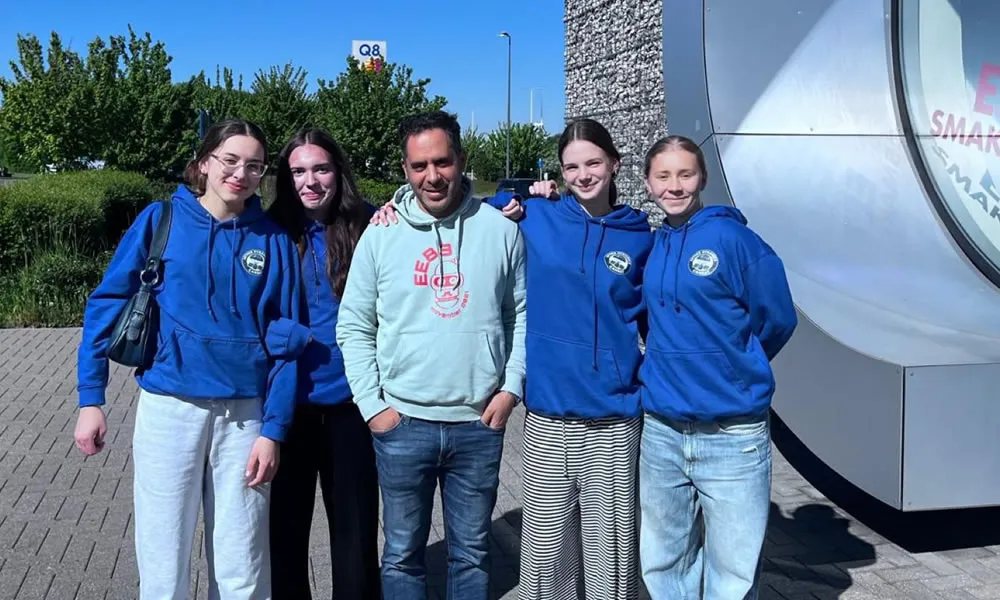
This year, the European School III in Brussels is participating in the competition under the guidance of Cypriot physics teacher George Christofi. The student team consists of eight members: Juraj Prokopič, Aidan Troy Timourhan, Argyris Christoforou, Richard Hrous, Eliza Guteckova, Katerina Laderou, Olivia Grose and Sophie Antonia Moreira. One of the participants, Argyris Christoforou, is Cypriot.
From design to launch and back
The competition unfolds over three days and includes several stages. Students first develop and test their CanSat devices, which are then launched to an altitude of around one kilometre before returning to Earth by parachute. During flight, the devices collect and transmit scientific data, which the teams later analyse and present.
Final evaluations are based on technical performance, scientific accuracy and presentation quality, with winning teams advancing to the European final, held annually in June.
Skills beyond the classroom
Speaking to CNA, Christofi said CanSat is organised nationally in Belgium by three regional organisations under ESERO, which operates under ESA. He noted that Cyprus is now an associate member of the organisation, opening up the possibility of developing its own national CanSat competition in the future.
He emphasised that the programme equips students with a wide range of practical skills, including programming, electronics, 3D printing, model design and project management. Teamwork is a central element, he said, with each student assigned a specific role to ensure the mission’s success.
Beyond technical skills, the competition also fosters responsibility, time management and cooperation, while exposing participants to different approaches to scientific problem‑solving through interaction with students from other schools.
Students’ perspectives
Student Argyris Christoforou described the experience as highly rewarding, saying it helped him form new friendships while learning to balance academic commitments with project work. He explained that the CanSat device collects environmental data such as temperature, humidity and atmospheric pressure, alongside a secondary mission involving soil analysis through camera imaging.
Other team members highlighted their progress in coding, 3D printing, parachute construction and electronics, while also pointing to the social dimension of the competition, which brings together students with shared interests and encourages long‑term collaboration.
A stepping stone for future scientists
Christofi noted that such initiatives help students connect theoretical knowledge with applied science and develop professional discipline at an early stage, offering valuable insight into potential future career paths in science and engineering.
Source: CNA