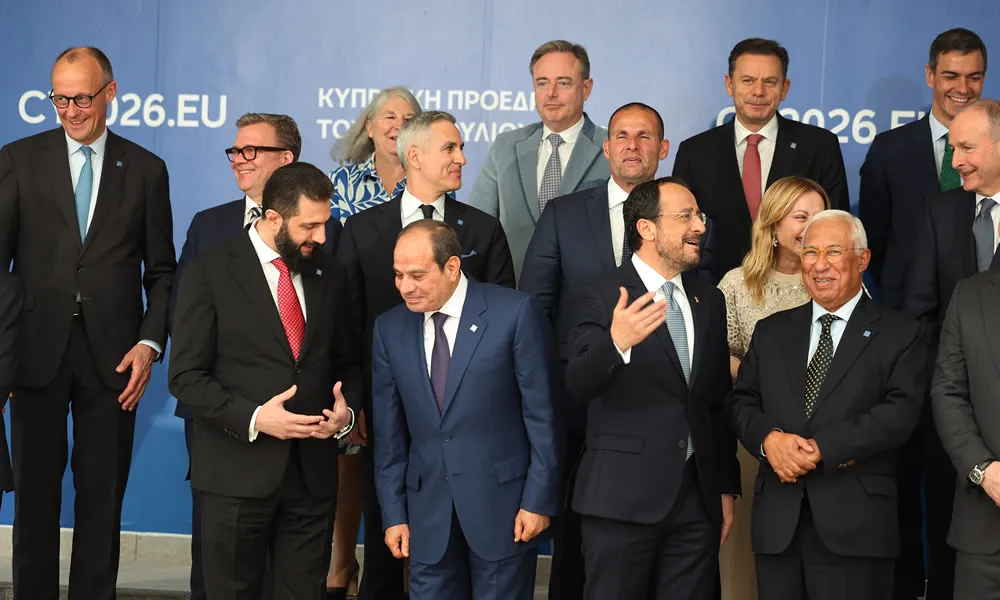



The informal meeting of EU heads of state and government concluded in Nicosia on Friday, with European Council President António Costa, European Commission President Ursula von der Leyen and Cypriot President Nikos Christodoulides holding a joint closing press conference at the Filoxenia Conference Centre that struck a tone of collective resolve across four interlocking crises: security, energy, competitiveness and the Middle East.
A Historic Moment for Cyprus
Christodoulides opened his remarks by noting the particular significance of the occasion. "This is in fact the first time that Cyprus is hosting an informal meeting of the EU heads of state and government," he said, describing it as a moment of pride borne of the same sense of responsibility with which Cyprus had taken on the EU Council Presidency. He drew an implicit connection between Cyprus's own experience of occupation and its conviction in the European project. "It is actually this experience of living conditions, of occupation, that fuels our deep-rooted conviction in the European project," he said. "More European integration and a more strategically autonomous, independent union, this is precisely what this moment calls for."
That assessment was echoed by Michalis Moutselos, Assistant Professor of Political Science at the University of Cyprus, who told CNA the summit's outcome was positive overall. "The discussion on Article 42.7 and the effort to upgrade relations with countries in the region are important for further advancing European strategic autonomy," he said, describing the summit as historic for Cyprus as the first of its kind held under this composition.
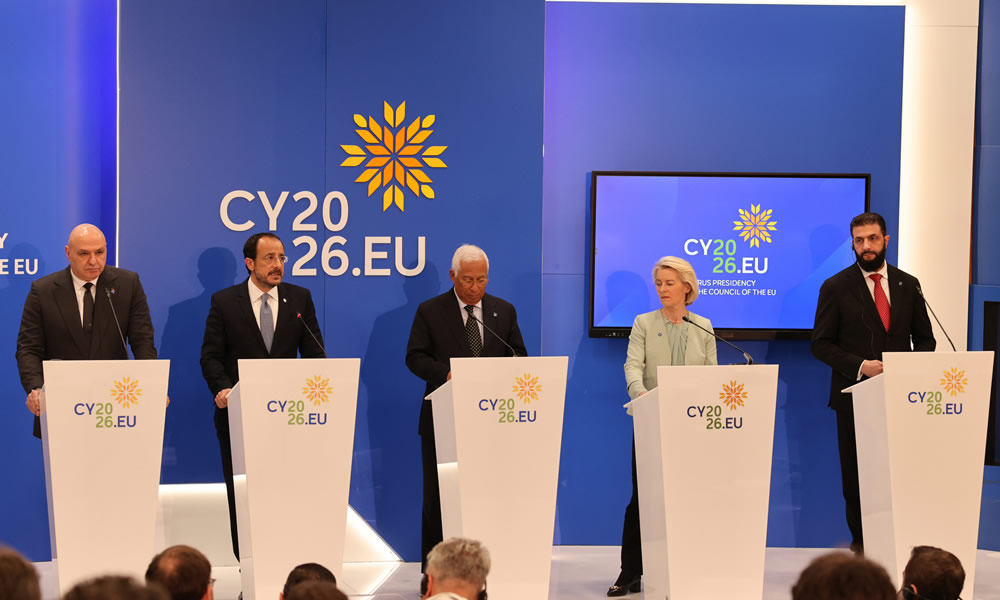
Article 42.7: From Paper to Practice
The most substantively significant outcome of the two days was the agreement to task the European Commission with drawing up an operational response plan for Article 42.7 of the EU Treaty, the mutual assistance clause obliging all member states to aid any EU country that comes under armed attack.
Christodoulides was unequivocal about the stakes. "We cannot continue to rely on ad hoc arrangements. We must formalise the mutual defence clause into a structured, operational mechanism, and be capable of transforming political statements into predictable action," he said. "When the sovereignty of one member state is threatened, the response is not a question of if, but how fast."
Von der Leyen added an important layer of detail, drawing a distinction between what the Treaty says and what it does not. "The treaty is very clear about the what, there is an obligation for other member states to support the one who is in need. The treaty is not clear about what happens when and who does what," she said, adding that the Commission was working intensively on the topic alongside the High Representative and the Commissioner for Defence. She cited the EU Civil Protection Mechanism as a working model, noting that member states know exactly how to trigger it and what their responsibilities are.
She also raised the question of the period before the clause is triggered, the so-called grey zone of hybrid attacks, cyber attacks and disinformation. "This is a very important period because this has to create the awareness with the member states that something is developing," she said.
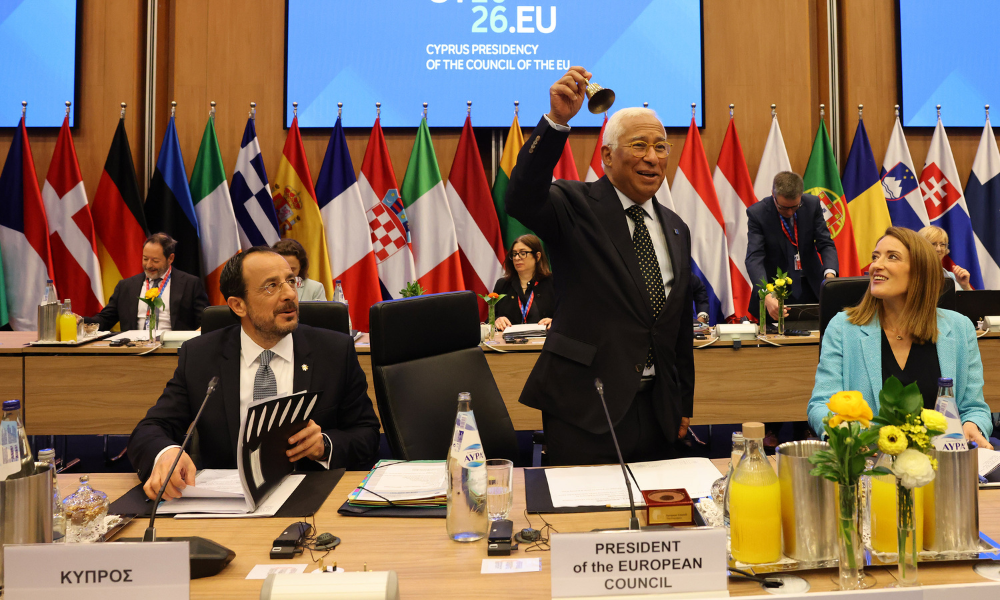
Moutselos singled out Article 42.7 as the summit's standout achievement, noting that the Cyprus Presidency had found allies in Greece and France to advance it. "The Cyprus Presidency managed to put on the table the operationalisation of Article 42.7 and to champion a more serious deepening of EU relations with countries in the region. These are small but successful steps in the right direction for Cyprus," he said. For a country outside NATO, he added, the clause carried particular weight. "It is one more reason to be able to upgrade our defensive and deterrent power through the EU."
Energy: A €25 Billion Bill in 54 Days
Von der Leyen delivered the summit's starkest economic figure: since the start of the conflict in the Middle East, the EU's bill for imported fossil fuels had increased by over €25 billion in 54 days, without a single additional molecule of energy. "We need to reduce our over-dependency on imported fossil fuels because these make us vulnerable to crises," she said. She confirmed that an electrification action plan with an ambitious target would be presented by the summer, and reaffirmed the push toward renewables and nuclear as the only path to genuine energy independence.
Costa framed the longer-term imperative plainly: "There is only one game in town for Europe, speeding up our energy transition and accelerating the deployment of homegrown clean energy sources." On the immediate response, finance ministers have been tasked with working up specific short-term measures, with two ECOFIN meetings scheduled for May.
One Market, One Europe
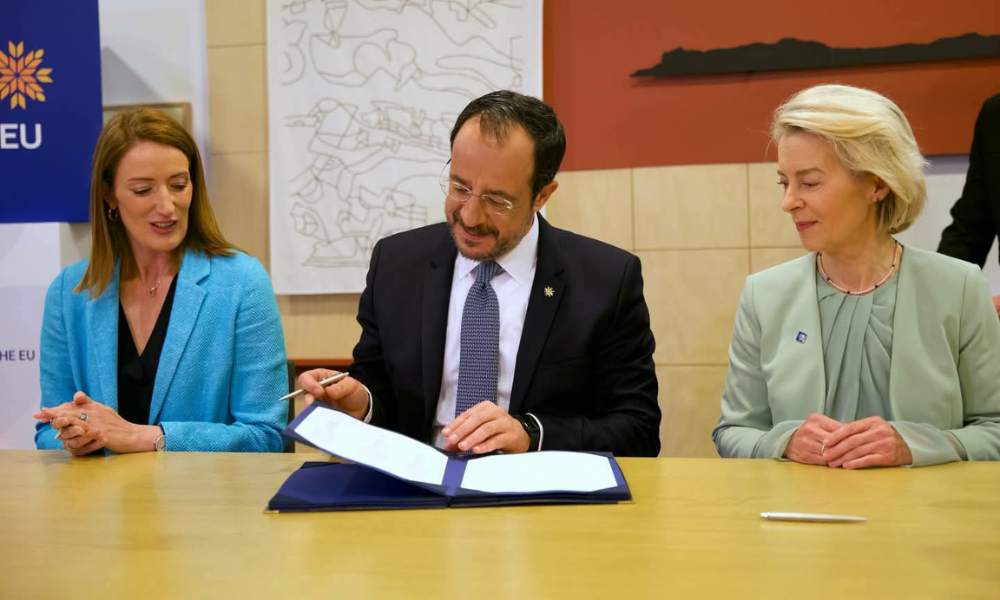
The morning's symbolic centrepiece was the signing of the "One Europe, One Market" roadmap by Christodoulides, Von der Leyen and European Parliament President Roberta Metsola. Christodoulides described it as a strong signal of collective determination to boost European competitiveness, with concrete timelines and comprehensive scope. Von der Leyen called it "excellent" and a "joint political vision for the completion of the single market by the end of 2027," while acknowledging it was "not the end, but the start of even more hard work to deliver."
MFF: New Own Resources Unavoidable
Von der Leyen laid out the budgetary equation with precision: from 2028, the EU must begin repaying NextGenerationEU; it must invest more in new priorities including AI, quantum, defence and energy; it must sustain funding for agriculture and cohesion; and it must keep national contributions in check. "If we want all four elements to be respected, then there is only one solution. New own resources are indispensable," she said. Costa confirmed that the Cyprus Presidency would present a negotiating box with figures at the June European Council, with a political agreement targeted by the end of 2026.
The Neighbourhood
Costa framed the broader geopolitical message with clarity. "The European Union is not part of the conflict, but we will be part of the solution," he said, adding that real peace could only be achieved by defending international law in a consistent and principled way. He identified three priorities: restoring freedom of navigation in the Strait of Hormuz, working toward a stable and lasting ceasefire, and ensuring a nuclear-armed Iran does not emerge from the current crisis.
Christodoulides rejected what he called the narrative that disassociates Europe from developments in the Middle East. "I reject any narrative that disassociates Europe from these developments because this is our neighbourhood," he said. "In an interconnected world, there is no such thing as a crisis that does not concern us."
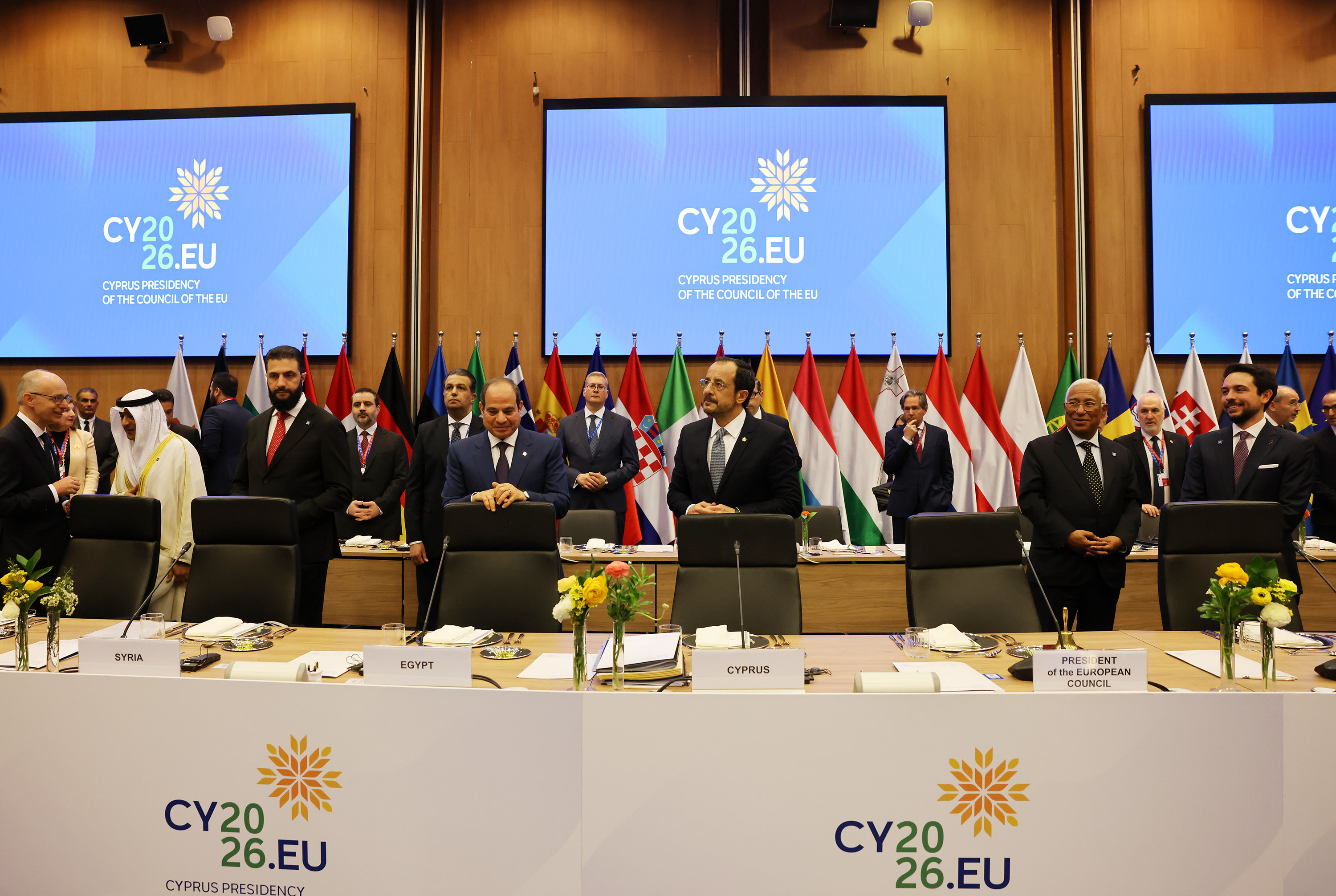
Moutselos highlighted the presence of regional leaders from Egypt, Syria, Lebanon and Jordan as the second major achievement of the summit. "The Cyprus Presidency played a leading role in getting these two issues onto the agenda," he said.
Source: CNA