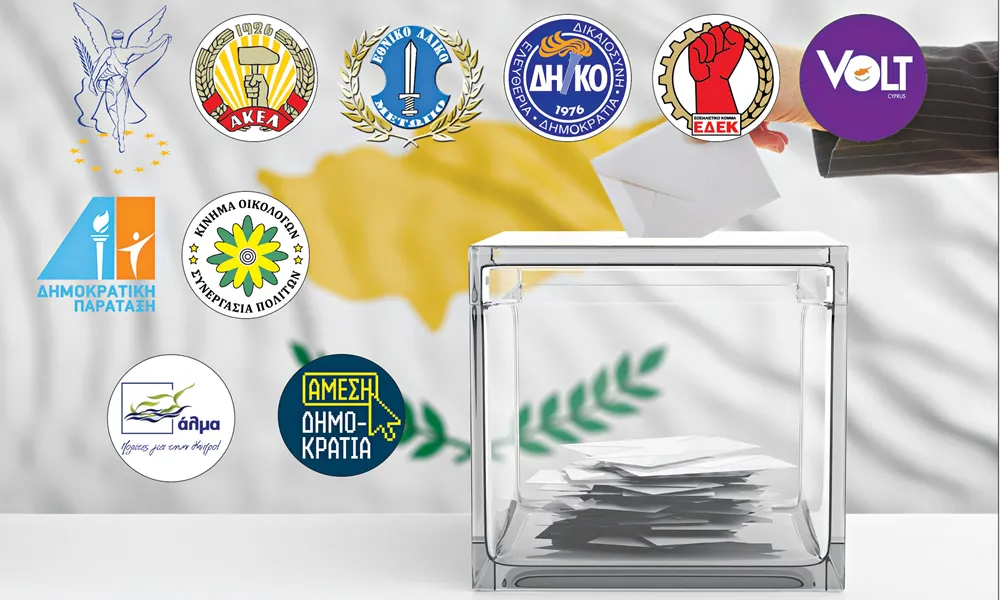
The fiercest battle of the upcoming parliamentary elections will be fought among the smaller parties battling tooth and nail to enter the House of Representatives. No one can predict the outcome with certainty, but it appears that not all of them will be able to cross the entry threshold of 3.6%. In fact, election analysts say there is even a possibility that no small party will enter parliament if the six largest political forces all record double-digit percentages or collect around 80% of the valid vote. Entry into parliament brings with it state funding and an institutional role, two highly important elements for a party that wants to stay alive and secure a future place in the country’s political life. The parties expected to fight this hard battle are primarily EDEK, DIPA, the Ecologists’ Movement and Volt.

The statistics
“Based on the polls, one could today calculate that the six parties with high and medium-level voting intention would definitely enter parliament,” political analyst Christoforos Christoforou, who has long experience in election contests, told Politis. That means DISY, AKEL, ELAM, ALMA, DIKO and Direct Democracy.
Even so, he stressed, “it is difficult for anyone to predict the result the small parties will ultimately produce, because even a small number of votes in a poll sample can significantly reduce or increase the percentages appearing in voting intention”. For that reason, he said, “the statistical margin of error in the case of smaller political formations is proportionally much greater than it is for larger parties”. He explained that if fewer or more voters for a small party are recorded in a poll, the percentage can shift significantly, whereas in the case of a large party the same number makes very little difference.
Continuing, he said there is still a significant percentage of soft vote, meaning people who say they have not yet decided or that they lean towards a party, but who in the same survey still give a voting intention in favour of some party. Consequently, he underlined, it is impossible to draw conclusions about the final vote in the ballot box, something made even more difficult by the significant share of those who either say they are undecided or genuinely belong to the so-called soft vote. We do not know how they will ultimately be distributed, which makes the weighting of percentages in the polls an unsound exercise.
The 2021 election
He referred to the 2021 parliamentary election, saying that more than 52,000 voters cast ballots for parties that did not enter parliament. “Apart from the United Hunters,” he added, “all the rest of those parties are not contesting the election today.” According to him, this amounted to 14.58% of the valid vote in 2021. He said that the vote for those parties functions like quicksand and noted that, for the first time, so many voters ended up unrepresented in parliament.
He also argued that the large pool of votes not contained within the parties’ 2021 figures must be taken into account. “That is,” he clarified, “AKEL’s cohesion is calculated on the basis of the 79,910 votes it received in 2021, DISY’s on the basis of 99,331, DIKO’s on 40,393, and so on.” However, he said, the electorate amounts to more than 550,000 voters, and if one adds up the cohesion levels of the parties contesting the election, the result comes to roughly half the electorate. Therefore, he continued, we do not know how the other half of the electorate, which is not included in the cohesion percentages, will move. At the same time, he said, there are also many new voters, namely those who registered on the electoral rolls after 2021 and those who will register up to April 2. Consequently, he noted, there is a vast reservoir of votes whose direction and final destination remain unknown.
Party machines
He then stressed the fact that more than 50 days still remain until the election, meaning the landscape has not yet taken shape. “Once we get to the final two weeks,” he argued, “the percentage of undecided voters may well decline, and then it will be easier to predict which of the small parties will ultimately enter parliament.” Of course, as he said, the picture that will emerge by then also depends on many other factors, such as the ability of party machines to produce positive results. Christoforou stressed that some of the smaller players are new parties, saying that their short time on the political scene and their inability to build party machines are negative factors that do not help the effort to achieve a good electoral result. They do, however, have the potential to win votes if their candidates manage to develop intensive activity.
Candidates
Another unknown factor in the electoral contest is whether the new candidates will be able to mobilise the people around them, and to what extent, Christoforou said. “For a great many candidates,” he noted, “we have no picture of the social influence they exert or of the preference votes they received in previous contests, because they have not stood in elections before.” As a negative example, he cited the Ecologists’ candidates in Larnaca in the 2021 parliamentary election, saying they were all men and some were of advanced age, with the result that they acted as a drag rather than giving the party momentum. As a positive example, he pointed to Michalis Hadjipantela’s candidacy in the 2024 European Parliament election on the DISY ticket, describing him as a surprise performer who far outdistanced the rest in preference votes, with 31,997.
EDEK
EDEK cannot be ruled out as a party that could reach 5%, because it has a traditional vote that does not show up in the polls but may emerge in the ballot box, Christoforou argued. He recalled that in the 2019 European Parliament elections, the polls had shown EDEK very low, yet it eventually reached 10.58% and elected an MEP.
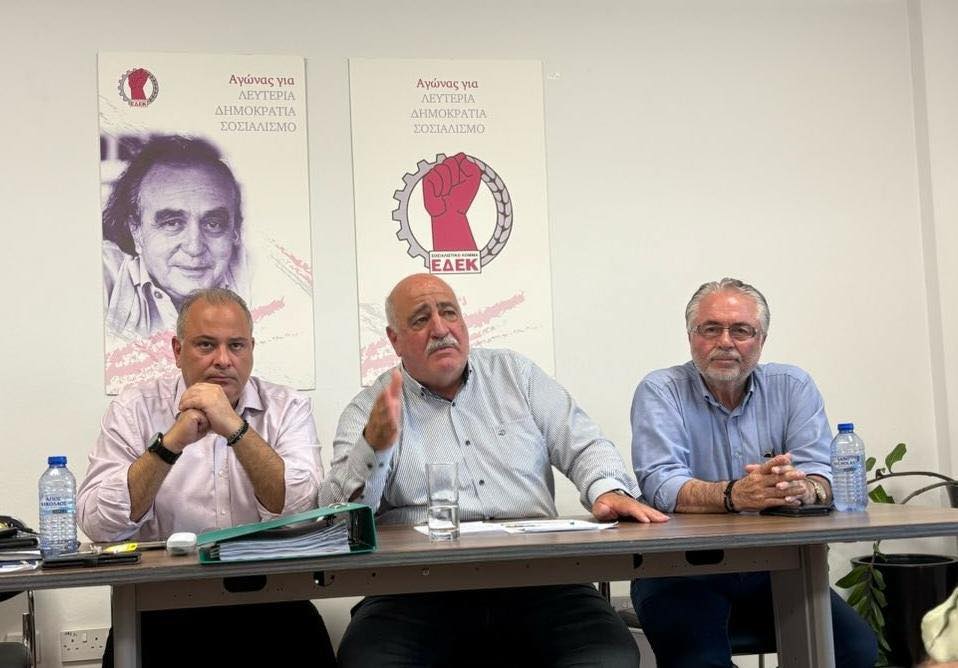
He then challenged interpretations that EDEK had merely benefited from tactical support in 2019, saying he had studied the results in a large number of communities and compared them with earlier elections. “In those specific communities,” he stressed, “the other parties did not lose voters in a way that would support the argument that EDEK was artificially boosted.” Rather, he said, EDEK voters who had distanced themselves felt it was their duty to vote for the party so that it would not lose the seat to ELAM.
Christoforou also said that the data for EDEK today are very different, explaining that there are no longer merely isolated expressions of dissatisfaction, as there were before 2019, but that the party has reached the point of disintegration, with very serious internal problems. He nevertheless stressed the importance of the clientelist relationships EDEK built over time, saying that this is a factor that must be taken into account because it does bring votes.
DIPA
Christoforou expressed the view that DIPA too could reach 5% because of the hidden vote that does not appear in the polls but may reveal itself at the ballot box. The 2021 election, he added, showed that DIPA has the hidden vote as one of its strengths. He stressed that it is a party with a tradition of clientelist ties because of the background of its cadres in DIKO, and so it is expected that it may secure a significant number of votes.

He noted that among the dozens of polls carried out in 2021, DIPA appeared with voting intention above 3.6% in only two of them, just a few days before the election. It went on to win 6.1%, while if one adds its votes to DIKO’s, the total reaches 62,000. He pointed out that DIKO had 51,000 votes in 2016, dropped to 40,000 in 2021 after the split, and stressed that DIPA did not simply take the “lost” 11,000 but twice that number. One possible explanation, he said, is that it attracted former DIKO voters who had kept their distance after the election of Nikolas Papadopoulos to the party leadership. He then stressed that “DIPA officials, through the relationship they had with DIKO, remain in positions in the public service or semi-governmental organisations, positions from which they can offer favours and bring votes to the party”.
Volt
Volt is a new political formation that has not developed clientelist relationships from which it could expect votes, Christoforou noted. As a new political party, he added, it does not have connections in spheres of influence in the way other parties do. He stressed that Volt relies on the standing that some of its candidates may enjoy in society, rather than on favours and influence. However, he said, it will be able to make use of the party’s positive image among the public.

He also stressed that it remains unclear how voters will react to the fact that Volt is part of a European political movement. He went on to say that this may not necessarily act as an electoral attraction, but it is nevertheless a helpful factor for Volt, because the party can draw on the mechanisms and know-how of the European movement. “This,” he added, “is not a decisive factor, but it is a positive element for a party whose cadres are politically inexperienced and can draw experience from Volt Europa in the application of communication strategy and the shaping of political programme.”
Ecologists
Turning to the Ecologists’ Movement, Christoforou said the party had functioned as a personal group around Giorgos Perdikis. We had seen, he said, what result the undermining of the new leadership under Charalambos Theopemptou had produced. “Although,” he stressed, “forecasts ahead of the 2021 parliamentary election suggested the party’s percentages would take off, because of internal undermining and a long-standing attachment to positions on the Cyprus issue that were closer to Neoi Horizontes than to an ecological movement, the Ecologists’ Movement failed to raise its percentages.”

He then said that the movement’s current leader, Stavros Papadouris, does not come from the party’s ranks, that certain cadres have moved away, and that we do not yet have a clear picture of the candidates and their capabilities. He also stressed that the Ecologists’ Movement has not developed clientelist relationships that would justify corresponding expectations for votes. A key problem for the party, he said, is the blurred picture the voter has of its exact political and ideological framework under the current leadership. “Up to this point,” he concluded, “it is not possible to predict what kind of performance it will record in May.”